| Olwen Pen Aur's Anglo Saxon Pottery |
 |
| Anglo-Saxon Style Beakers |
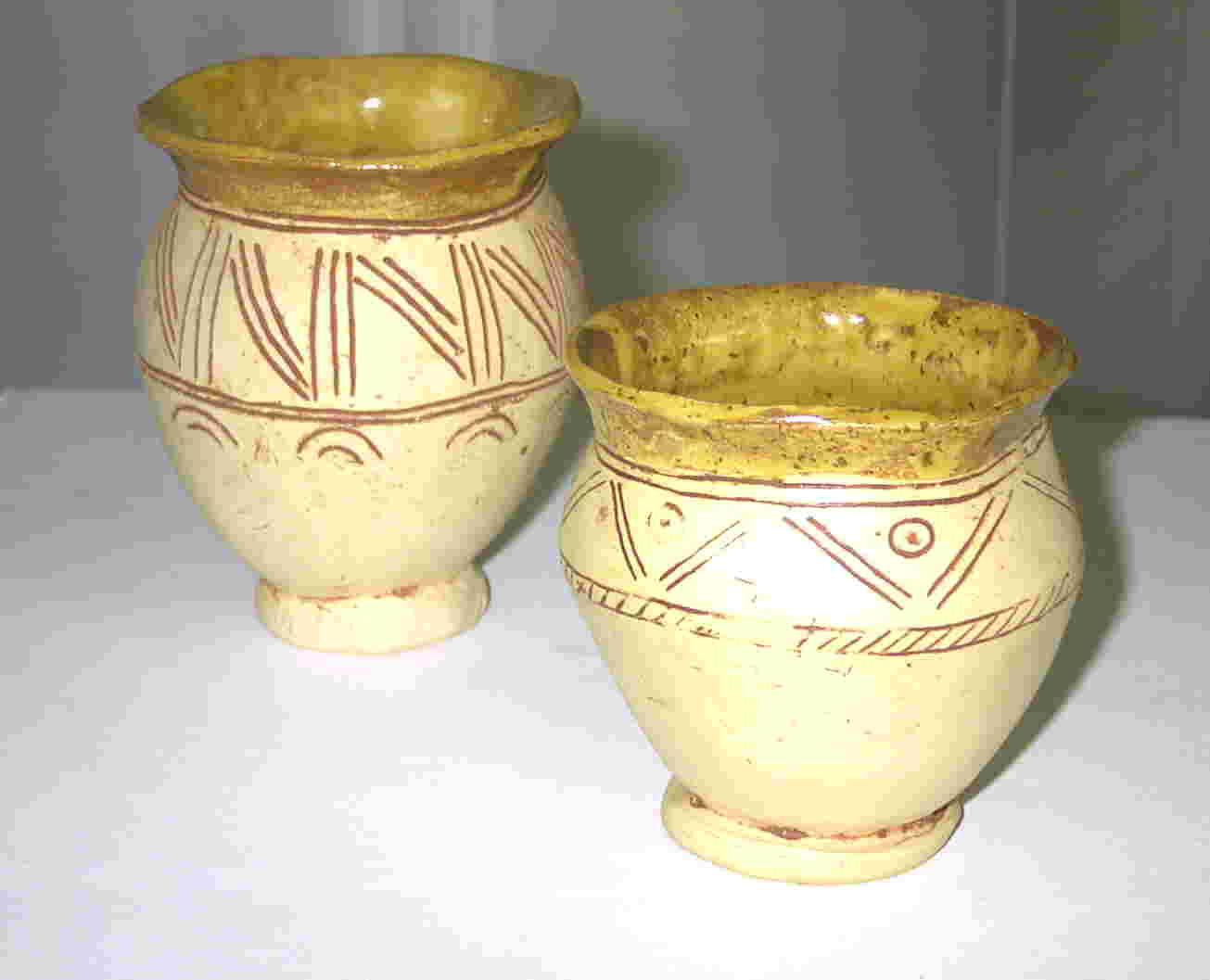
| Thousands of this style of beaker are found in Anglo-Saxon cemeteries and rubbish heaps throughout Britain and Europe. In most cases, the decorated ones were used as funerary runs, to contain the cremated bones and ashes of the dead. But there are also many examples of beakers that may have been used as bowls or drinking vessels. Funerary urns are larger, since they need to hold a given quantity (a cremated human leaves a surprising amount of residue. Even with modern cremation, which reduces everything to ash, a small to medium sized person takes up about a litre or so in volume. Cremation using only wood-fueled fire is less certain and leaves larger bits unconsumed, so the urns would have been that much larger, probably more like two litres in volume). Numerous smaller beakers have been left, which were almost certainly used for domestic purposes such as cooking, serving, storing and eating. Mistress Meresigha Stonegate has also graciously provided me with an illustration from the Anglo-Norman period, which shows a man holding a drinking vessel that's identical in size and shape to mine. While the beaker in the illustration was likely made of wood, it demonstrates that a vessel of this size made of pottery could have been used as a drinking vessel. There are significant differences between the original Anglo-Saxon pottery and my own. Theirs were fired in open pits or clamp kilns, which results in lower temperatures. Their clay was earthenware, and their firing temperatures were lower. This results in a pot that is structurally weaker. My clay can be fired much hotter, which yields a pot much stronger and more durable. Also, the firing in flame gave their pottery distinct marks of smoking, like modern raku. As mentioned on my main Pottery page, I chose to glaze my pots on the inside for hygienic reasons. They would have glazed theirs using lead, or by letting the ashes fall onto the outside of the pot. I refuse to use powdered lead, and since I fire in an electric kiln, not in a wood-fired one, I don't have the option of using natural ash. You will also note that I enhance the incised lines. I use a slip made of a dark red clay and brush it on, then wipe it off so it stays in the lines. I do this partly because I like the look. But also, due to the clay I use and the temperature I fire to, the surface of my potery changes more than the surface of earthenware. Decoration like incising, stamps and so on stand out better on earthenware, while on higher fired pottery, the increased changes to the molecular structure of the clay often obscures the fine details. Enhancing the decoration with a contrasting colour compensates for this loss of detail. I have found a reference to the use of coloured slips on the surface of early medieval pottery. When I find it, I'll post it here. The use of coloured slip (liquid clay) to decorate was common among Roman potters as well as later medieval potters. Using this is well within the technical and aesthetic parameters of the time period and the culture. |
| Anglo-Saxon style beakers in the style of the early pagan invaders, circa 400-700 A.D. Off-white medium fired stoneware with incised decoration and iron slip, commercial glaze on the interior. Both are decorated with motifs derived directly from J.N.L. Myres, Anglo-Saxon Pottery. The beaker on the left won the Sciences War Point at Clinton War in about 1997. |
 |
| Anglo-Saxon Style Urn Used as Food Storage Container |
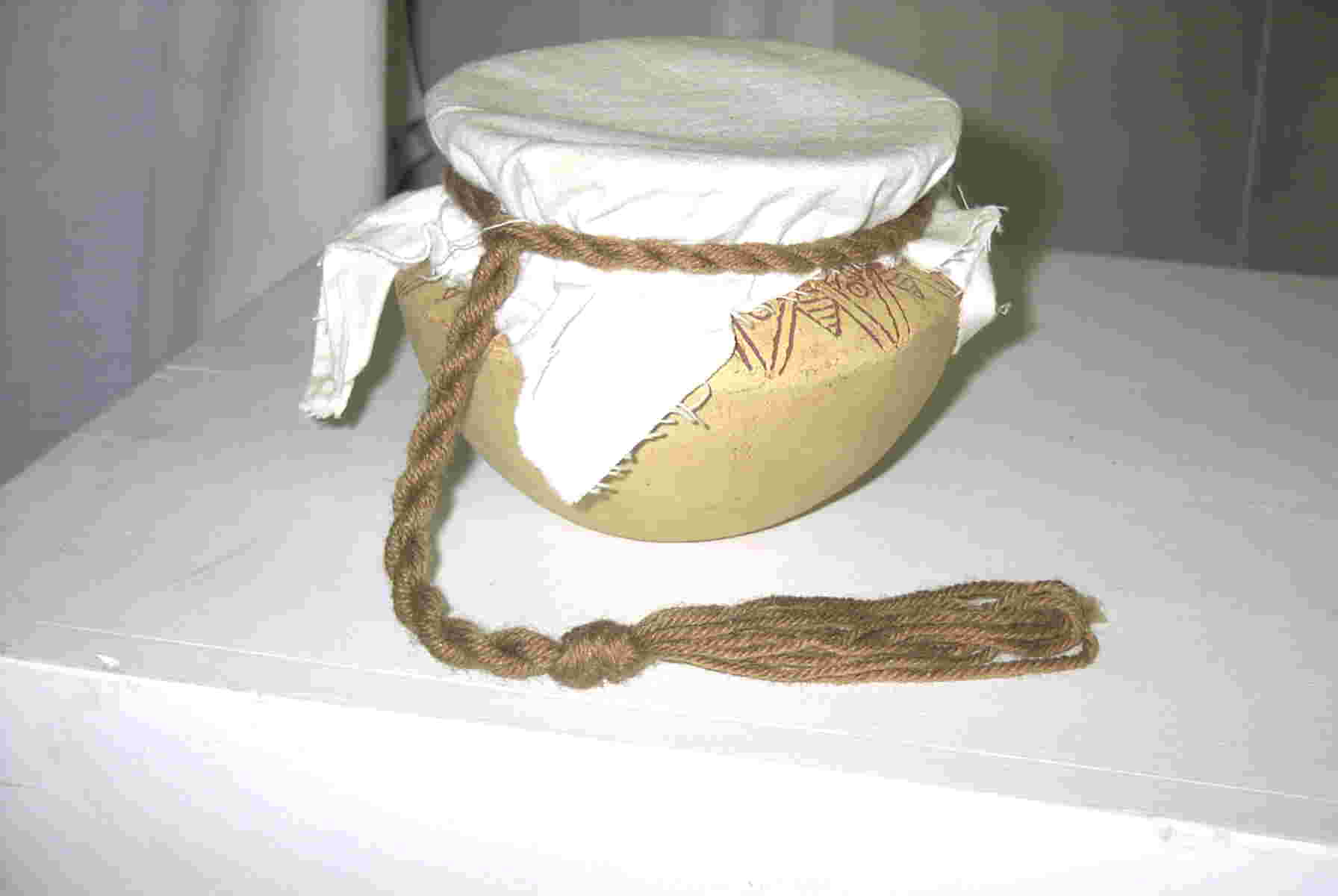
| The same shape repeats itself in Anglo-Saxon and medieval pottery, in cooking jars, funerary urns, drinking vessels, and more. It's referred to as "biconical" in Myres book on Anglo-Saxon pottery. With assorted variations, I see it as the defining shape of European pottery. Not all European pots have it, but if you extend the neck and narrow it, you get a Greek amphora. The Beaker Folk of the late megalithis period in Britain used it, the La Tene Celts used it. It can be soft and rounded or angular. But the rounded belly, narrower neck, and flaring lip shows up in European pottery for thousands of years. It's very useful for many purposes. In a drinking vessel, it gives you a shape that's easy to hold onto without a handle, and your lip fits just nicely under that flare. And for a storage jar, you get a built-in place to anchor a lid or cover, as we see here. It's probably historically incorrect to use a decorated piece for food storage. Decoration may have been reserved for ceremonial use. On the other hand, unless we find actual bones in a pot, the term "ceremonial function" is art historian-ese or archeologist-speak for "we don't have a clue what this was used for." So I take the whole "ceremonial function" thing with a big dose of salt. For domestic use, most pots were pretty plain. But I felt like decorating this one. And hey, if artisans could decorate buckets, weaving tools and other everyday implements, as we see in the Oseberg burial, there's no firm reason why they might not have decorated a storage jar just because they felt like it, or the client was paying enough. The decoration is authentic in style. In reading about the ways jars were sealed before we had canning lids and rings, I found that there are many possibilities. Waxed parchment tied on with leather thongs or linen string is one option. Leather or fabric is another. A thick layer of wax or solid animal fat is another. And for simply keeping bugs and dust out, a piece of fabric tied on would do. I've used the last option here so I can use this pot for demonstration purposes. It contains dried fava beans, which do not need to be kept in airtight conditions. Fava beans are also period for the Middle Ages. |
| Anglo-Saxon style jar, medium fired off-white stoneware with incised decoration and red iron slip. Covered with cotton fabric tied on with tie made of plied cotton cording. |
 |
| Anglo-Norman Style Spouted Pitcher |
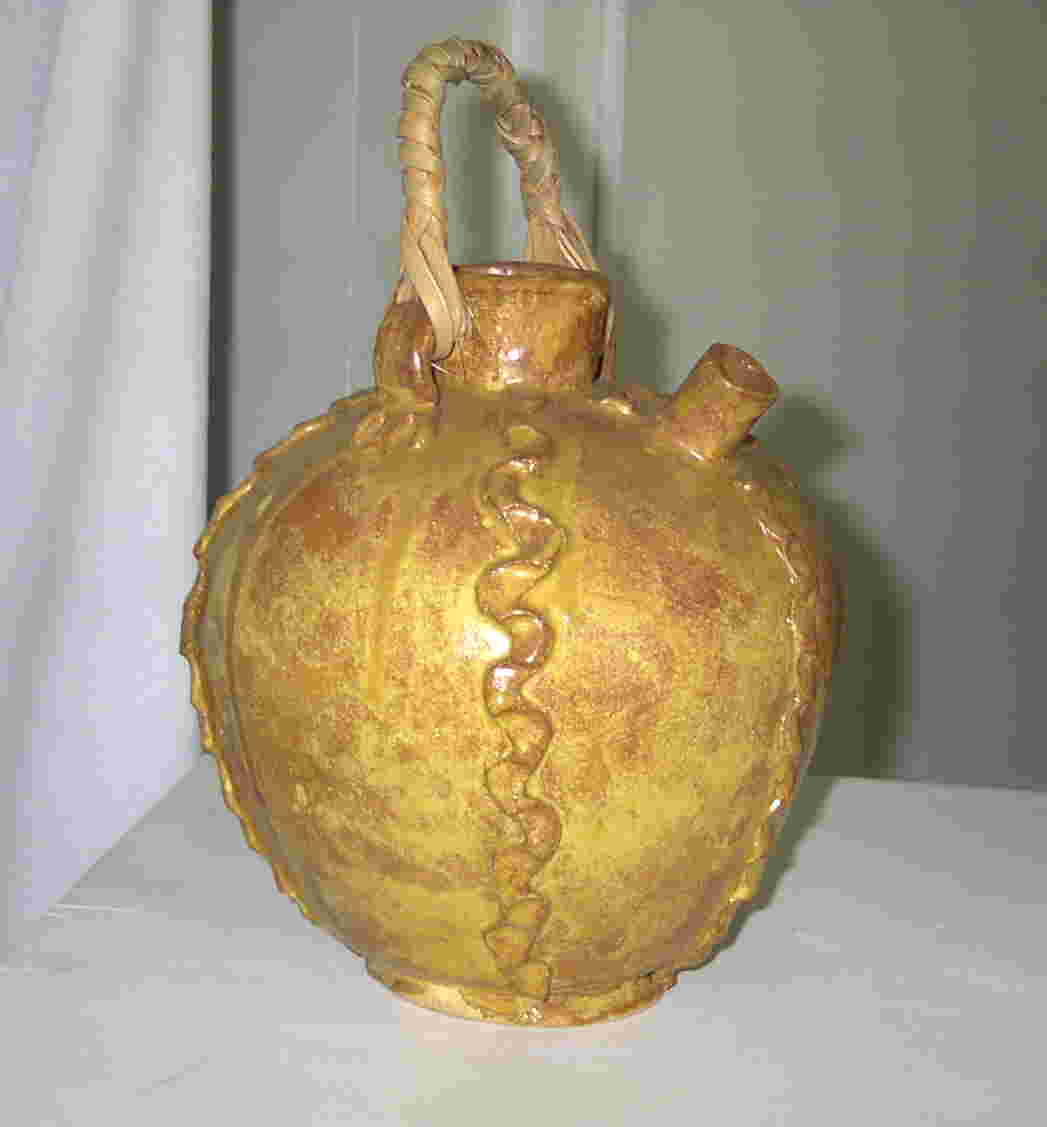
| Anglo-Norman style spouted pitcher of about the 10th-11th centuries, hand-made with two lugs and "thumbed" lines added. Off-white medium-fired stoneware, commercial glaze. Handle made of woven soft-wood splints. |
| This is a fairly early period style of pitcher. Note that the liquid comes out of a spout that is separate from the neck, unlike most modern pitchers. Modern pitchers have pulled spouts, in which the spout or lip is formed by pulling out one edge of the neck of the pot. Or by adding an extra piece to the neck. I was mystified by the lugs for a long time. In all cases, there are 2 or 3 lugs on the neck of the jug. We would expect one, because we're used to a single large handle on the top or back of the pot, like a teapot. Three is the most common number, but where there are less than 3, there are 2, never 1. And if there are two, they're on opposite sides of the neck relative to the spout. I gave this a lot of thought, and pictured how such a jug could pour. Eventually, it came to me that they were lugs for attaching a separate handle. If the handle was made of some fibrous material, such as rope or basketry, the handle would have long ago disintegrated, leaving little or no trace. Only the clay was left. So this pitcher was, in the mind of its maker, more like a bucket than a jug. It has a flexible handle made of fibre, as most buckets had before wire handles became the norm. It's designed to pour by tipping it just as a bucket is tipped (or pitched, which may account for the word "pitcher"). It has a regular neck, albeit much narrower in relation to the body than that of a bucket. And for ease of pouring, it has a spout, but the fact that it's stuck on the shoulder almost like an after-thought tells me this was an idea that was being worked out. This was, in many respects, a bucket altered to make it better for pouring, especially for drinks. Trying to slop wine out of a bucket is feasible, but can be messy. And alcohol evaporates, so a narrower neck would be preferable. This design works well if you hang it, or if you want to pour the liquid straight into your mouth. I've found that fighters in particular love it for that reason. And one of the best things about it is that it pours perfectly, with none of that glug-glug thing. What causes the glug-glug is that liquid can only come out while air presses it down. If you only have one opening in the container, air has to move in as the liquid moves out, and if too much liquid is coming out, not enough air can move in to replace it. So every second or so, the liquid stops pouring because there isn't enough air pushing it, then air rushes in to replace the liquid that has left, and the cycle starts again. The arc of liquid actually moves back and forth as this is happening. With this design, once it starts to pour, you know exactly where the stream of liquid will end up. It won't keep burping and thereby moving the stream of red wine so it slops all over your nice white tablecloth. |
| Sources Charleston, Robert J., World Ceramics: An Illustrated History, (Toronto: Hamlyn, 1976) Cooper, Emmanuel, A History of World Pottery, (Radnor, PA: Chiltern, 1988) Haslam, Jeremy, Medieval Pottery in Britain, (Aylesbury, Bucks, U.K.: Shire Archaeology, 1984) Myres, J.N.L., Anglo-Saxon Pottery and the Settlement of England, (Oxford: Clarendon Press, 1969) |
| Back to Pottery page |
 |
 |
| Olwen's Home Page |