|
||||
| About
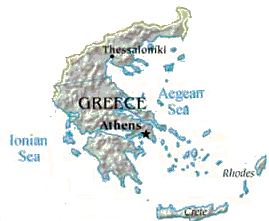
this site: This site was founded in order to give more praise to the under appreciated immortal, Chris Psaros. Since Chris is Greek, it was only within his best interests that this site would focus on the beloved olive. The creator of this site hopes that his creation will spark life and love back into the heart of Chris, while educating and entertaining others on the history and beauty of the olive. History of the Olive: Chris is from Greece, a small Mediterranean nation south of Macedonia: This nation, though currently small and weak in power, was once one of the most advanced of its time. This period, occurring about 3000 years ago, lead to the production and refinement of Olives and their much loved oils. In 1259 BC, the great Minoan leader, Olivacles, defeated the five-headed she-witch and returned to Minoa with the sacred olive tree of the Gods, planted by Zeus himself. Ever since then, countless wars have been fought between the Greek city-state nations for olive dominance. Its fruits, the olive, were a delicious snack and salad component, while the oil was great for cooking, greasing, and lubricating the anal cavities of young Grecian boys so that the philosophers could get their jollies. The Trojan war, for example, was fought between the green-olive growing Macedonians, and the black-olive worshiping Trojans. After prince Paris of Troy abducted the beautiful Helen for her olive-tending skills, a great legion of ancient Greek heroes, including Achilles and Odysseus, fought for her return and safety, so that their olive crops would flourish under her care. Alexander the Great attempted to conquer the Indus valley region in order to obtain more olive-growing lands for the Greek people. He died when he mistakenly swallowed a rotten olive in Alexandretta, Egypt. He left behind his great Olive Oil Goblet, which Jesus used during his last supper as a wine glass. This would be later known as the Holy Grail, and would be finally discovered, though lost, by Indiana Jones and James Bond. The Romans took over Greece and in turn used olives for their own food. This spread the growth and usage of olives and olive oil throughout Europe. The Carthaginians refused to buy olives from the Romans, as the supple food and its oil was so addictive. So the Romans forced Carthage's trading posts into buying Olives in the Punic Wars. The Romans burned Carthage to the ground, and poured Olive Oil all over it. They were being symbolic or something. After
the Roman Empire fell because of civil wars and inside olive trading
amongst the Emperors, the Byzantine empire founded itself in Byzantine,
later Constantinople (but you can't go back to Constantinople) and
spread its influence through Greece until the Turks invaded. The Ottoman empire shifted the economic structure of Greece from olive production to that of foot rests (Ottomans). But eventually, after revolution and war, the Greeks got their independence and started producing olives and olive oil again under Zorba the Greek. Today, Greece's economy rests solely on the production of olives and olive oil. But due to the great distances between Greece and California (where Chris Psaros lives), the cost of olives and olive oil is too great for our friend. So, that is why he needs your help. Send your olives to Chris, so that he may continue to live his life in America, as he did as a young man growing up in Greece. |
||||
All
information on this and following pages are sole property of our
living demagogue and immortal Chris Psaros, though not maintained
by the beloved Greek. If you have any problems with the material
on this site, please take an olive and shove it up your ass, until
full penetration into the rectal cavity is achieved. ©2003, Olives for Psaros Enterprise. |