by P. E. Katzer
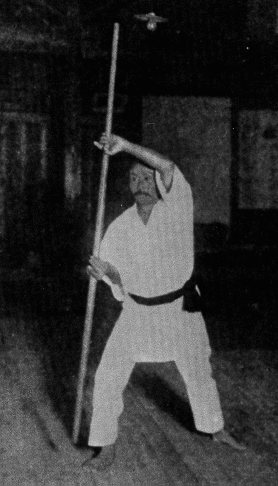 The staff commonly refers to a long wooden staff, one of the oldest martial weapons. In Okinawa, the Bo, like many other martial weapons, was based on tools used by commoners. The Bo may be disguised as a tenbin, used to carry buckets of food or water balanced across the shoulder. The Bo was also disguised as a walking stick. The fact that the staff is a long stick made it an easily acquired weapon and one of the first weapons to develop into various combat arts around the world.
Early man has used the staff worldwide in stick fighting or self-defense against better-equipped armies. It was used by peasants in Europe during the middle ages and developed in Africa, China, Japan, and Okinawa. A
Buddhist priest, Daishi Darum, leader of the Shorin Temple helped spread the use of the Bo. He ordered his disciples to master bo-jitsu, the art of the Bo, along with other martial arts to protect their temple during China�s volatile years, circa 517 A.D. This helped to influence a position for the Bo as one of five weapons systemized in Okinawa during the development of te, the founding martial arts style that eventually led to karate. Bo katas date back to the time of Matsu Higa, 1790-1870 A.D. in Okinawa
The staff can come in a variety of lengths and styles. Different lengths of the staff are shown in Table 1:
The staff commonly refers to a long wooden staff, one of the oldest martial weapons. In Okinawa, the Bo, like many other martial weapons, was based on tools used by commoners. The Bo may be disguised as a tenbin, used to carry buckets of food or water balanced across the shoulder. The Bo was also disguised as a walking stick. The fact that the staff is a long stick made it an easily acquired weapon and one of the first weapons to develop into various combat arts around the world.
Early man has used the staff worldwide in stick fighting or self-defense against better-equipped armies. It was used by peasants in Europe during the middle ages and developed in Africa, China, Japan, and Okinawa. A
Buddhist priest, Daishi Darum, leader of the Shorin Temple helped spread the use of the Bo. He ordered his disciples to master bo-jitsu, the art of the Bo, along with other martial arts to protect their temple during China�s volatile years, circa 517 A.D. This helped to influence a position for the Bo as one of five weapons systemized in Okinawa during the development of te, the founding martial arts style that eventually led to karate. Bo katas date back to the time of Matsu Higa, 1790-1870 A.D. in Okinawa
The staff can come in a variety of lengths and styles. Different lengths of the staff are shown in Table 1:
*Shaka is a unit of measure approximately 1 foot long
The staff remains an integral part of martial arts including non-Asian, western fighting disciplines. Its simplicity of being a stick helped make it one of the first weapons in use world-wide.
References:
1. http://www.etp.phys.tue.nl/bertus/schermen/types.htm, Non-Asian Weapons, Fencing And Fighting Methods by Maurice Donners
2. http://www.fightingarts.com/learning/maworld/ma_a_z.shtml#bojitsu, Fighting Disciplines A-Z, Fighting Arts.com
3. http://www.seito.co.uk/kobudo/bo.html, Weapons of Kobudo, Bo (Kon), United States Kobudo Kai International
4. http://www.cfxs.com/Weapons.htm, History of the Bo Staff, from The Weapons of Xena and Gabriella, History of the Xena
5. http://www.ste-m.clara.net/martial/jitsu/staff.html, Staffs, The Unofficial University of York Jiu Jitsu Club World Wide Web Site
6. http://www.geocities.com/cbfisher2000/shihan8/goju37.html, Six Karate Weapons, Sakana-Dan Ryu Goju-Kenpo Karate-Jutsu
7. http://www.grandmaster.cc/bo.php3, Bo Staff, www.GrandMaster.cc
8. http://www.loyola.edu/maru/weapons.html, Weapons Choices, Loyola Ju-Jitsu Club
9. http://www.mastersage.com/bo.htm, Bo, Master Sage.com
| Copyright © 2009 cyberpunk Send E-Mail: webmaster |
 |
Revised 1 Jan 2009 |