The Story of Karate from Buddhism to Bruce Lee
by Luana Metil and Jace Townsend
Summary by P. E. Katzer
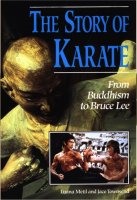 This book is relatively new, written in 1995, and presents a very good compilation of history related to karate. The book is easy to read and most pages provide excellent photographs related to the subject from the Shaolin temple monk statues, to Hollywood karate legends. The style of the book is reminiscent to a National Geographic magazine and martial artist of all ages will enjoy this book.
The books starts out by retracing Bodhidharma's life as a boy in India watching the warriors practice their fighting skills in the art of the vajramushti warrior. Bodhidarma's journey to China and his influence in the Shaolin Temple are presented with spectacular photographs of the Shaolin Temple. This book brings up several legends of the time that may interest other readers to research Bodhidharma and the Shaolin Temple further. Bodhidarma taught the Shaolin monks the exercises of the varamushti warrior and Zen Buddhism.
The second chapter discusses the expansion of Bodhidarma's original Eighteen Hands of the Lo Han, loosely translated as the exercises for the ultimate holiness. The Shaolin monks introduced elements found in nature to the fighting styles such as the energy conservation of the quick strike of a praying mantis, the accuracy of deadly strikes by snakes, the balance of a crane, the monkey's ability to confuse opponents with summersaults and side-to-side or back-and-forth motions, and the strength and speed of a tiger strike. Nearly 100 years after the introduction of the Eighteen Hands, the self-defense fighting style of the Shaolin monks became known as wu shu, or Shaolin Temple boxing. Monks viewed the kung fu philosophy and physical aspects as a way of life. Stories of the monk's fighting skills spread throughout China and their skills were used to support military goals. After the rescue of a kidnapped prince in 621 A.D., Prince Li honored the monks after becoming emperor. An interesting legend has it that the emperor allowed the monks to wear gold colored clothes, a color once reserved for only the emperor. As centuries passed, the monk warriors combat skill with empty hand fighting and with weapons were legendary. Monk warrior frequently defended the border areas of China. Several times, the monks were asked to be part of the royal temple, but they always chose to return to their own temple. In 1674, one emperor feared the great number of monk warriors that were not under his direct command. Emperor Qing's forces ambushed the Shaolin Temple. Many monks were killed, a few escaped the destruction, and the temple was in ruins. Years later, the temple was renovated and the monks returned. In honor of their comrades, many statues were added. Today there are more than 200 sculptures of the monks.
Chapters three and four focus on Okinawan Karate and Korean Karate fighting styles and how their geographical surroundings influenced their methods. Both styles trace back to kung fu fighting styles brought by Chinese immigrants and Buddhist missionaries. Okinawans practiced karate secretly after Sho Shin banned weapons in 1478 and under Japan's takeover in 1609. There is a nice summary on weapons in Chapter three that explains how farm implements were used as weapons. The bo was once a carrying stick held across the shoulders to hold a farmer's planting supplies. It was made with the hardest wood available to stand up to swords. The kama was a three foot sickle to cut rice and grains. The nunchaku was hidden with farm implements and could conceivably be a rice thrasher but the Okinawans knew it to be more effective as a weapon. The sai was another weapon that was probably camouflaged as a farm tool to help scrape the soil to plant seeds but it is thought this weapon originated in China and was very effective for trapping swords with its pitchfork design. The last weapon discussed is the tonfa, a grinder for grains that could be used as a club or to block attacks.
Korea had a similar history developing their martial arts. Starting with a Chinese unarmed combat style, Koreans added high spinning kicks. The original style was known as Taekyon. When Japan took over Korea in 1909, Koreans had a new interest in Taekyon but practiced it secretly since Japan banned military arts. Today, Taekyon is part of the South Korean military training. In 1955, all the South Korean martial arts schools become part of one system and called this art tae kwon do translated to "the way of the foot and fist."
Chapter 5 presents an interesting background of ninjas and the art of ninjutsu, the "art of invisibility." Ninjas worked for the samurais in Japan and were part of the ninja class. Samurais used ninjas to do work they thought to be dishonorable or beneath their dignity such as spying. Ninjas and kunoichi (female ninjas) were trained in ninjutsu from the time they are children. Ninjas trained from the time they were children to run, swim, climb, balance on beams and tree limbs, pretend to be statues, and to play hide-and-seek. Ninjas used camouflage to their advantage with their clothing often being reversible to a different color. Wrapped over their uniform is an obi, a nine-foot cloth used to store weapons or to use as a rope or bandage. Ninjas were experts at weapons often having a James Bond flavor to their weaponry, such as a lady's fan with a hidden knife when folded, hairpins dipped in poison, collapsible boats hidden in shrubs, or a musical flute disguising a blowgun. As time went on and Japan remained a peaceful country, many ninjas became secret police or bodyguards and their social status further declined. Much of the knowledge of the ninjutsu system has been lost as new trainees became rare. Only one American, Steve Hayes, was trained by ninjutsu grandmaster Masaaki Hatsumi. Hatsumi was selected by the last member of a ninja clan to learn the ninja secrets. Today, most of the existing ninja scrolls are in museums with many having been destroyed to protect the names and skills of dying clans who did not want unqualified outsiders to learn of these methods.
The next three chapters provide biographies and summaries of founders of martial arts and of legends from Hollywood. Chapter 6, Modern Karate, provide histories on Shotokan Karate's Gichin Funakoshi, Judo's Jigor Kano, Aikido's Morihei Uyeshiba. The section on Funakoshi is one of the most comprehensive biographies on Funakoshi's life going beyond most common information typically found on karate web sites. One unknown fact brought out on this book is Funakoshi's three-month tour to U.S. Air Force bases after the American occupation of Japan at the end of World War II. He attracted a large number of Americans to see his demonstrations. Chapter 7 discusses American Karate pioneers such as Robert Trias who started the first American karate tournament in 1955 after his training in Japan and Korea as a policeman for the U.S. Navy. Ed Parker is another pioneer who taught karate to movie stars and runs the International Karate Championships tournament in Pasadena California. Jhoon Rhee helped expand tae kwon do in the US. After studying engineering in the US, he taught at the Pentagon, teaching Secret Service and some congressmen tae kwon do and invented sparring safety gear after one of his students was seriously hurt (Rheemax safety equipment). The age of this book is most noticeable in Chapter 8 discusses the Hollywood legends of Bruce Lee and Chuck Norris and briefly mentions Steven Seagal and Jean-Claude Van Damme. There are no signs of Jet Li, Jackie Chan, or Yuen Wo-ping in this particular book.
The last chapter of the book is titled Karate Today. Most notable in this chapter is the recommended reading list. The chapter talks about the current state of karate in the U.S. and the basics of belt ranking and class philosophies. The book is not a technical curriculum karate book but it does cover history, culture, and biographies associated with karate.