





Like branches on a tree, we grow in different directions, yet our roots remain as one and our lives will always be a part of each others.
O’Donald Coat of Arms and History
 Our
Family Motto and Coat of Arms
Our
Family Motto and Coat of Arms
Tradition has it that Saint Patrick upon meeting our ancestor Conall Cremhthainn who was an elder son of King Niall of the Nine Hostages, used his staff to impress a cross upon Conall's shield. This staff called the Bachall Isa is the same one that he used to drive the snakes out of Ireland. Then Saint Patrick promised Conall that anyone of his family who carried that sign on their standard would never be overcome in battle. This is why our family motto is: In Hoc Signo Vinces which translates to: Under This Sign Thou Shall Conquer.
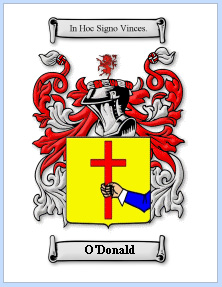
Our coat of arms is gold, with an arm coming from the right side of the shield, the arm is vested in blue with a silver cuff and holding a red cross.
Our Branch of the Family's History
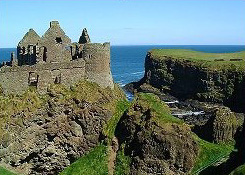
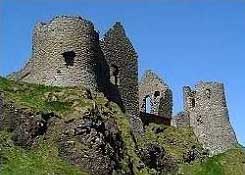
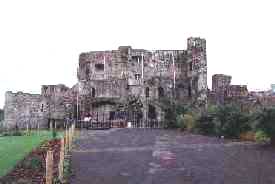
The name O'Donald first showed up in county Galway, Ireland, where we held a family seat from very ancient times, even before the Norman Conquest of England in 1066 A.D. The castle below which stands in ruins barely clinging to the side of the hill on which it was built is thought by some to be one of the O'Donald clan's first castles.
The first recorded American settlers named O'Donald were Charles, Roger, Thomas, and William O'Donald who arrived in Philadelphia, Pennsylvania between 1840 and 1860.
Since many people who came to American did not know how to read or write, several spelling variations of our family name have occurred. These variations of O'Donald include: O'Donnell, O'Donell, O'Donall, O'Donel, and O'Donle. Some of the first recorded American settlers with one of the other variants of our family name were Phillip O'Donel who arrived in Boston, Massachusetts in 1767 and John O'Donell who arrived in Salem, Massachusetts in 1822.
So I decided to solve the mystery of when our name changed from O'Donnell into O'Donald. I discovered that it happened not too long after we arrived in America.
My Great Great Great Great Grandfather Fielding O'Donnell who was born in Belfast, Ireland came to American and settled in Virginia where he met and married Phoebe Elswick. Fielding and Phoebe had my Great Great Great Grandfather William O'Donnell who was born in 1795 in Virginia.
William married Mary Westfall and they moved to Tennessee where in 1824, my Great Great Grandfather John O'Donnell was born. John married Elizabeth Ann Jones and when they had their first child, my Great Grandfather, they named him Jonathan Wesley O'Donald. From this point on, our last name has been recorded as O'Donald.
Click here if you want to know more about where our name came from and read more about our history. The O'Donnell history is interesting and contains photos of some of our possible ancestors and the Castles they owned in Ireland. The stories and photos may pertain to our branch of the family tree... however, I can't guarantee that they do, so, if you want to skip the rest of the history and start checking out our Family Pages, just click the Family Tree button on the left side of this page. It will take you to the page which has a diagram of our Family Tree and contains links to our other Family Pages. After studying this chart, you should have a better idea of where you belong in the O'Donald Family Tree.
Each Individual's Family Page will contain some photos and a little information about that individual's family and will have buttons leading to the family pages for all of their children. We hope you enjoy your journey through our family pages.
While you are here, why not check out your Family Page and make sure your information is current and correct. If your branch of the family does not have any photos or information... it is because we have not received anything to put on your page. We hope that you will join with us and email your family information and photos to us so that we can add them to our site.
Around the year 1000 A.D. Brian Boru, then High King, ordered that families take surnames. The practice before that was for a person to add the name of his father or grandfather to that of his own, a practice which still exists in some parts of Ireland today. The change was very gradual and it was not until a century later that the surname Ó Dómhnaill appeared when Cathbharr adopted the name of his ancestor - Dómhnall Mór - as his surname. Another clan in the Clare/Tipperary area adopted the same surname but from a different ancestor of course. This was long before Cineal Chonaill did and sometimes causes confusion and misunderstandings. It is difficult to know whether an O'Donald in the south of Ireland is descendant from the Clare/Tippereary clan or from a 'northern' O'Donnell who 'lost his way' on his journey to or from Kinsale. It is important to note that for some time before Dómhnail Mór's name was accepted as the official surname, many clan members were unofficially using that of Dálach, a former chieftain slain in 868. The latter is still used in Gaelic in the following cases - O'Donnell Clan = Clann Dálaigh; The O'Donnell = An Dálach; The O'Donnells = Na Dálaigh.
Meaning of the Name: "Domhan" is the Gaelic for "world" and "Domhnall" means "world ruler". "Ó Domhnaill" means "descendent of Dómhnall".
About the Clan: Niall of the Nine Hostages (Nial Naoi nGiallach) who reigned from 379- 405 AD and who is reputed to have brought St. Patrick to Ireland as a slave boy, had many sons. One of those. Conall, asserted his dominance over that territory which later became known as Tir Chonaill (approx. Co. Donegal minus Inishowen). The O'Donnells, descendant from Conall, at first lived along the river Lennon but later established themselves in south Donegal.
At the beginning of the 15th century they built a castle at Ballyshannon which now stands in ruins barely clinging to the side of the hill on which it was built. Click this link to see a couple of photos of the old castle.
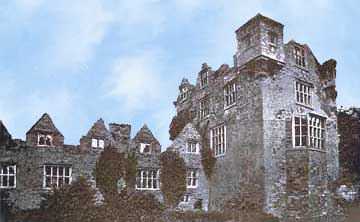
About 50 years later, they moved to Donegal Town where they built Donegal Castle shown below. This castle stood in ruins for 300 years until it was recently restored.
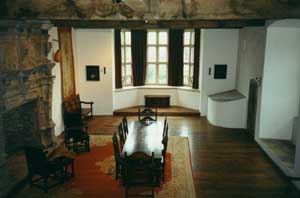
The photo below shows the main banquet room in Donegal Castle, which was recently restored and is now open to visitors in Donegal Town.
The prominent role played by this royal family in Ireland's history is well recorded but after their overthrow and the collapse of the old Gaelic system in 1602 (Battle of Kinsale) less is known about them. The main family immigrated to the European Continent in 1607 where all died within a short time -the last dying in 1642. Other branches of the family were moved to Connaught during the Cromwellian Plantations.
 About
the middle of the 18th century some of the family immigrated to
Spain and Austria and played an important role in their new
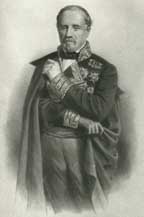
countries. The photo on the left is of General Leoopoldo O'Donnell
of Spain, who brought Morocco under Spanish control. For this he and
his descendants received the title, Duke de Tetuan.
About
the middle of the 18th century some of the family immigrated to
Spain and Austria and played an important role in their new
countries. The photo on the left is of General Leoopoldo O'Donnell
of Spain, who brought Morocco under Spanish control. For this he and
his descendants received the title, Duke de Tetuan.
The most senior O'Donnell family in Ireland today (according to the Chief Herald) is that of John O'Donnell (deceased), Blackrock, Co. Dublin, namely, Fr. Hugh O.F.M., Nuala and Siobhan. Next in seniority is Hugh O'Donnell, Duke of Tetuan, Madrid. The next in line live in Austria, Gabriel, Count O'Donell von Tyrconnell.
One of the most famous O'Donnells in history was Hugh Roe O'Donnell also known as "Hugh the Red" or "Red Hugh". Here are a couple of stories about him.
The Battle of Yellow Ford
In January of 1598, Brian Óg O Ruairc made an alliance with the English, which caused some discontent among the northern clans of Ireland. Hugh O'Donnell, in particular was annoyed because Brian was closely related to him and had been of great assistance to him in the past. Red Hugh could not afford to loose any of his allies and didn't wish to attack O'Rourke but he knew that he would have to change O'Rourke's mind in some way. At first Red Hugh pleaded with him and when that seemed to fail, he used threats. Eventually, realizing that O'Donnell was stronger than the English, O'Rourke returned to the Irish confederacy.
Nothing much else is recounted in the records for that year until mid-August when one of the greatest battles in Irish history took place "Cath Bhéal an Atha Buí". In English that would be... the Battle of the Yellow Ford.
The English, during a time of "peace and amity" had built a strong fortress north of Armagh, on the Blackwater. The three hundred choice soldiers garrisoning it often preyed on the locals for food. Finally, Hugh O'Neill with the help of Red Hugh O'Donnell decided to attack it and raze it to the ground. But being unsuccessful they abandoned their attack and returned to their homes. Later, O'Neill lay siege to it. The English, on learning of the plight of the garrison, assembled five thousand, both infantry and cavalry, well-armed troops to relieve the fort. O'Neill, on learning of their plans, invited O'Donnell to his aid. Red Hugh with his assembled troops, about 2,000 along with the same number of Connacht men and some Scots joined O'Neill before the English got there. The English marched from Dublin to Drogheda, from there to Dundalk, then to Newry and finally to Armagh. The Irish camped on the route they would take from Armagh to the fortress.
Finally, on the morning of August 10th, 1598 (some records say it was the 14th) the English got up at dawn and "proceeded to clothe themselves with strange tunics of iron, and high-crested, shining helmets, and foreign shields of well-tempered, refined iron. They seized their wide-edged axes, smooth and bright, and their straight two-edged swords, and their long, singled-edged blades, and their loud-voiced shot-firing guns, so that it would be very hard for their leaders to recognise them if they were not known by their speech, owing to the array of shields, helmets and armour on them outside, hiding and covering their faces and their features, and to the quantity of arms also concealing them." Their captains under the supreme command of Henry Bagenal proceeded to arrange them in battle order and at last they marched to meet the Irish.
The Irish, according to Beatha Aodha Ruaidh Uí Dhomhnaill, marched to meet them.
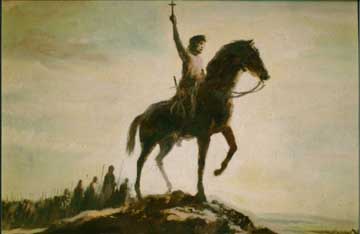
"Their weapons and dress were different, for the Irish did not wear armour like them, except a few, and they were unarmed in comparison with the English, but yet they had sufficient wide-bladed spears and broad-grey lances with strong handles of good ash. They had straight two-edged swords and slender flashing axes for hewing down champions. There were neither rings nor plates on them, as there were on the axes of the English. The implements for shooting which they had were darts of carved wood and powerful bows, with sharp-pointed arrows, and the English generally had quick-firing guns."
From these descriptions we see that the English were superior in arms. However, they were inferior in numbers. The field the Irish chose was a narrow strip of ground with the River Callan to their right and a bog and woods to their left. O'Neill had chosen the field well and had made some preparations. He had trenches dug and covered over with branches and heather in front of the Irish line. He and the Irish chiefs then proceeded to exhort and instruct their men in preparation. "…be not feared or frightened by the English on account of their strange engines, their unusual armour and arms, and the thundering sound of their trumpets and tabours and war-cries, and of their own great numbers, for it is absolutely certain that they shall be routed in this day's fight." One of O'Donnell's bards who had accompanied them, reminded them of the prophecy made by an Irish saint which promised victory to an O'Neill fighting at a place called 'Béal an Átha Buí.'
All of this had its affect. By the time the English arrived, the Irish were really roused and ready for battle. Their spirits were further raised on seeing the English cavalry charging towards them and suddenly disappearing into the ground. Realizing their greatest danger was from the English guns, the Irish, quickly closed in on the English leaving no room to use their muskets. The English right flank was attacked by O'Donnell and Maguire who had been hiding in the woods. Thus the English were pushed together so tightly that only those on the outside could fight. Furthermore, the English suffered two strokes of bad luck. First, all of their gunpowder exploded killing many and throwing the whole center of the army into confusion. According to Lughaidh Ó Clérigh, "… all round was one mass of dark, black fog for a while after, so that it was not easy for any one to recognise a man of his own people from one of his enemies." Second, several of the English leaders, including Henry Bagenal, were killed and this added to the confusion. Henry's sister, Mabel, had sometime previously been married to Hugh O'Neill much against Henry's wishes. Though the English fought gallantly, nothing seemed to be in their favor and finally they fled towards Armagh having sustained the greatest defeat that had befallen them since the first Norman set foot on Irish soil in 1169 AD.
The Irish pursued them all the way to the city and then returned to the battlefield where they beheaded those severely wounded and collected the booty. The Irish then lay siege to Armagh. After three days, the English asked to parley. Finally it was agreed that all English could go free provided those in the fortress departed leaving all their possessions behind. It is estimated that the English lost between 2,500 and 3,000 men including some of their best officers and nobles while the Irish losses are put at something around 500.
News of the battle infuriated Queen Elizabeth so much she complained that, "naught but news of fresh losses and calamities," from Ireland reached her ears. Morale was now at an all-time high among the Irish and many more joined the Irish confederacy while much of Munster rose in rebellion.
O'Donnell, after resting his men, turned his attention to Connacht once again. For thirteen years the English had held Ballymote Castle. It was a strong fortress with an English garrison which had withstood many unsuccessful attacks from the Irish. Then, one day by some stroke of luck, the local Clann Donncha of Corran took it and held it. It was a great embarrassment to Sir Conyers Clifford, Governor of Connacht, that his strong strategic fortress should slip away so easily from the English. He offered a handsome reward for its return. On hearing of these developments, Red Hugh, immediately, set off and on arrival there besieged the castle. He tried all means to gain possession of the castle, force, threats, begging, pleading, promises etc. He finally ended up buying it for four hundred pounds and three hundred cows. The three hundred cows he rounded up in the next few days from those in the neighborhood not loyal to him. It is possible, though not stated in the records, that he acquired some of the money in like manner. The records do state that "nine score pounds of that money" came from Seán Óg O Doherty. "The town was given over to O Domhnaill then, and he remained there afterwards." Red Hugh seems to have established Ballymote Castle as his military base from then on.
This all happened in the month of September and from then till the end of the year O'Donnell kept his men busy attacking and taking cattle and booty from all those on the English side, "and his army took the prey with them without strife or skirmish till they came by slow marches to Ballymote. Never before was the spoil of enemy's cattle collected the like or equal to it in that place since it was first built. Thereafter O Domhnaill's army go to their homes." And thus ended 1598.
The Battle of Curlews
 The
following account of the Battle of the Curlews is closely based on
the account of Colonel Cyril M. Mattimoe, retired from the Irish
Army.
The
following account of the Battle of the Curlews is closely based on
the account of Colonel Cyril M. Mattimoe, retired from the Irish
Army.
After the victory at the Yellow Ford in August of 1598, Red Hugh moved to Ballymote Castle which he had bought from the McDonagh for £400 and 300 cows. In May 1599, the most powerful and most expensive army yet seen in Ireland had begun to land in Dublin under the command of the man who bears the ultimate responsibility for the Battle of the Curlews - Robert Devereaux Earl of Essex - Lord Lieutenant, soldier, courtier and great favorite of the Queen.
Elizabeth's orders to Essex were brief and clear: he was to move against Ulster and destroy O'Neill and O'Donnell. Instead he turned south and in a useless campaign almost destroyed his fine army with nothing to show for it. While resting in Limerick he held discussions with Sir Conyers Clifford, Governor of Connacht, who had been summoned there to meet him. One decision made was to have very serious repercussions for all concerned. O'Connor Sligo who belonged to Essex's entourage was to return to his castle at Collooney and endeavor to rouse the people in that area against O'Donnell. The plan was most unwise. It had no hope whatever of succeeding but Essex in his burning desire for success did not see things in this light. Clifford returned to Athlone. O'Connor Sligo got safely back to Collooney Castle. The Lord Lieutenant Essex, having had his fill of misfortune in Munster, arrived back in Dublin just as disastrous news was coming in from Connacht. O'Connor Sligo had no sooner reached Collooney Castle than he was besieged by O'Donnell. Essex was in a dilemma. He was in no condition now to tackle O'Donnell; yet he could not remain idle in Dublin. He summoned Clifford and spent two days working out a new plan for Connacht. Clifford, with some reinforcements supplied by Essex, would return to Athlone and begin preparations for an advance to Collooney via Roscommon - Tulsk - Boyle - Curlews. Having raised the siege of Collooney he would continue to Sligo and there erect a new fortification which would replace the one burned down by O'Donnell, and serve as a base for further operations against West Ulster. Building materials would be shipped from Galway to Sligo by Tiobóid na Long(Theobald of the Ships) who had inherited his mother's(Grace O'Malley) fleet.
It was now nearing the end of July. Clifford returned to Athlone and in three weeks was ready for the advance to Collooney. Before departure Essex warned him not to move unless he was fully satisfied he had everything he needed. But Clifford felt confident and wished to meet O'Donnell before O'Neill could come to his aid. On the 14th of August he set out from Athlone. Among Clifford's army were some Irish clans submissive to the Queen namely 'O'Connor Don with his assembly, MacSuibhne na dTuath who was in rebellion against O'Donnell and in league with the Governor.'
O'Donnell, having organised the siege of Collooney Castle (mid-June), left his cousin Niall Garbh with 300 men to continue while he, with the rest, moved to Dunavaragh a secure location high in the hills above the Curlew Pass. His strength is given as 2000 but shortly before the battle he dispatched 600 to Sligo to prevent Theobald of the Ships unloading his cargo there. Some of O'Donnell's advisers felt it was unwise of him to split his army so, but Hugh was determined to keep these three elements apart.
Furthermore he reminded his army that 'it is not by the number of soldiers the battle is broken but by the power of God.'
We are told that O'Donnell's men spent several weeks at Dunaveeragh waiting for the Governor to pass that way. During that time they were exercising themselves and preparing their weapons for the fight. 'They were cleaning, polishing and adjusting their guns, and warming and sunning their grain powder and filling their pouches and casting their leaden bullets and heavy round balls, socketing and riveting their stout round javelins and war-halberds, polishing their long broad-swords and their bright-shining axes, and preparing their arms and armour and implements of war also.'
In Beatha Aodha Ruaidh Uí Dhomhnaill (Life of Red Hugh) by Lughaidh Ó Clérigh, almost a page is given to the religious preparations of O'Donnell and his men. It was customary for Red Hugh to fast for three days, confess his sins and receive Holy Communion before a battle or whenever there was danger. On this occasion he requested his army to fast on the day before the Feast of the Assumption. On the morning of the Feast day, Sunday, August 15th, all attended Mass. Afterwards they went to their tents to take a meal before encountering the enemy. When finally assembled, Red Hugh addressed them and, even those who were not near him could hear, 'on account of the loudness of his voice and speech.' (#) indicates a footnote.
Red Hugh 's Address to his Soldiers before the Battle of the Curlews
"Brother
chiefs, and clansmen loyal, tried in many a bloody fray;
God be thanked these robber Saxons come to meet us here today.
Boasting Clifford, Essex minion, swears he'll make the rebels flee.
We will give him hearty greeting, like to that at Ashanee.
(1) What,
though traitor Celts oppose us - be their number three to one?
Greater glory to Clan Connell, when this tough day's work is done.
Shrived at Holy Mass this morning, danger we may fearless dare;
For we draw the sword of justice, shielded all in faith and prayer.
Not for conquest, or for vengeance, on this blessed Lady Day,
Not in strength or numbers trusting, do we face their proud array;
But for Holy Mary's honour, by their tainted lips defiled,
For the sacred rights of freemen, for the mother, maid, and child.
Prone and bleeding lies our country, sorrow clouds her crownless
brow,
All the lines of peerless beauty limned in ghastly colours now.
In the light of glories olden beaming through our dark disgrace,
See the madd'ning wrongs and insults heaped upon our fallen race!
Roofless homestead, broken altar, slaughtered priest, dishonoured
maid -
Children of an outraged mother! Whet ye well the thirsty blade.
Scorning rock and brushwood cover, rush like swooping eagles forth,
Hard and home push every pike-head, sinewy spearsmen of the North!
Cleave in twain the lustful Saxton, tame Dunkellin's soaring pride,
Smite the double-souled O'Connors - traitors false to every side.
(2)
Down upon them, Banagh's chieftain! Sweep their ranks your spears
before,
As the North wind sweeps the stubble through the gap of Barnes-more.
Forward! Forward! Brave McDermott, strike for fair Moylurg's domain,
For yon lake in beauty sleeping, for the holy island's fane. (3)
Strike! And drive the swinish Saxon, herding in their sacred shade,
Far from Boyle's old abbey cloisters, where your father's bones are
laid.
Holy Virgin! We implore thee, by that abbey's rifled shrine,
(4)
Colmcille of Doire Calgach, patron of O'Donnell's line,
(5)
Good St. Francis! For the glory of thy name in Donegal,
Speed ye now Tirconnell's onset, till we rout them one and all.
Should O'Donnell fall in combat - if the foe be forced to yield,
Better death I never pray for, than to fall upon the field,
Where the cause of Erin triumphed, and the Saxon was laid low,
With that green flag floating o'er me, and my face against the foe.
Never chieftain of Clan Dalaigh to th'invader bowed the knee;
By the black years of my bondage, it shall ne'er be done to me.
I would rather angry ocean rolled o'er castle, cot, and hall,
Than see any Saxon bodach rule in royal Donegal.
Deathless fame in song and story will enshroud the men who die,
Fighting God's and freedom's battle bravely by O'Donnell's side.
Great will be his need of glory, honoured long the victor's name,
Pointing proudly to her kinsman, many a maid will tell his fame;
"Lo! He fought at Doonaveragh," aged men will whispering
say,
And make way before the altar for the heroes of today.
Gleaming bright through dark'ning ages will this great day's memory
glide,
Like the Saimer's bright-wav'd waters glancing onward to the tide."
Footnotes to better understand Red Hugh's speech
(1) Ashanee - Ballyshannon, where O'Donnell routed Clifford and his forces on Lady Day, two years earlier.
(2) O'Connor Don and O'Connor Roe on this occasion, not for the first time, joined the English.
(3) Lough Cé, at the foot of the Curlews, in which was a monastery dedicated to the Holy Trinity.
(4) The Cistercian abbey of Boyle was dedicated to the Blessed Virgin.
(5) Doire Calgach - the grove of Calgagh - the ancient name of Derry.
Lughaidh Ó Clérigh then gives an account of how O'Donnell positioned his men. 'He placed his swift energetic youths and his nimble athletic men and his marksmen, with their loud sounding sharp-aiming guns and their strong smooth-curved bows and their cruel, whetted javelins, and their throwing darts also.' It goes on for a whole page in great detail about how the battle was planned by O'Donnell. Trees were cut to make barriers at intervals along the rout through which the English were expected, musketeers and archers placed in the woods along the pass while Red Hugh with most of his men waited out of sight over the ridge. The plan, of course, was for the snipers to harass the enemy all the way up the Pass so that exhausted they would come face to face with O'Donnell's well-rested men at the top.
Also present at the Curlews were Conor McDermot and Brian Óg O'Rourke. O'Rourke and O'Donnell were not on friendly terms. Apart from centuries-old rivalries O'Rourke resented many actions taken by O'Donnell recently and so on this day Brian Óg with his clansmen refused to place himself under Red Hugh's command but instead took up position east of the Curlews. From this spot his sentries could detect an enemy force moving out of the town of Boyle and he could have his men at the Pass within half an hour.
McDermot with his 300 men positioned themselves in the woods on both sides up along the Pass through which the English would march. As this was McDermot territory it was their privilege to strike the first blow.
Clifford, as we have seen, was in a hurry when leaving Athlone and so pressed his men very hard covering 30 miles the first day over rough roads with little food. Next day they covered 15 miles to Boyle arriving there exhausted and hungry. Here they had planned to eat and rest but Clifford receiving intelligence that the Pass was undefended and that his army was not yet expected, decided to resume the advance. His men and senior commanders complained but Sir Conyers would not change his mind. He promised food and rest when they were through the Pass and so the tired and weary soldiers struggled to their feet and took their place in the ranks for the long climb to the top of the Curlews.
Clifford's army amounted to 1496 Foot and 205 Horse: a small force considering the task in hand. Two thirds were armed with Arquebus; the rest used Pike. The Arquebus was a crude forerunner of the musket, only accurate at close range. Re-loading was slow and cumbersome. Clifford increased the strength of the Vanguard to enable it to force its way through the Pass if needs be.
In those days the way over the Curlews was a rough narrow track. It was known as the Red Earl's Road (Bóthar an Iarla Rua) after De Burgo, a Norman Lord, who passed that way in the 13th century. Traces of this ancient track can still be seen. This same track left much to be desired, parts of it were so rough that they were impassable by wheeled vehicles while other stretches were bog.
The English had only gone a few hundred yards when they encountered the first barricade and came under fire from the woods on both sides. They instantly attacked but the Irish fled with little or no resistance. This pattern continued well up the Pass. After about an hour the vanguard were running out of powder and ball. New supplies should have been sent up from the rear but conditions were making this difficult and so the vanguard became very vulnerable. Worse was to follow. Sir Alex Ratcliff, commander of the Vanguard, already suffering from two wounds was hit a third time and died.
The situation in the vanguard now called for urgent action by Clifford himself but non was taken. At this point Brian Óg O'Rourke with a company of men(some sources say 140: others 500 men) came rushing to the fray. To the vanguard (already leaderless, out of ammunition, and with tactics that were achieving little), this new arrival did much to undermine their confidence. Confusion began to develop; followed shortly by panic. Men began throwing away their weapons and running back down the hill through the main body who hadn't yet encountered the enemy. The latter seeing the vanguard fleeing decided to follow suit. The rearguard did likewise.
Clifford and his officers did everything in their power to halt the flight, even killing a few to make an example, but all to no avail. Sir Conyers shouting, roaring and fuming at such cowardice, and declaring he would not 'outlive the dishonour of the day', rushed to meet an on-coming party of Irish. He died from a pike-stroke.
Back at Boyle, the Horse having waited about an hour and a half were ready to move forward, thinking of course, that the Pass had been secured. Suddenly, noticing signs of confusion in the distance, they decided to move forward to investigate. As they drew closer to the Pass they realized that something unusual was happening and galloped up the hill by a different rout. Seeing some of the Foot about half a mile away fighting for their lives they galloped to their rescue. Their sudden arrival seemed to surprise the Irish and caused them temporarily to check their pursuit. But soon many of the horses came to grief in the soft bog and O'Rourke, seizing the advantage, counter-attacked. The Horse withdrew but not before they managed to cover the retreat of many of the Foot. Sir Griffin Markham, commanding the Horse, had his right arm broken while Brian Óg O'Rourke was wounded in the hand and right thigh.
The Irish continued the pursuit to the foot of the mountain. Shattered remnants of Clifford's force continued it's flight and found refuge inside the walls of Boyle Abbey. The Battle of the Curlews was over. It had lasted about two hours.
Moving around the battlefield Brian Óg O'Rourke came upon the dead body of Sir Conyers Clifford and recognized it. O'Rourke ordered the body to be decapitated and the head sent back to Red Hugh who in turn dispatched it to Collooney Castle. On receiving this grisly proof of Irish victory, O'Connor Sligo surrendered. Tiobóid na Long, on hearing the news, returned with his cargo to Galway.
Clifford's body was sent for respectful burial to Trinity Island on Loch Key and word of this action was relayed to Boyle in a letter written in Latin by McDermot.
English losses were great while the Irish lost very few. The Irish afterwards collected the spoils of war, killed all the wounded enemy, gave medical attention to their own wounded and buried the dead. The glory of this victory is claimed by three. Most would say O'Donnell was the hero. It was he who planned to meet the enemy there and orchestrated the battle; but there are those who say Red Hugh didn't even see the battle and that it was the McDermots who did most of the fighting; and of course the O'Rourkes maintain if it hadn't been for their intervention at the right time the English may not have been beaten so early. Let's not forget that several decisions and errors by the English contributed to their downfall.
The Battle of the Curlews, in my opinion, was the last great battle fought and won by Irish clans fighting against their archenemy, the Sassanach.
Sources used for history: Beatha Aodh Ruaidh Uí Dhomhnaill by Lughaidh O'Clery Translated by Paul Walsh / Annals of the Four Masters: A Short History of the Irish People by Hayden and Moonan / The Broken Sword of Ulster by Richard Cuninghame / A History of Ireland by Edmund Curtis Ireland under Elizabeth by Don Philip O'Sullivan Bear
Thanks for Coming By
I hope you enjoyed visiting our little family website! Feel free to drop us a line and be sure to sign our guest book before you leave.
This website was created by Kyle's daughter, Pat. If you would like Pat to create a website for you. Just click the button below to email her.

©1999
All graphics and text on this site copyrighted by 4rd Art
Do not make copies without permission from Patricia Ford.
Any reproduction or other use of the information contained on this website is expressly prohibited.