The following information is only intended to provide an initial understanding of hard disk drives. For more detailed and extensive information see the sites listed on the links page.
The following descriptions and depictions are not how all hard drives have been designed but does cover the classical design of hard disk drives for IBM compatible personal computers.
A hard disk includes platers which is where the data is stored. The circular platers are made of a magnetic metal alloy, and it is the polarity of discreet sections of the plater (ie. individual bit areas) that are used to determine whether the bits have the value 1 or 0, or from a magnetic polarity point of view is the polarity north or south aligned.
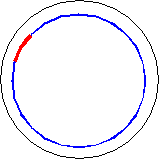
| Top down view of disk drive |
The following image is designed to look as if you are looking down on the circular face of a hard disks plater. The outer black circle depicts the perimeter of the disk plater. The inner blue circle depicts a single track of data on the plater. The red arc depicts a sector in the track. |
 |
|
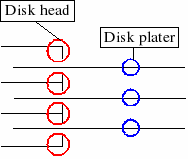
| Side on view of disk drive |
The following image is designed to look as if you are looking side on to the hard disk and so able to see for example all three platers of the hard disk, the platers are the three straight parallel lines. The four lines with perpendicular lines at their right end are to depict the drives read/write heads that collect and store data on the disk. The head number is used to determine which read head to use, and in the picture you'll notice there are six heads, one to read/write each side of the three disk platers. The cylinder number refers to a cylinder of tracks eg. track 0 on both sides of all platers. |
 |
|
| Same view | |
 |
And that quite simply is all there is to it, assuming you were only wondering what the Cylinder, Head and Sector counts are refering to and where the term track fits in as it is used interchangable with head.