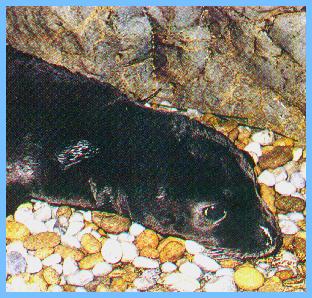
The name monk was attributed to this species of seal because it does not
living in large groups preferring solitude and isolation from human presence and/or its
head resembles the typical hood of some Catholic monks. Distribution
In the old times, the monk seal was widely spread along the coasts of the
Mediterranean, Black Sea, and the Atlantic coast of Morocco and Mauritania. Over
time and due to the various pressures posed on the animal and its habitat, it has become
extinct in more than 10 countries during the last 20 years. To accurately assess the
number of remaining individuals is very difficult, as its populations are dispersed and
existing data is still limited. Generally, it is estimated that only 400-500 individuals
survive today. Many scientists believe that Greece holds at least the half of the total
remaining monk seal population. On the North Atlantic coast of Mauritania (Cap
Blanc) the monk seal population is estimated to be 100-150 animals, a
population which for the last few years is under a serious threat due a virus
epidemic. Smaller populations, are scattered along the coasts of Madeira,
Morocco, Algeria, Tunisia, Croatia, Albania, The Black Sea, Turkey and Cyprus.
Morphology
The monk seal, both male and female, have an average length of 2.4 m and average weight
of around 280-300 kg. The newborn monk seals have an average length of 1m and weight about
15-20 kg. The colour of the monk seal shows a wide range of variation. Usually, the
adult's back varies from dark brown/black to gray with dark spots, always with lighter
colours in the ventral side. There are no significant differences between males and
females.
Reproduction
Gestation lasts about 10 to 11 months and births occur mostly between May and November,
with a peak in September - October. Lactation period lasts about 4 to 8 weeks. Because the
gestation and lactation period is long the births usually occur every other year. The monk
seal usually gives birth to only one pup each time. Nowadays, births mainly take place in
caves. This was not always the case in the past, but only since the monk seal was forced
to abandon the sandy beaches due to the increased disturbance caused by human activities.
Within a few weeks after their birth the pups are able to dive and swim but they can not
swim well during the first days of their life. The life span of the monk seal it has not
been scientifically proved but it is estimated to be around 35 to 40 years.
Feeding
The monk seals seem to be opportunistic predators, feeding on all kind of fishes and
cephalopods which abound in the area where they live. An adult seal is estimated to
consume 5-10% of its body weight per day. In order to find food they attack fishing nets,
follow fishing boats or the migration routes of fish.
Threats
The main threats to the monk seal are:
a.Increased adult and Juvenile mortality caused by deliberate
killing.
The deliberate killing of monk seals is identified as the main factor in the decline of
their population over the last decades. Over fishing in the Mediterranean has reduced the
amount of fish that is available to seals, to the point that the seals resorts to
attacking nets in order to find sufficient food. Due to this behaviour fishermen usually
become the animal's enemy because the seals damage their nets and consume the fish. The
majority of the dead monk seals found in the past few years, were killed by fishermen,
usually by use of shotgun or dynamite explosives.
b. Increased pup mortality due to loss of suitable habitat.
Monk seals in the past were giving birth to their pups on open beaches and big caves..
Today, due to human activities (tourism, summer houses, ports, roads etc.), the animals
have been forced to pup on beaches within caves. The pup mortality in such caves is higher
than on open beaches due to the fact that inexperienced pups can be easily injured or
drowned by waves during severe storms.
c. Increased adult and juvenile mortality caused by incidental
entanglement in fishing gear. Incidental mortality, mainly by drowning, is a
concern throughout the Mediterranean. Monk seals can become entangled in all kinds of
fishing gear, but mostly in static fishing nets. |