Switching in Telecommunications
Introduction
Local area networks (LANs) are used to connect computers located in close proximity, such as the same building or an office floor. This facilitates data communication (e.g., e-mail, file transfer) within the organisation using the LAN. Moreover LANs also allow sharing of computing resources (e.g. databases, disk space, printers, processing power etc.) maintained by the organisation.
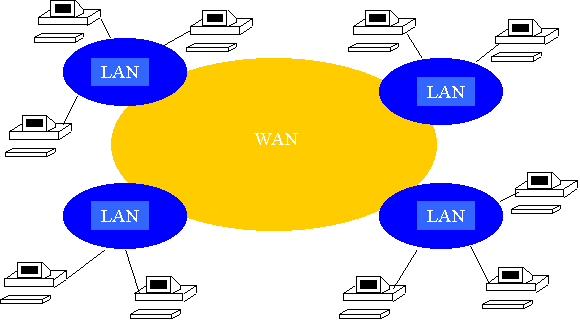
Many organisations have offices at distant locations. Although, within these offices, computing resources may be shared by installing and using a LAN, it may not be possible to share these resources between distant offices. Wide area networks (WANs) are used to interconnect these geographically distant LANs so that their resources may be shared and data communication between distant sites may be achieved.
Unlike LANs, WANs neither share a common communication medium nor do they use a single switch to interconnect various computers. WANs are constructed using a number of interconnected switches.
This article presents some basic concepts and terminologies used for switching in telecommunications. Then switching in data communications is discussed. In the end, the article focuses on switching in ATM (Asynchronous Transfer Mode) networks.
Previous : Contents
Next : Connections in Telecommunications
Top : Contents
© Omar Bashir, December 1998