
Switching in Telecommunications
Connections in Telecommunications
Connections in telecommunication systems can be divided into two basic types, direct point to point or switched connections.
Direct Point to Point Connections
A direct point to point connection connects one message source to one message destination only.
If three devices need to communicate with one another, they require 3 links. However, four devices, in order to communicate using point to point links, would require 6 links.
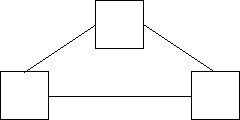
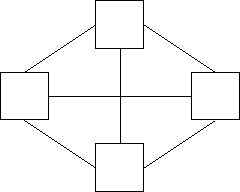
Thus the total number of connections grows more rapidly than the total number of communicating devices. Mathematically,
Direct Connections Required =  , where N is the number of communicating devices.
Dedicated or leased point to point connections are suitable for heavy usage. They are expensive and the subscribers are charged a flat rate for the duration of lease rather than the amount of usage.
Switched Connections
Switches may be used to interconnect multiple communicating systems. Once a device needs to communicate with another device, it requests that a connection be established between itself and the other device. Once the switch sets up the connection, the two devices communicate with each other. At the end of the session, the connection is released.
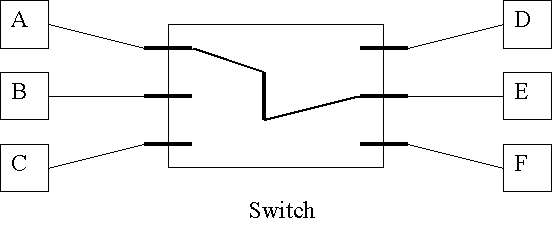
Dial-up or switched connections are suitable for infrequent or non-continuous usage. The subscribers are charged on call by call basis and on the nature of connection or the quality of service desired.
Switching systems allow the evolution and development of economic, flexible and scalable networks.
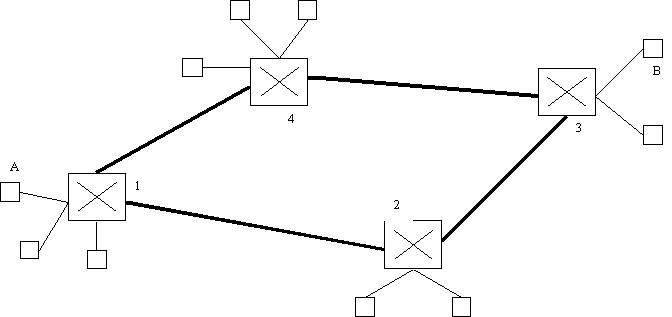
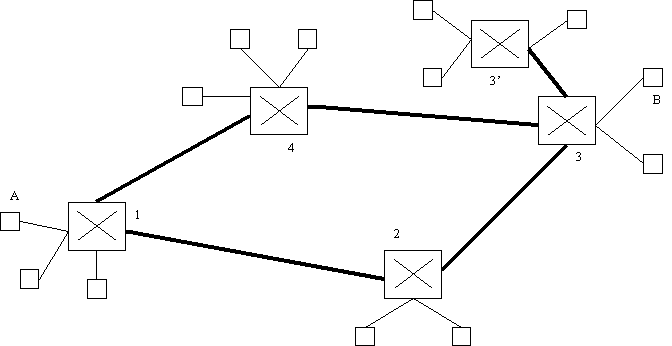
If subscriber A wishes to communicate with subscriber B, the call may be established via switches 1,2 and 3 or via switches 1,4 and 3. If the number of subscribers in the region being served by switch 3 increase, another switch may be installed to share the load.
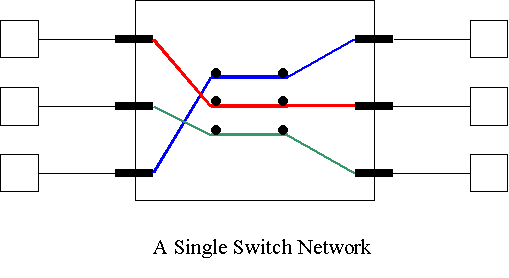
A Basic Switch
Switches form the basic elements of telecommunications equipment. The basic function of a switch is to connect a subscriber, connected to one of its ports, to another subscriber connected to another port. This may also be termed as a single switch network.
In a network of interconnected switches, a switch is also required to route a subscriber’s call through the network to another user connected to a port of another switch.
Previous : Introduction
Next : Evolution of Telecommunication Switching Equipment
Top : Contents
© Omar Bashir, December 1998