Switching in Telecommunications
Functions Performed by ATM Switches
A generic ATM switching unit is shown below
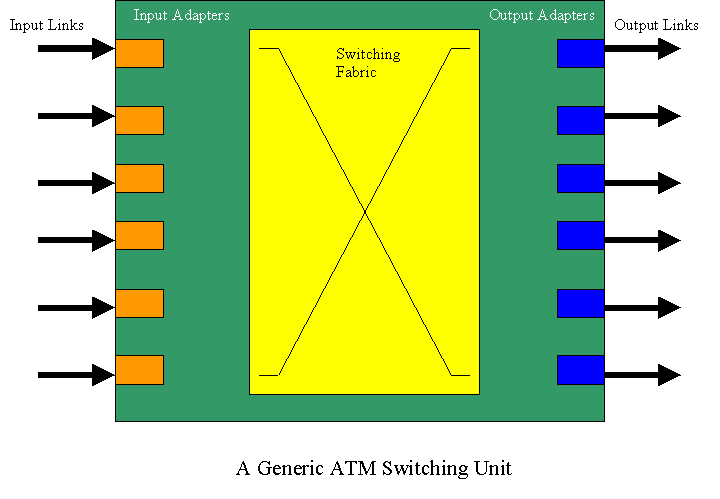
ATM switching units perform the following functions
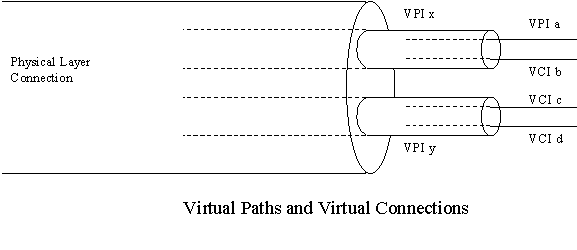
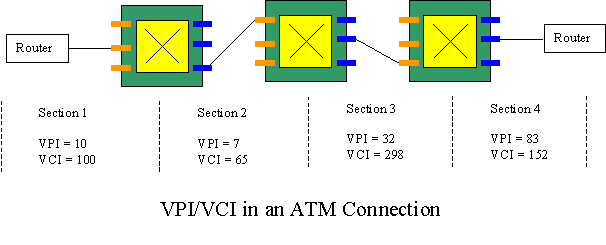
- Analyse the cell header to determine the route. Each ATM connection is uniquely identified by a pair of values, i.e., VPI (Virtual Path Identifier) and VCI (Virtual Channel Identifier). A virtual path (VP) is a prearranged route through the network. Each VP has a bandwidth allocated to it which it shares in some manner among its associated virtual channels (VC). VPs can, therefore, be visualised as pipes, carrying bundles of VCs, within a physical link. VPI/VCI values for the same connection vary for each section of the connection, e.g., between two ATM switches. Each section of the connection keeps its chosen values for the duration of the connection.
- Route cells to the appropriate output ports. The connection between an input port and an output port determines the route that a cell needs to follow through the switching fabric. This connection must be previously known and stored in a table of connections. Routing may be indirect, where the connection information is held as a marker, which establishes a specific path for transferring the cells related to a given connection. Alternatively, self routing may be employed, where a label added to the cells allows them to direct themselves to the appropriate output port.
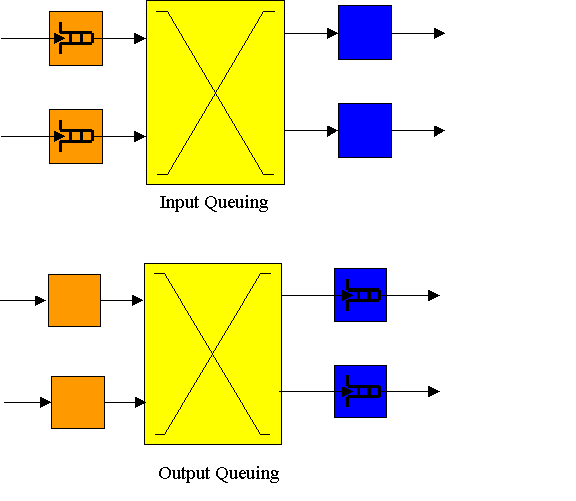
- Temporarily store cells. In certain switching fabrics, internal blocking may occur, as it is not always possible to establish a path between an input port and an available output port. Thus storage devices such as queues are essential in avoiding unacceptable cell loss. However, even if a non-blocking switching fabric is used, cells still have to be stored temporarily to resolve output contention. This occurs when several cells received on different input ports are in competition for simultaneous access to the same output port. Input queuing method associates FIFO (First In First Out) queues with each input port . Cells arriving at an input port are placed into the respective queue before they are placed on the correct output lines. Only the earliest cells are sent to their output lines. If cells in several different queues contend for the same output, only one of them is selected according to the contention resolution scheme. Others remain in the queues and contend in the next contention resolution cycle. Input queuing method, though simple in implementation, provides a poor performance for broadcasting function. This method is also extremely susceptible to non-uniform input traffic. Output queuing method associates a FIFO queue with each output port. All cells entering the switching element are switched to the appropriate output adapters where they are stored in the respective queues. Output queuing increases switch complexity to a considerable extent. However, switching elements that employ output queuing support broadcasting and multicasting.
- Cell header translation. As mentioned above, values for the VPI/VCI pair change for each section of an ATM connection. These values, therefore, only have a local meaning. An ATM switch should provide for cell header translation by maintaining a look-up table that enables the incoming VPI/VCI values to be translated to the out-going VPI/VCI values.
- Manage several parallel cell flows differentiated by priority levels and provide preferential handling for high priority cells.
- Broadcasting or multicasting cells arriving from the same source. Although the source itself could provide distinct copies of each of the cells to be broadcast, these cells would be routed as so many independent flows. This leads to a wasteful use of available bandwidth. Moreover, the source will have to maintain a complete list of destination addresses.
- Check the Header Error Control (HEC) of all incoming cells. This field contains an error detection and correction code used to correct single bit errors and detect double bit errors in the cell’s header. This prevents the cells from being delivered to the wrong end user. If a cell has errors that exceed the HEC field’s correction capacity, the cell is destroyed. When a cell is transmitted with the new connection identifiers (VPI/VCI pair), the HEC field must be recalculated and inserted into the cell. HEC is also used to synchronise the receiver to the cell boundaries of an incoming stream of bits.
- The switch must have a mechanism for handling congestion. This is often in the form of discarding cells when congestion occurs.
- The switch must have a mechanism for updating the routing tables within the switch.
- The switch must have an operations administration and maintenance (OA&M) system for setup operations, control of the network, fault diagnosis and reporting.
- The switch must also have a system for collecting billing information.
Previous : Switching in Data Communications
Next : ATM Switch Architectures
Top : Contents
© Omar Bashir, December 1998
Omar’s home page
Omar’s interests
Omar’s library