| |
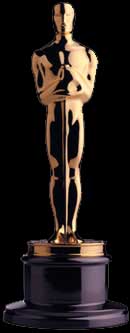
The Oscar statuette, designed by MGM's chief art director Cedric Gibbons, depicts a knight holding a crusader's sword, standing on a reel of film with five spokes, signifying the original branches of the Academy: Actors, Writers, Directors, Producers, and Technicians. |
 |
|
| |
- Oscar's height: 13 1/2 inches
|
- Oscar's weight: 8 1/2 pounds
|
- Number of Oscars presented at Academy Awards shows or to winners absent from show to date: 2,443
|
- Number of eligible categories in 1927: 13
|
- Number of eligible categories in 2002: 24
|
- How many people it takes to make a statuette: 12
|
- How long it takes to make a statuette: 20 hours
|
- Number of Oscars manufactured each year: 50-60
|
- How many Oscars have been refused: 3 - Dudley Nichols for writing The Informer, Marlon Brando (accepted his first one for On The Waterfront, but rejected his for The Godfather) , and George C. Scott (for, Patton). Woody Allen was never on hand to pick up his awards ( Writing Hannah and Her Sisters, and Writing and Directing for Annie Hall), but he never publicly refused them. Rumor has it he never picked them up either.
|
- According to legend, secretary Margret Herrick remarked that the statue looked like her Uncle Oscar, giving the statue it's nickname. The Academy began officially using the nickname in 1934.
|
- Since 1949, each Oscar™ has been individually numbered, starting with number 501.
|
Approximately 50 Oscars are made each year in Chicago by the manufacturer, R.S. Owens. If they don't meet strict quality control standards, the statuettes are immediately cut in half and melted down.
|
- The only Oscar statuette ever made of wood was presented to Edgar Bergen in 1938 for his "outstanding comic creation," his ventriloquist dummy Charlie McCarthy.
|
- The Oscar is made from pewter, then plated 4 times: copper, nickle, silver and finally 24 carat gold.
|
- From 1942 until the end of World War II, Oscars were made out of plaster to conserve metal. After the war, the winners received "real" replacement statues.
|
- The Academy protects the image of it's award, the standing rule is that if an Oscar winner decides they no longer want their statuette, they must offer to sell it back to the academy, for $1. Despite this, several Oscars have ended up in auctions over the years. Over the past 4 years, director Stephen Spielberg has twice purchased Oscars at auctions and donated them back to the Academy (first Clark Gable's Oscar, then later Bette Davis's).
|