 JOHOR DARUL TAKZIM // MALAYSIA // MELAKA BANDARAYA BERSEJARAH
MELAKA BANDARAYA BERSEJARAH


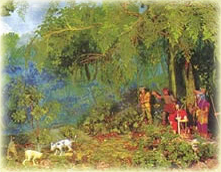
PARAMESWARA

HANG TUAH
During that period, Islam was introduced in the region, arriving along with Gujarat traders from Western India for trading textiles and Melaka became known worldwide as a center for silk and porcelain trading. During the first decade of the 16th century, Melaka was a bustling and cosmopolitan port that attracted hundreds of ships every year.
Malaysia gained its independence on the 31st of August 1957 when the first Prime Minister, His Highness Tunku Abdul Rahman Putra Al-Haj, was handed over the power to rule the country by the British.
After the Independence, a colonial building built by British in Melaka, which was known as Malacca Club, was opened to public after being used by the British upper class as their place for social activities. Exactly 38 years later, the same building was turned into The Proclamation of Independence Memorial; a place that commemorates Independence Day of Malaysia
RIVER BOAT CRUISE

MALACCA ZOO

A FAMOSA WATER WORLD

PEACOCK PARADISE BIRD PARK

Discover the places where countless generations of traders from all over the world had lived and pilled their trade. Part of Malacca's charm lies in its narrow, meandering river which winds through the heart of the old town. Witness the spot where one scene from the movie "Entrapment" starring Sean Connery and Catherine Zeta Jones was filmed. In the actual movie it shows both of them cruising down the Malacca River with the foreground replaced with the Kuala Lumpur skyline. Located near the Malacca Tourist Information Centre.
Malacca Zoo
It is located about 13 km from Malacca city. It is the second largest zoo in the country covering and area of 54 acres with about 1,200 animals made up of 200 different species of animals found in Southeast Asia and Africa amidst natural setting. It was established in 1963 and it is the first zoo in the region with the almost extinct Sumatran Rhinoceres and Seladang on display. The latest attraction is the "Safari Theme Park". Rated the best zoo in this part of the country, it is an enciting place to discover the animal kingdom at your own pace. Entrance fee for adult is RM5.00 and children is RM2.00. Visiting hours is daily from 9.00 am to 6 pm.
A'Famosa Water World
Located near Simpang Empat, Alor Gajah. A'Famosa Water World is fully equipped with a captivating array of international standard water theme park facilities ensuring thrilling hours of fun and excitement for everyone.
Peacock Paradise Bird Park
Located in 4.5 hectares of landscaped pathways the Peacock Paradise Bird Park is the world's largest walk in aviary. It contains over 3000 free flying birds from 100 species within a netted enclosure. It opens from 9.00 am to 6.00 pm with entrance fee for adults at RM5, children 7 to 12 years old RM2 and children from 5 to 6 years old RM1 . Located near Air Keroh along the way to Durian Tunggal Town.

ONDE ONDE

COCONUT SHAKE

SOUP DUCK NOODLES
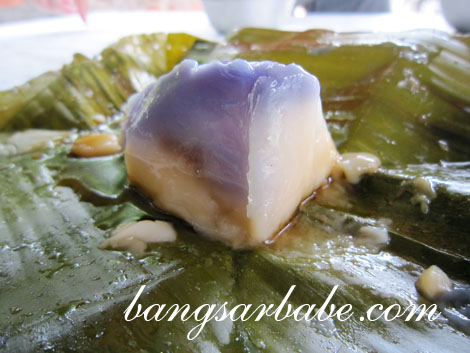
KUIH BONGKONG
The onde-onde is warm and The Gula Melaka filling oozes into your mouth. When you're here, ignore the diet and indulge in all the sweet delights delights available.
There' nothing like a good kuih with fresh ingredients.
COCONUT SHAKE
Coconut shake is the best thing created to combat the sweltering heat in Melaka. The coconut flesh is blended together with coconut water and some ices cubes and the special version come with a scoop of vanilla ice cream on top, The end result is a most refreshing, tropical concoction with a sweet and creamy after taste from the ice cream.
SOUP DUCK NOODLES
Soon Yen along Jalan Tengkera is known for the Malacca-style Duck Noodles and you have a choice of soup and dry noodles.
the latter is tossed in a thick gravy and topped with shredded duck meat. This come with a small bowl of soup. The soup version is also decent.
KUIH BONGKONG
Its ihas a smooth and silky texture.
Almost like the texture of a bean curd.
THE BABA NYONYAS


DANCE

PORTUGUESE DANCE
The Baba Nyonyas
Peranakans are descended from Chinese migrants who first came to
Malacca many centuries ago. Adopting Malay customs and cultures, theirs
is a unique heritage unlike any other. Peranakans are also referred to a
'Straits Chinese'.
It is still a subject of debate whether the Peranakans actually
intermarried with the local Malay population or maintained a pure
bloodline, but most are said to be of Hokkien ancestry. 'Babas' refer to
male Peranakans while 'Nyonya' refer to females. Often Nyonya is used
to substitute the term 'Peranakan' as well. Peranakans also settled in
Penang, the only other state than Malacca.
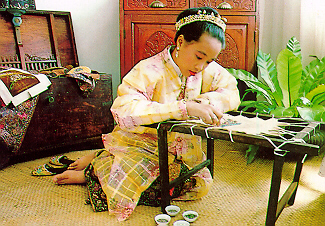
In terms of dressing, the women wear traditional Malay costumes, notably
the 'Baju Kebaya' a form of blouse woven with silk. Foot-binding, a
practice carried over from China, used to be common among the affluent
folk but over the centuries, it is no longer practised and for good
reason. Perhaps the Peranakan's most famous legacy is Nyonya food, a
fusion of Malay ingredients with Chinese cooking styles. Some of the
most popular dishes include 'Belacan', 'Assam Laksa', 'Cendol' and 'Kuih
Talam¡'.
The Portuguese
When the Portuguese conquered Malacca in 1511 and ruled for 130 years, a few stayed behind and formed a fishing community that has lasted till today. As devout Catholics, they celebrate various festivals dedicated to their religion which can be witnessed throughout the year in their settlement the Portuguese Square.
Over the years, the Portuguese intermarried with the local population and are now collectively referred to as Portuguese-Eurasian or 'Kristang', but they still maintain their traditional surnames such as 'Sequiera' and 'Lopez'. Usually, they speak a distinct language which is a Creole (fusion of two languages) based on Portuguese and Malay.
The Portuguese community in Malacca are a merry bunch, often celebrating with loud dances, music and song. Their most famous tune is the 'Jinggling Nyonya', a happy dance-song routine. They've also brought their food; 'Curry Debel¡' is among the most famous of their dishes.
In June, the Portuguese Suare becomes abuzz with activity as the villagers celebrate a feast in honour of their patron saint. It is truly a sight for visitors to behold and a great chance to get to know this special 3,000-odd group of people in Malay
|
Portuguese Dance
The history of Portuguese dance can be traced to the arrival of the merchants and soldiers in the 16th Century. The port of Malacca was crucial in the time of seafaring merchants, the spice trade and the silk trade. Many of the descendants of these merchants continue to live in Malacca retaining plenty of their own culture – food, religion, attire while simultaneously merging their some of their culture with those of the locals. The Portuguese settlements are still popular and inhabited by those with names like D Cruz, Lopez etc! Two of the most popular dances are the Branyo and Farapeirra. The Branyo Dance is mainly favoured by the older generation of the Portuguese descendants. The male dancers wear Western-like costume while the female dancers wear baju kebaya and batik (sarongMusical instruments used are only rebana and violin. The beat and rhythm of the dance is similar to 'joget' (the Malay dance arts). Meanwhile, Farapeira is for the youngsters. The dance is very cheerful and this resembles the cheerful life of the youngsters. It is performed by couples dressed in the costume of the traditional Portuguese descendants of Malacca. Modern musical instruments such as guitars and tambourines are used to make fast beats and rhythm. |
|
|
|
