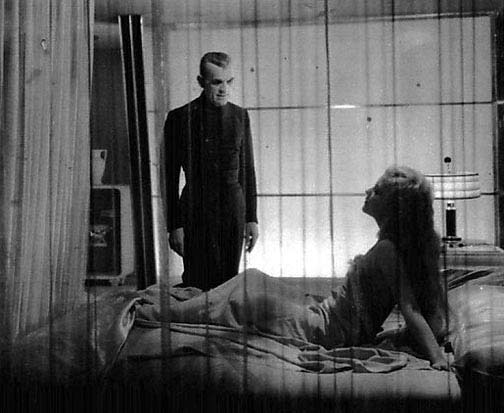
This page features brief reviews of the best movies featuring the great Boris Karloff. They are rated on a ten star sytem, with one star being worst and ten stars being best. (Since we're focusing here on the BEST of Boris Karloff, no ratings are less than Seven Stars. If you want to comment on any of the reviews featured here (or perhaps post a review of your own), please visit the messageboards and speak up.
All reviews and ratings are by Steve Miller. To see second (and third and fouth) opinions on the films featured here, or to purchase copies of the films, click on the Amazon.com links. (Purchases made through those links help fund the costs involved with maintaining this website.)
| Frankenstein
Year of Release: 1931 Steve's Rating: Seven of Ten Stars
Starring: Colin Clive, Boris Karloff, Mae Clark, Dwight Frye, and John Boles Henry Frankenstein (Clive), a true madman with dreams of "knowing what God felt like" when he created life, successfully animates a monster made from parts taken from several corpses. Unfortunately, abuse heaped on his creation by an idiot assistant (Frye) and Frankenstein's own missteps causes the creature (Karloff) to go bezerk and flee into the countryside. Soon, Frankenstein's creature comes back to haunt him and those he cares about. "Frankenstein" is one of the great monster movies that started the horror genre, so I feel a bit awkward about not liking it more than I do. I feel like I should be giving it a rating of 8 or 9, but all I feel it deserves is a low 7. That is not to say that the film doesn't have some great moments. Boris Karloff gives a great performance as the creature who is clearly yearning for the sort of comforts every human being wants, but receives nothing but abuse. It's truly the only film portrayal of the Monster that made me feel sorry for it. The sets are also spectacular, the lighting and camerawork fantastic, and all the actors give excellent performances (but Karloff truly excels). Where the film doesn't work for me is on the level of script and character interaction. I find it impossible to believe that Frankenstein's fiance Elizabeth (Clark) would want to go with a walk in the park with Frankenstein after the raw, total madness she witnessed when he brought his creature to life,and I find it even harder to believe that their mutual friend Victor (Boles) wouldn't be doing everything in his power to keep her from the marriage. I understand that horror movies Back In The Day tended to move rather swiftly along as far as characters go, but the lack of reaction to Henry's insanity really ruined the entire picture for me. I think this movie is a must-see for anyone who considers themselves a film-buff or a fan of the horror genre, as it (along with "Dracula" and "White Zombie" set many of the ground-rules for horror films that persist to this day. However, as gorgeous a film as it to look at, as great as all the actors are, it suffers from some major story issues that may get in the way of your enjoyment.
|
|
| The Mummy
Year of Release: 1932 Steve's Rating: Eight of Ten Stars Starring: Boris Karloff, Zita Johann, David Manners, and Edward Van Sloan After an archeologist accidentally restores him to life, a cursed ancient Egyptian high priest Imhotep (Karloff) sets about likewise reviving Princess Anckesen-Amon for whom he gave up everything so they can resume their forbidden love. Unfortunately, she has been reincarnated, and her spirit is currently residing within Helen Grosvenor (Johann), the daughter of a British diplomat. Imhotep hasn't let the natural order of things stop him in the past, and he's not about to let it get in his way now. "The Mummy" is perhaps the best, most intelligent mummy movie ever made. It's more of a gothic romance story set in Egyptian surroundings than a monster movie, with Imphotep trying to recapture a love that he lost 3,700 years ago. The actors in this film are all perfectly cast, and they are all at the top of their game. Karloff is spectacular, conveying evil, alieness, majesty, and even a little bit of tragedy in his character with a minimum of movement. (Unlike most mummy movies, Imhotep isn't a bandage-wrapped, shambling creature, but instead appears like a normal human being; he is still dried-out and somewhat fragile physically, though, and Karloff does a fantastic job at conveying this.) Johann likewise gives a spectacular performance, particularly toward the end of the movie as Imhotep is preparing to make her his eternal bride, and she has regained much of her memories from when she Anckesen-Amon. Johann is also just great to look at. The two remaining stars, Manners and Van Sloan, are better here than anything else I've seen them in. Manners in particular gives a fine performance, rising well above the usual milquetoast, Generic Handsome Hero he usually seems to be. (Even in "Dracula" he comes across as dull. Not so here.) The cinematography is excellent and the lighting is masterfully done in each scene. Karloff's character is twice as spooky in several scenes due to some almost subliminal effects caused by lighting changes from a medium shot of Manners to a close-up of Karloff... and the scene where Imhotep is going to forcibly turn Helen Grosvener into an undead like himself is made even more dramatic by the shadows playing on the wall behind the two characters. There are some parts of the film that are muddled, partly due to scenes that were cut from the final release verson, or never filmed. Worst of these is when Imhotep is interrupted during his first attempt at reviving Anckesen-Amon, and he kills a security guard with magic during his escape. However, he leaves behind the spell scroll that he needs for the ritual. Why did he do that? It's a jarring, nonsensical part of the movie that seems to serve no purpose other than to bring Imhotep into direct confrontation with the heroes. (The commentary track sheds light on what the INTENTION was with that devolpment, but it just seems sloppy and badly conceived when watching the movie. And I'm knocking a full Star off because it is such a badly executed story element.) While "The Mummy" may seem a bit slow to people who are used to Brandon Fraser dodging monsters--or even the Hammer Films mummy movies--it is a film that every cinema buff should see. |
|
| The Black Cat (aka "The House of Doom" and "The Vanishing Body") Year of Release: 1934 Steve's Rating: Eight of Ten Stars
Starring: Bela Lugosi, David Manners, Boris Karloff, and Jacqueline Wells Honeymooners Peter and Joan Allison (Manners and Wells) are stranded in an isolated house in a Hungarian backwater. Here, they become drawn into the evil Satanist Hjaldmar Poelzig (Karloff) and the revenge-plans of his one-time friend Dr. Vitus Werdegast (Lugosi). As the story unfolds, the depth of Poelzig's evil and perversion is revealed in its fullest, and it seems there will be no escape for anyone. "The Black Cat" is a stylish, incredibly creepy B-movie. It takes place almost entirely within a house built upon the site of a ruined WWI fortress, with the lower levels being the decaying remains of the original structure and the upper floors consisting of a sleek, ultra-modern home. Both sections of the structure lend to the tone of dread that permeates the entire film--with the well-lit, clean rooms of the upper levels of Poelzig's home being even creepier than that the shadow-haunted lower levels thanks to some fine camera work--although the revelation of Poelzig's "exhibit" of beautiful women below has got to be the most terrifying moment of the film. (In fact, I'm hard-pressed to think of a more evil and perverted character present anywhere in these classic horror films than Poelzig: Satanism, treachery, mass-murder, pedophelia... you name it, Poelzig's done it/is into it. (Karloff doesn't have a lot to do acting-wise, other than to just be sinister... but, boy, does he do that in spades here!) Perhaps the most interesting aspect of this film is Lugosi. First, those who watch "The Black Cat" will get to see that he was, in fact, a great actor at one time. The pain Dr. Werdegast feels when he is told his wife and daughter died while he languished in a Russian prison is conveyed with incredible strength, as is the mixture of pain and rage when he later learns the truth about their fates, as he and the Allisons manage to seize the initiative from Poelzig and his cultists. Second, it's interesting to see Lugosi playing a hero for once, even if a deeply flawed hero. On a quirky note, I often complain that horror movies from 30s through the 60s and early 70s often just end: The story resolves and the credits roll without providing the audience with the nicety of a denoument. "The Black Cat" DOES provide what I wish more films would, yet here I almost wish that last minute or so hadn't been included. This is a film that probably should have ended while still in darkness. While "The Black Cat" has absolutely nothing to do with the Poe tale that "suggested" it--it's got more in common with "The Fall of the House of Usher", I'd say--I think it represents a high point of the horror films that Universal was making in the 30s. I don't see it mentioned often, and I think it's a shame. It's a film that's worth seeing. |
|
| The Raven
Year of Release: 1935 Steve's Rating: Seven of Ten Stars
Starring: Bela Lugosi, Boris Karloff, and Irene Ware
After saving young dancer Jean Thatcher (Ware) from certain death through a miraculous feat of neurosurgery, the mentally unstable Dr. Vollin (Lugosi) becomes obsessed with her. When her powerful father makes it clear that Vollin is to stay away from her, Vollin forces a wanted murderer (Karloff) into assisting him in eliminating Jean, her fiance, and her father in hideous death-traps modeled after gruesome scenes from the writing of Edgar Allen Poe. "The Raven" isn't really an adaptation of the Poe story by that name, but is instead the tale of a thoroughly evil and utterly insane man so rich and so obssessed that he's built a house full of secret doors, secret basements, and entire rooms that serve as elevators... all so he can reinact scenes from Poe's writings. There is plenty of potential in this B-movie, but tepid direction and mostly uninspired lighting and set design leave most of it unrealized. Lugosi is completely over the top in this film, taking center stage as the perfect image of a raving madman. He is ably supported by co-star Karloff who plays the role of the tortured, remorsef-illed murderer trapped into serving Vollin with the promise of a new life in the exact opposite direction of Lugosi--remaining subdued as he slinks through each scene he's in. Ware is very attractive in the scenes she's in, but that's about all she is. In fact, the only actors in the film who aren't just so much set decoration are Lugosi and Karloff. The "torture room" is nifty, and the climax where Dr. Vollin has houseguests trapped in a Poe-world of his making is excellent. All in all, an entertaining film, but it would have been much better with a more inspired supporting cast and more creativity on the technical side of the camera. |
|
| Bride of Frankenstein
Year of Release: 1935 Steve's Rating: Eight of Ten Stars
Starring: Boris Karloff, Colin Clive, Valerie Hobson, Ernest Thesiger, and Elsa Lanchester
As monster-maker Henry Frankenstein (Clive) is recovering from the near-fatal injuries he received at the hands of his monstrous creation, he is approached by the sinister Dr. Pretorius (Thesiger). Pretorius is a mad scientist, who, like Frankenstein, is obsessed with creating life. He has allied with Frankestein's creation (Karloff) in order to force Frankenstein to create a mate for it, so that Pretorius may learn Frankenstein's techniques. Frankenstein must create this other creature, or his own wife (Hobson) will be killed. Although "Bride of Frankenstein" is presented as a direct sequel to the 1932 film "Frankenstein", it is somewhat divorced from that movie. First off, it's set up like a fictional story being told by Mary Shelley (Lanchester). Second, the film has a higher comedy element than the original. Third, a number of characters are somewhat different than they were in the first film, with Frankenstein being less of a complete lunatic--and who actually wants to give up the whole monster-making gig, until Pretorius and Frakenstein's Monster force him to make a mate for the original creation; and Frankenstein's Monster, who has grown in intellect while wandering injured in the wilderness. What remains the same, however, is the tragic quality of the Frankenstein's monster. While the monster commits acts of genuine evil--where in "Frankenstein", he was mostly acting out of ignorance or self-defense--these are balanced by the presentation of the monster as a deeply lonely, unhappy creature who has no place in, purpose in, or connection with God's creation. The fundementally tragic nature of Frankenstein's creation, and the fact that the most evil actors in the story are Frankenstein and Pretorius, has never been driven home in any other Frankestein film than in the final ten minutes of "Bride of Frankenstein." I also think that final reel is also one of the greatest horror movie sequences to ever appear on screen. "Bride of Frankenstein" is also remarkable for the amazing sets and camera work. The fantastic use of lighting and quick cuts, and the twisted angles in the buildings serve to underscore both the horror and some of the scenes of absurd humor in the film. |
|
| The Black Room
Year of Release: 1935 Steve's Rating: Eight of Ten Stars
Starring: Boris Karloff, Thurston Hall, Marian Marsh, and Robert Allen The much-hated, psychopathic Baron Gregor de Bergmann (Karloff) summons his respected, kindhearted twin brother Anton (also Karloff) back to their ancenstral lands following Anton's ten-year absence. Gregor announces that he intends to step down and elevate Anton to the position of Baron, thus restoring faith in the noble family... and hopefully avoiding a prophecy that stated Anton would someday murder Gregor. However, the evil twin has ulterior motives, including designs on the innocent noble-woman Thea (Marsh). A period melodrama that has some fairly shocking twists and turns for a film made in 1935, "The Black Room" is a stylish, well-acted and well-filmed movie with impressive sets and costumes. Karloff in particular shines in the dual role of twin brothers--one good and one evil--and his performance is particularly impressive when one takes to impersonating the other, and he switches between the two characters. If you enjoy the Roger Corman-produced/directed Poe adapations from the 1960s, you'll love "The Black Room." Although rarely mentioned, it's definately one of the best films Boris Karloff appeared in, and it features one of his best performances, so it's a Must See for Karloff fans. |
|
| Mr. Wong, Detective
Year of Release: 1938 Steve's Rating: Eight of Ten Stars
Starring: Boris Karloff, Grant Withers, John St. Polis, Maxine Jennings, Lucien Prival, and Evelyn Brent
When business magnate Simon Dayton is found dead inside his locked office moments after police detective Sam Street (Withers) saw him standing at the window, reknowned private James Lee Wong (Karloff) joins forces with the homicide squad to interpert the only clues found at the scene--tiny fragments of delicate glass. When Dayton's business partners start dying under equally mysterious circumstances, and sinister agents of foreign powers start appearing in the shadows, Wong and Street have to race against time to prevent more murders, including, possibly, their own. "Mr. Wong, Detective" is a fast-paced, well-scripted complex mystery with lots of twists, turns, and misdirections. The array of suspects and the way suspicion moves on and off them, the way motives come into focus and blur again, the clever way the murder weapon is triggered, and the way Wong ultimately unmasks the very clever murderer, all add up to a mystery movie that deserves more attention than it gets. Another element that adds to the film's quality is the acting. Boris Karloff is excellent as Wong, playing a more subdued and refined character than in just about any other role he played before or after, with Wong's sarcastic, stereortypical "oriental politeness" in the face of the bad guys adding flavor to the character and comedy to the film. Grant Withers as Street is likewise excellent in his part, shining particularly brightly in the scenes with Maxine Jennings, who brings effective comic relief to the picture as his feisty girlfriend, Myra. The supporting cast and co-stars also all turn in top-quality performances. "Mr. Wong, Detective" is a film well worth the time a fan of 1930s mysteries should devote to watching it. |
|
| British Intelligence (aka "Enemy Agent") Year of Release: 1940 Steve's Rating: Seven of Ten Stars
Starring: Margaret Lindsay, Boris Karloff, and Holmes Herbert It's World War I. The German high command dispatches the beautiful master-spy Helene (Lindsay) to London to support an operation managed by legendary German agent Strengler--the infiltration of the very highest levels of the British war ministry. By posing as a French refugee, she is taken into the home of newly appointed minister, Arthur Bennett (Herbert). Here, she is intergrated into a complex web of spies who report Bennett's every move and every top secret government dealing back to Berlin... the milkman, Bennett's secretary, and even Bennett's butler (Karloff) are all German spies! But British Intelligence have recognized something is amiss with the Bennett household, and they've got an operation of their own going. There is a double-agent in the German spy ring. "British Intelligence" is a nice little spy movie with healthy doses of World War II propaganda. Despite its outdated political messages, the film is still fun to watch today for anyone who enjoys spy movies. The film consists of a steady stream of plot twists and turns as British and German agents and double-agents try to trap and outwit each other. The film is well directed, with fine acting, great lighting and camera work, and no padding whatsoever. The final chase scene through the streets of London as it is being bombed by German zeppelins is very tense and expertly executed. On the downside, the film starts to feel a little like a "Spy Vs. Spy" cartoon (from the old "MAD Magazine") toward the end, and the ending that I'm sure must have seemed ironic or poetic to viewers in the 1940s feels EXACTLY like the end of a "Spy Vs. Spy" cartoon. Nonetheless, "British Intelligence" held my interest until the end, and it's a nice little time capsule featuring a tight story and fine performances. It's a dated film that's still worth seeing today. |
|
| Lured
(aka "Personal Column") Year of Release: 1947 Steve's Rating: Seven of Ten Stars
Starring: Lucille Ball, Charles Coburn, George Sanders, George Zucco, Cedrick Hardwicke, and Boris Karloff Scotland Yard's Inspector Temple (Coburn) hires sharp-eyed, sharp-witted, and sharp-tongued down-and-out American actress Sandra Carpenter (Ball) to serve as a lure for a serial killer who has been prowling through London's shadows, murdering young women he contacts through personal ads. With her Scotland Yard "guardian angel" Barrett (Zucco) watching over her, she undertakes the dangerous task of drawing out the insane killer. "Lured" is a well-done, light-touch police procedural thriller (with touches of romance and melodrama along the way) that features an all-star cast of 1940s B-movie actors (and a respected stage actor thrown in for good measure), all of whom deliver great performances. The dialogue is snappy, the tense moments geniuinely tense, the funny moments genuinely funny, and the many red herrings tasty. (Boris Karloff's character serves as the oddest and funniest fish of them all--and it's not a spoiler to say that he isn't the serial killer. Yes, it's the sort of part he often plays, but not here, and it will be obvious to viewers almost immediately.) I think this is a film that will be enjoyed by anyone who likes classic mystery movies. I also think that fans of Lucille Ball will enjoy seeing her in her pre-screwball comedy days. (Speaking of comedy, George Zucco's scenes with Ball are always amusing, as Sandra repeatedly inadvertantly helps Barrett solve the crossword puzzles he's constantly working on with stray comments.) All in all, "Lured" is an enjoyable film that's worth seeking out.
| |
| Abbott and Costello Meet the Killer (aka Bud Abbott & Lou Costello Meet the Killer, Boris Karloff) Year of Release: 1949 Steve's Rating: Seven of Ten Stars
Starring: Bud Abbott, Lou Costello, Boris Karloff and Lénore Aubert When Freddy (Costello), a dim-witted but harmless bellhop, is suspected of murdering a high-powered attorney, the arrogant hotel detective at the Lost Cavern Hotel, Casey (Abbott) decides to help him clear his name by prove that one of the other guests--many of whom were about to be ruined by the tell-all memoirs the attorney was about to publish. As evidence against Freddy starts to plie up (along with more bodies), a mysterious masked figure targets him for death as well... and wacky hi-jinx ensue. "Abbott and Costello Meet the Killer" is a fast-paced, hilarious comedy that mixes the Bud and Lou's fast patter with a who-dunnit spoof. There are plenty of sinister suspects (with Boris Karloff leading the pack as a murderous swami), but the mystery isn't truly over until the final punchline (which is, literally, a punch line in this film). Although the mystery elements of the script are weakened by virtue of having too many red-herring suspects, so virtually none of them are given any real development or screentime (with Karloff and Aubert being the only exeptions), the comedy aspects of the film are grand. The sequence where it's proven that some people truly are too dumb to die, and Freddy whiling away the time while waiting for the killer to arrive in the caverns from which the hotel draws its name, are priceless. If you've enjoyed other Abbott and Costello films, I think you'll like this one, too. |
|
| The Comedy of Terrors
(aka "The Graveside Story") Year of Release: 1964 Steve's Rating: Nine of Ten Stars
Starring: Vincent Price, Peter Lorre, Boris Karloff, Basil Rathbone, Barbara Nichols, and Joyce Jameson When threatened with eviction by his cold-hearted landlord John Black (Rathbone), undertaker Waldo Trumbull (Price) decides it's time to work on actively expanding the funeral home's business... by sneaking into the bedrooms of wealthy old men, smothering them in their sleep, and then being onhand with his assisant (Lorre) to make the funeral arrangements. Eventually, Trumbull decides to end his rent problems once and for all by making Black his next "client", but things go awry when Black won't stay dead even when laid out at his own burial service "A Comedy of Terrors" is a hilarious horror movie spoof where a collection of dramatic and horror greats get to show off their talent for comedy and screwball antics. It's even more fun to watch the actors like Price (who plays a scarcastic, mean-spirited boozehound as oppsed to his usual suave character), Karloff (who plays a senile fool), Lorre (who gets to be the love interest!), and Rathbone (who is great as the sword-fighting, never-stay-dead landlord) do characters who are either totally different from what they usually play and/or wildly and hilariously over the top. The film drags a little bit when the gags surrounding Rathbone's character get a little repeative, but the spectacular performances of its four great stars and the swift-running patter of Richard Matheson's breezy script still keep the energy high and the laughs coming. I think this film is a must-see for fans of its stars and for lovers of horror comedies. |
|
| Targets
Year of Release: 1968 Steve's Rating: Nine of Ten Stars Starring: Boris Karloff, Tim O'Kelly, Nancy Hsueh, and Peter Bogdanovich Director: Peter Bogdanovich As Byron Orlok, an aging horror movie star (Karloff),prepares to retire from filmmaking, a seemingly average young man, Bobby (O'Kelly), embarks on a murderous killing spree. The creator of make-believe monsters and the real-life monster come face to face when Bobby's day of terror culminates with a sniper rampage at the drive-in where Orlok is making his final public appearance. In "Targets", Bogdanovich expertly interweaves two storylines that only really connect in a single scene at the film's climax. In the process, he manages to build a tremendous amount of tension, because we come to like and care about Orlock, his secretary (Hsueh), and the young writer/director (Bogdanovich) who is trying to convince him to make at least one last movie--his movie. The audience can see that these three characters are going to walk head-long into Bobby's gun-sights, and Bogdanovich establishes that he is a good shot. Although the entire film is perfectly paced, well-acted--with Karloff in particular shining, despite his health being poor at the time--and looks far better than the shoe-string budget it was shot on should allow, it's the scene where the two stories finally completely merge, with Orlok and Bobby confronting each other that really makes the movie for me. This is a film that's definately worth seeing for fans for suspense and horror movies and admirers of Boris Karloff. If you pick up the "Widescreen Collection" DVD edition of the film (available for a song at Amazon.com), make sure you watch the interview with Bogdanovich... it gives some fascinating insights into how the movie came to be. (The commentary track is also full of interesting facts about the making of the film.) |
|