|
Overview
IF YOU AREN’T MANAGING RISKS, YOU SHOULD BE
The issue of information security sees organisations of
all sizes and from all sectors, with an identical
problem – their inherent vulnerability.
No
matter how secure and well protected an organisation
appears to be, sensitive information can be leaked
without you even realizing until it’s too late. All
information in all departments, whether on computer
disk, paper or in the heads of those you employ, is at
risk from any number of very real threats. Information
security is no longer just an issue for IT managers –
a single breach of information security could cost your
company hard earned profits whilst
doing irreparable damage to your image and reputation.
Your capacity to trade profitably depends on your
ability to manage this risk effectively.
As
the number of reported information security breaches
consistently increases, the need to create a management
framework for information security intensifies. An
Information Security Management System (ISMS) – BS
7799-2:2002. The International Standards organisation
document ISO/IEC 17799 provides guidance on the use of
the control identified in Annex A of BS 7799-2:2002,
will provide a well- proven framework to initiate,
implement, maintain and manage information security
within any organisation. Once you start using BS
7799-2:2002 as a basis for your ISMS, your management
system can be audited and registered by a third party.
This process adds significant value to the ongoing
effectiveness of the system.
What is
Information Security BS 7799?
An
enabling mechanism An enabling mechanism whose
application ensures that information may be shared
shared in a manner that ensures the appropriate
protection of the information & associated
information assets.
Aim
-
Build
on a Common Basis for Organisational Security
Standards Development
-
Enhance
Security Management Practice
-
Increase
Confidence and Trust in Inter-Organisational
Dealings
OHSAS
18001 does not state specific OH&S performance
criteria, nor does it give detailed specifications for
the design of a management system. OHSAS 18001 is not a
legislative requirement or a guide to implementation.
Threats
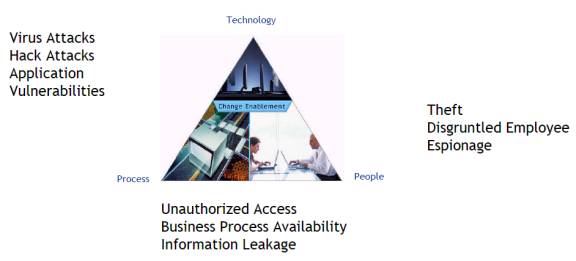
Parameters
of Information Security
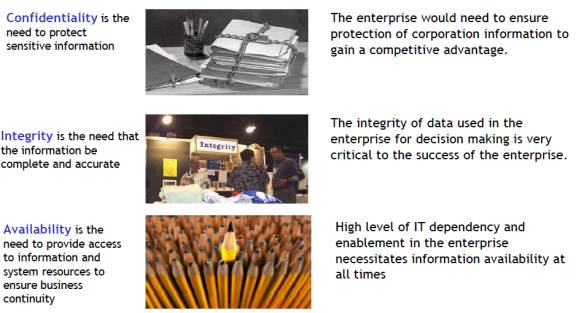
Components
of Information Security
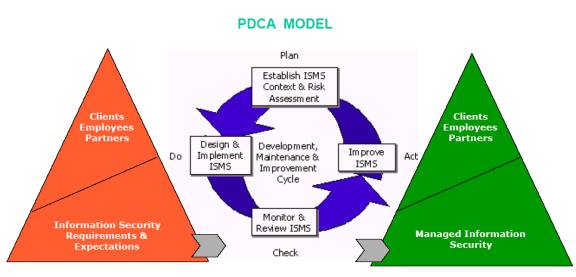
BS7799
Cycle and stakeholders
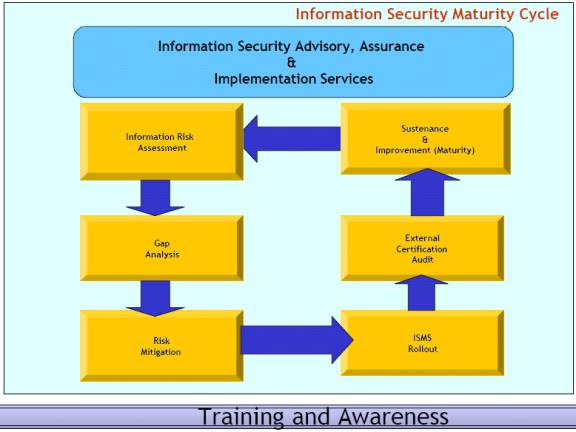
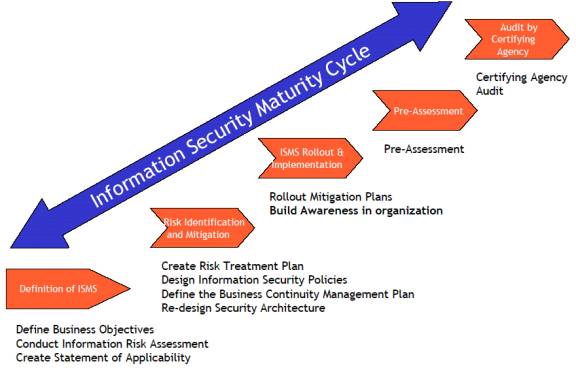
Roadmap
to certification
Features
& Benefits
Due
to the all encompassing nature of BS 7799-2:2002 and the
code of practice, we have highlighted the key areas you
would have to address when using the BS 7799-2:2002
Information Security Management System:
-
Security
policy –
A document to demonstrate management support and
commitment to the Information Security Management
System process.
-
Security
organisation –
An established management framework to initiate and
control the implementation of information security
within your organisation and to manage ongoing
information security provision.
-
Asset
classification and control –
A comprehensive inventory of assets with
responsibility assigned to ensure that effective
security protection is maintained.
-
Personnel
security –
Well defined job descriptions for all staff
outlining security roles and responsibilities.
-
Physical
and environmental security –
A clear and concise definition of the security
requirements for your premises and the people within
them.
-
Communications
and operations management –
Optimise your communication to facilitate smooth
operation of the Information Security Management
System.
-
Access
control –
Network management to ensure that only those with
the appropriate responsibility have access to
information in the networks and the protection of
the supporting infrastructure.
-
Systems
development and maintenance –
Ensuring that IT projects and support activities are
conducted in a secure manner through data control
and encryption where necessary.
-
Business
continuity management –
A managed process for developing and maintaining
business contingency plans, which protect critical
business, processes from major disasters or
failures.
-
Compliance
–
A demonstration to clients, employees, and the
authorities of your commitment to meet statutory or
regulatory information security requirements.
If
this exercise has highlighted areas that need more work,
or you have any queries regarding the issues raised,
please contact NUCLEUS on 09382834534
For
more information - just contact us [email protected]
|