Carey's Bible Study Notes
home |
theological studies |
why christianity is true
theological studies
a reason to believe: why christianity is true
introduction
Normally when we say we believe that Christianity is true, we say it is because the Bible tells us so! Our mamas brought us up believing the Bible and that�s good enough for us. For 95% of us, that alone will do; however, many of us are now encountering a society that no longer claims to be Christian. Instead, many in our society claim to be Hindu, Muslim, or Buddhist. What happens when you encounter one from another faith and they claim that their mamas told them that the Koran is true but the Bible is wrong. What makes the Bible right and the other religions� scriptures wrong? Just because my mama told me the Bible is God�s Word does not make it right. Whereas the Bible is God�s Word and is extremely important in this discussion, the way the Bible addresses our issue is ultimately what matters in this discussion.
Before we look at the truth of the resurrection and of Christianity, we need to make some preliminary remarks. First, there is no question that Jesus lived and that He died on the cross. The first Christians were Jews. A Jew would have never come up with a Savior who died on the cross. This idea of a Messiah who saved His people by dying on the cross ran completely against everything the Jews thought the Messiah would be like (all you have to do is read the gospels to see this). The disciples never believed Jesus would be that kind of Messiah until after He actually did die and rise from the dead. Even Jews today are adamant that the Messiah will only come as a conquering hero and claim that Jesus could not be the Messiah because He died an ignominious death on the cross. Because the early believers who claimed that their Messiah died on the cross were Jewish, you can bank on it that Jesus did live and did die on a cross.
Second, there are no serious questions from the time of Jesus that He performed spectacular feats. Jewish writings and Christian writings after the time of the apostles (for example, Justin Martyr�s Dialogue with Trypho the Jew) never questioned once that Jesus performed spectacular feats. No one questioned these because Jesus performed these feats in public, for example, the feeding of the 5000 occurred in the presence of at least 15,000 people (see Peter�s sermon to Cornelius; Acts 10:37). The question though is whether these spectacular feats were miracles, works of magic, or works of the devil? The standard Jewish response was that they were either works of Satan or works of magic. The fact that the Jews claimed that they were works of magic or works of Satan prove that Jesus performed spectacular feats.
evidence for the resurrection
In order to prove that Christianity is true, one must prove that the resurrection of Jesus Christ is a real event in history. Everything hinges on the resurrection. If the resurrection of Christ really occurred as the Bible claims, then Christianity is true. If it did not occur, then Christianity is false. It has produced some wonderful ethical teachings; however, like B.F. has said many times, if the resurrection did not occur, then these ethical teachings come from either a liar, lunatic, or demon from hell, not from God the Son and not from a good moral teacher.
significance of the resurrection
The first major significant thing about the resurrection is that is it an act that only God could do. Of all the people who have lived on the earth, only 2 have escaped death: Enoch and Elijah. All others have died. Death has an absolute lock on the human race. Recently, scientists have patted themselves on the back because by cloning a sheep, they claim to have created life. First, they did not create life, they cloned it. Second, after the second sheep was produced named Dolly, they discovered that although she had been alive for only a few days, her body was as old as the donor sheep. The scientists had not cloned life; they had actually cloned death. Death is absolute. That is until the resurrection of Jesus Christ. By resurrection, we mean that radical transformation of Jesus� body so that it is immortal and primarily spiritual. Only God could perform such a deed.
Next, the resurrection of Christ affirms His deity, that is, that He is God. Jesus made startling claims for Himself, that He was God the Son. He proved it by rising from the dead. Jesus combines both of these thoughts in John 8:28: "When you lift up the Son of Man, then you will know that I Am!" There are 2 significant parts to this verse. The words "lift up" in the Gospel of John refer to (1) Jesus� being lifted upon the cross, (2) His being lifted up from the grave, and (3) being lifted up to the right hand of the Father. The words "I Am" remind us of the name of God. When Moses asks God what His name is so that the people will believe God sent him, God responds that His name is I Am. By combining these 2 thoughts, Jesus is saying, "When I am raised from the dead, all will know that I am God." The resurrection affirms the deity of Christ.
Finally, the resurrection also affirms the Trinity. When I ask the children at TeamKids how many gods are there, they reply, "One!" When I ask them how many persons that God exists as, they reply, "Three! God the Father, God the Son, and God the Holy Spirit." One God who exists as three persons is the definition of the Trinity. By His resurrection, Jesus proves He is God; however, He never claimed to be God the Father. In fact, He prayed to the Father and also spoke of the Spirit. He was as much God as the other 2, and yet He was God the Son.
the source of the resurrection, jewish christians, argues for its authenticity
The fact that the earliest believers and proclaimers of the resurrection were Jews argues for the truth of the resurrection. The Jews simply never would have concocted a story that God would become a Man, die on the cross, and rise from the dead; the Greeks maybe, the Jews never! When I was in Israel March, 2000, our Jewish guide would every now and then launch a few bombs at Christianity. I let them slide by because I don�t think our people knew what she was doing. She went too far though when we on the Via Dolorosa. There on one of the most holiest sites in all Christianity, she gave the Jewish version of the trial and crucifixion of Christ. It totally contradicted the Gospels. She then turned to me and asked me to respond. She did not like my response. I had kept quiet during her presentation; however, when I started talking, she repeatedly interrupted me. When I would respond again to her objections, she would object some more. Finally, she blew up: "I knew I should have never brought this up in the first place!" All the veneer of politeness was stripped away, and beneath that veneer was rage and hostility against Christianity and Christ. The incarnation, death and resurrection of God are abhorrent to the Jewish mindset. The Jews have not changed either. It was abhorrent to those Jews living in Jesus� day, even to the first disciples, and it is abhorrent to them today. Never would they believe God would do such a thing UNTIL He actually did it. The only thing that could change the mind of these early Jewish followers of Jesus was that He actually did rise form the dead.
How far were these early Jewish followers of Jesus prepared to go with their claim that Jesus rose from the dead? The Jews who opposed Christianity claimed that Christianity contradicts the OT. Peter in what seems to be a startling admission claims that if the resurrection contradicted the OT, then he would choose the resurrection over the OT, so compelling was the evidence for the resurrection. Fortunately though, Peter claimed that instead of contradicting the OT, the resurrection confirmed the OT. According to Peter, we know the OT is God�s Word because the resurrection confirmed it (2 Pet. 1:19). Moreover, Peter and the rest of the NT writers claim that they did not contradict the OT; instead what they contradicted was the Jewish interpretation of the OT. In many ways, the NT is a fresh and proper interpretation of the OT. That is the reason the NT writers quote the OT so much; they want to give the proper interpretation to the OT.
Finally, the Jews and Jesus� Jewish followers were so convinced that Jesus was not God and that He would not rise from the dead, that even when they heard Jesus� predictions about His resurrection and they saw an empty tomb, they did not believe Jesus rose from the dead. Instead they thought that somebody had stolen Jesus� body. The only thing that convinced them that Jesus rose from the dead was their actual encounter with the risen Jesus. Of all the followers of Jesus, only John, the disciple who loved Jesus, realized that He had risen from the dead. Even then, it was not the empty tomb which convinced him but the grave clothes which He left behind and the position of those grave clothes which convinced him Jesus had risen.
resurrection appearances
Another fact which argues for the truth of the resurrection is that the stories of the resurrection claim that women were the first to encounter the risen Jesus. According to all 4 gospels, Jesus did not first appear to men but to women. This is significant because women were held in low esteem by Jewish society. Their testimony was so suspect that they were not allowed to be admitted as witnesses in a court of law. Not only that, the main woman who encountered Jesus Mary Magdalene had once been demon-possessed. If a normal woman�s testimony was not credible, how much less was hers? If gospel writers were going to concoct the stories about the resurrection, they would have never claimed that women were the first to encounter Jesus; they would have claimed that men were the first witnesses. In fact when Paul lists the witnesses of the resurrection in 1 Cor. 15:5-8 (around 57 AD), he does not mention any women, only men. When the gospel writers though started putting down in ink the stories of the resurrection, they were faced with a dilemma. Would they list men as the first witnesses even though they had not been in order to make their stories more credible, or would they tell the truth and admit that women were the first to encounter Jesus? They knew that if they were going to be true to history, then they were going to have to mention the fact that Jesus appeared to women first. Paul was just making a list; therefore, he could leave out women. The gospel writers though were writing history and if they were going to be factual in their accounts, they were going to have to mention the women. The fact that the gospel writers claim that women were the first witnesses attests to the truth of the story. Moreover, the fact that all four gospel writers claim women beheld the risen Jesus first points to the fact they are telling the truth.
Also, note that the resurrection appearance were not to just one person. Mormonism is based upon one man�s experience. The same is true with Islam. Mohammed alone claims to have had an encounter with the angel Gabriel, and hundreds of millions of people follow him today. That is frightening. On the other hand, Christianity is based upon the experience of hundreds of people. Paul gives us the official list (1 Cor. 15:5-8): Cephas (Peter), the 12, James, all the apostles, 500 brethren at one time, and lastly Paul.
Moreover, suppose the NT had been written by only one person who claimed that all these people saw the resurrected Jesus. The writings of one man would be questionable evidence for such a religion. For example, one of the problems with Mormonism and Islam is that their sacred books were written only by one person, Joseph Smith and Mohammed respectively. On the other hand, the NT was written by 9 separate authors, each claiming either to seen the resurrected Christ or else to know someone who did. Moreover, they were able to point people to other witnesses of the resurrection.
Finally, we have records not only from the Bible but also from other writings that these people who claim to have met the risen Lord believed so much they had met Him that they were willing to die for what they claimed to be true. James the brother of John was put to death by Herod Agrippa I in Jerusalem; Peter was crucified upside down in Rome; the apostle Thomas was boiled in oil in India; the apostle Mark was dragged through the streets of Alexandria, Egypt until dead; and the apostle Paul was beheaded in Rome for his faith. It�s one thing to say something is true and quite another to die for it. You die for the truth, not for a fable.
Moreover, not one of those who met the risen Jesus broke ranks with their faith. You would think that of the 500+ people who claimed they saw Jesus, at least one of them would have broken ranks and claimed that it was all false when they were faced with persecution. That probably would have happened if the resurrection had been a fable all along. The fact they did not break ranks but died for what they claimed to be true points to its historicity.
empty tomb
Next, the fact that the tomb is empty points to the resurrection of Jesus. Now the empty tomb does not prove Jesus rose from the dead; however, if Jesus rose from the dead, then the tomb must be empty. The only kind of resurrection the Bible knows about is bodily resurrection. In order for Jesus to be rise from the dead like the OT said He would, it was necessary that He rise bodily from the dead. Well, the tomb was empty. If it was not, then all the Jewish religious leaders had to do was take everybody to the tomb and show them the body.
The view that the disciples would steal the tomb is absurd. First, the Jewish religious leaders made sure that this is exactly what would not happen. They understood Jesus� predictions about His resurrection better than His own disciples did; therefore, they took extra precautions to make sure that this did not happen. In addition to this, if the disciples had stolen the body, the Roman soldiers would have been executed for failing in their duty (the very thing which happened to the soldiers who were guarding Peter when the angel miraculously released him�Acts 12:19. The fact that they were not executed proves the disciples did not overwhelm the soldiers and steal the body). Moreover, the tomb was closed with a stone which would have taken much effort and time to move, plenty of enough time for the Roman soldiers to call for reinforcements. Moreover, to claim the frightened disciples would have done such a thing is an insult both to the Roman soldiers and to our intelligence as well. Also, the Jewish religious leaders had such a network in Jerusalem that even if the disciples had been able to overwhelm the guards, the Jews would have been able to discover where they had hidden the body. Next, the disciples had nothing to gain by stealing the body and claiming that it rose from the dead other than persecution and death. That simply does not compute logically. To believe the disciples stole the body, concocted the story of the resurrection, and then died for that story requires greater faith than the story of the resurrection itself.
The charge that the disciples went to the wrong tomb is ridiculous also. The Jewish religious leaders knew where the tomb was and could easily have put an end to the spread of Christianity by simply taking everybody to the occupied tomb in order to prove that He had not risen from the dead. Instead of taking everybody to the tomb though, the Jewish religious leaders tried to suppress the new religion by persecuting the Jewish Christians. Taking everybody to the occupied tomb would have been the logical way to suppress Christianity if Jesus had really not risen from the dead; persecuting Christians is the logical way to suppress Christianity if Jesus rose from the dead. (Why did they want to suppress Christianity if it was true? Because it threatened their position of power; something many men will die and kill for).
conversion of paul
Why does the conversion of Paul especially point to the truth of the resurrection? Before Paul, most believers were people already friendly to Jesus Christ, with the possible exception of his half-brother James. (The fact that a half-brother would ever confess his own brother to be God the Son argues for its truth! Can you imagine any man claiming his brother to be God unless it were true? Not likely.) Paul, on the other hand, was hostile towards Christianity. According to his own account, he had murdered Christians because he was a Jew of the Jews who realized the serious threat that Christianity posed to Judaism. If left to flourish, Christianity spelt the doom of Judaism. That was not going to happen as long as he drew breath. What changed him was meeting the resurrected Jesus on the road to Damascus. If a skeptic claims that the resurrected Jesus did not change Paul, if he claims that the experience never occurred, then the burden is upon him to give a sufficient reason to explain what changed Paul. There is none. Either the resurrected Christ changed Paul or Paul never changed, and no one doubts that Paul changed.
Paul was not the only one who has been changed by the resurrected Christ. In the 1800�s, General Lew Wallace, an officer in the Union army, doubted so much the resurrection of Christ that he went to Europe to do research in order to prove it never happened. He came away from that experience a believer in the resurrection and in Jesus Christ. As a result of his conversion, he wrote the book Ben Hur. Most of us do not understand the impact of that book. Until the 20th century, Ben Hur was second only to the Bible in popularity. The film became one of the highest grossing films of all time. That�s what happens when a person with intellectual integrity attempts to disprove the resurrection; he becomes a Christian and defender of the resurrection.
Jesus not only changed lives in the 1st century and 19th century; He still changes lives today. In his book Fresh Wind, Fresh Fire, Jim Cymbala describes numerous examples of the life-changing power of Jesus Christ. One Easter Sunday Cymbala conducted 4 worship services which last 21/2 hours each during which a woman gave a powerful testimony about how Jesus had changed her life, a homeless man walked down the aisle coming right towards him. Jim rolled his eyes because he could tell by his appearance that the man was homeless and that like nearly all homeless people he was going to come with outstretched hand to ask for money. When the man approached Cymbala, Jim had to turn his head because the stench of urine, garbage, and dirt was overwhelming. He was unshaved with 2 front teeth missing. Jim Cymbala had smelt homeless people before but nothing like this. When the man came near, Cymbala reached for his wallet. The man stuck his finger in Cymbala�s face and said, "I don�t want your money. I want the Jesus that woman was talking about." It broke Jim�s heart that he had reduced this man to being nothing more than a money-grabber. That man became saved and after a process of healing now has 2 front teeth, a clean appearance, a wife, children, and a job as maintenance supervisor over 10 people at Jim�s church, the Brooklyn Tabernacle.
Like this man, millions of people claim to have met the resurrected Lord. Someone one time said that he didn�t know if Jesus changed water into wine, but he did know that Jesus changes beer bottles into furniture. Well the truth is that it is a lot easier to change water into wine than it is to change the hearts of people. If Jesus can change the hearts of people, then He is able to change water into wine any day.
these stories based on the bible; isn't it suspect?
All this time, we have been using the Bible to a large degree to discuss this issue. Isn�t there a problem with using the Bible because it is suspect? Well, first, the Bible is not the only source for our knowledge of the early days of Christianity. We have writings from Christians who lived in the next generation who wrote about the resurrection, for example, writings from Justin Martyr and Papias. Moreover, we have the writings of the Jews (the Talmud) which while attacking Christianity nevertheless proves that people actually believed what Christians taught; otherwise, the Jews would not have been attacking it.
Next, whereas it is true that we depend upon the Bible for the details of our faith, we should not dismiss it so readily. In the history of ancient texts, there is nothing like the New Testament. We all know that Caesar wrote The Gallic Wars in the first century BC. We accept it as fact. Well, the earliest copy we have of Caesar�s Gallic Wars was written ~900 years after he wrote his account. The same is true with the plays of the ancient Greek writers, and yet we never doubt they wrote those plays. NINE HUNDRED YEARS! On the other hand, we have thousands of copies of the NT which were written ~200 years after the first documents were written.
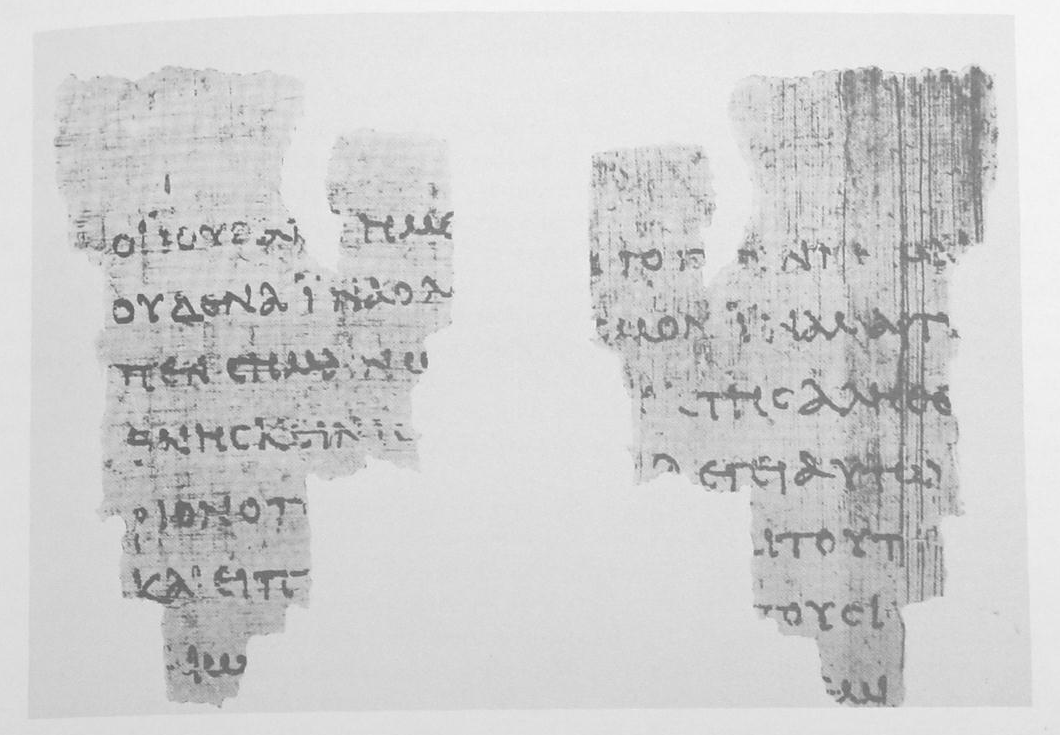
In the 1800�s, many liberal NT scholars from Tuebingen University in Germany claimed that the NT was not written until around 200-250 AD. As a result, they claimed it reflected the beliefs of the people who lived 200 years after the time of Jesus and not the beliefs of those first Christians. In 1920 though, a manuscript was found in the sands of Egypt which blew this away. Nearly every NT scholar believed that the Gospel of John was one of the last NT books written. The manuscript found (John 8:31-33, 37-38) was dated 130 AD. Since it was in Egypt, it meant that some time had to have elapsed between the writing of the Gospel itself and the writing of this copy. It is easy to assume that at least 40 years elapsed between the writing of the Gospel and the copying of this piece of papyrus because not only did it have to be copied, it also had to be transmitted to Egypt without the use of e-mails and fax machines. That would place the original composition of the Gospel of John in 85-90 AD which conservative NT scholars all along believed was the original date for its composition. As a result, it pushed back the date for the composition of all the other NT writings (except for the Book of Revelation) to the 40�s, 50�s, 60�s, and 70�s of that first century. In other words, the NT accurately reflects what those early Christians believed. Since they died for what they believed, you have strong evidence that it is true.
conclusion
Finally, you can nit-pick each and every element of this presentation; however, when you take all the different elements into account, you come away with overwhelming evidence which points to the resurrection of Jesus Christ. What were those major points? The early Christians were Jews; the resurrection appearances; the empty tomb; Paul�s conversion; the claim of millions that they have not only encountered Jesus but have been transformed by Him.