This Ole Banjo
Several Photos, Please Be Patient While They Load.

This ole banjo is a result of the influence and appreciation, that
I have grown to enjoy for music. My mother and her family, as well as
my
sisters and their families, have also held music as a mainstay in their
homes. This ole banjo is my very first attempt at building
one.
My second banjo was completed in October, 2001. Click
Here to view it. I call it my Woody banjo, after viewing
you'll
understand why.
I had quit taking piano lessons in the 7th
grade
1965. I remember, around 1970, I had my first encounter with a banjo. I
was then learning the guitar and was leaning more toward playing the
bass,
because it was easier. Around 1978 our assistant pastor, Lynn Conner
now
a missionary in Mexico, had built a banjo from a kit through the mail
and
that had re-sparked my interest in it. I thought though, that building
one was a little extreme for me at the time.
It wasn't until I was laid off work with John
Deere Tractor in Waterloo,
Iowa
and
moved to Kansas City, Missouri
in 1986, that I bought my first banjo. Actually I bought it in Waterloo
at Levi's Pawn Shop, for $50 or $65, on a visit to see my father. I
brought
it back to Kansas City and started learning the basics.
Then around 1991, I visited theGower
Goodtimers MusicClub, in Gower, Missouri, and developed an even
stronger
desire for the instrument and music. Through this continued yearn of
music
and being around "shade tree" luthiers, I started researching the
construction
of instruments and learning what constituted a "quality" instrument and
how you could affect the sound and tone quality of instruments. It
wasn't
until then that I decided that building an instrument wasn't as far
fetched
of an idea as I had once thought it might be. By 1992 I was determined
to start building. Having a no pressure job afforded me the opportunity
to do some of the construction and machining at work. With literature
and
blue prints in hand, I was ready.
This banjo is a replica of the Gibson
Mastertone with some modifications to personalize it to my taste,
which
I found produced a rich mellow sound with excellent tone, so I've been
told. The inner wood rim is made up of scrap Maple pieces found in the
trash at work. It is a little thicker than normal, by choice. The neck
is made up of 4 pieces of Maple. The outer 2 pieces are Birdseye Maple.
The neck is also about 3/8" thicker than normal and about 1/8" wider to
fit my hand better, hoping to reduce cramps when fingering. It also
meant
making a custom capo which was difficult because of the spring
mechanism.
I've since purchased a Shubb guitar
capo and it seems to work for now, time will tell.
The peg head shape is a mix from Gibson and Veggie
and
my own. I cut the shape by hand, using a coping saw. The shape of the
neck
was cut with a band saw. The entire neck was then finished using a hand
file and sand paper.
The metal truss rod in the neck was made out
of
drill rod and was hand threaded and bent. Drill rod is stronger and
more
durable than cold roll steel, which I thought would improve neck
strength
and help reduce bowing.

The resonator was made from strips of Maple veneer only 1/64"-1/32"
thick. These were built up to a thickness of approximately 1/2" on the
sides and 1/4" on the back. The back was shaped using a pair of field
disk
blades, or shovels, that I got from a farmer at work. I found out later
that those blades were warped, so my resonator back has a built in
flaw.
The resonator was also covered with Birdseye veneer. There are several
blotches on the back where air bubbles had developed, I did the best I
knew how to conceal them. Some people have told me they thought they
were
knots in the wood. The "eyes" were stained a walnut color first and
then
sanded out to produce richer grain contrast. The wood was then finished
in a honey gold stain and lacquered several times.
The fingerboard and peg head are Ebony. I
purchased
the fingerboard already cut for frets. It is a 27" fingerboard.
Although
these photos don't show the extensive detail, The Mother Of Pearl in
the
neck and pegged is of a guitar board design. I purchased it for two
reasons.
I liked the style and it was the cheapest! I had to re-size most of it
to fit on the narrower banjo neck. This was all done by hand with a
file.
I inlaid all of the pearl using a hobby engraving tool, Xacto, to
be exact. Of course there some boo-boo's that I couldn't cover, I
chalk them up to just "battle" scars and experience. The neck is minus
one fret due to miscalculation of length to attach to the rim's radius.
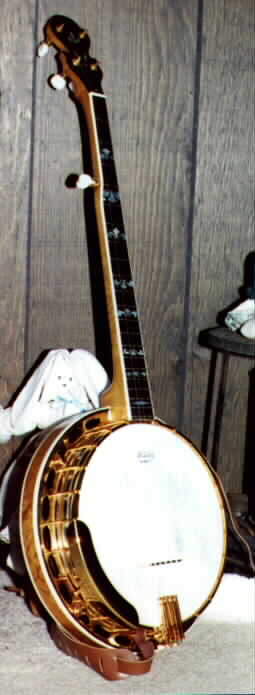 All the trim binding on the neck and resonator was cut and set by hand.
The black fret dots were also put in by hand. I purchased fret wire and
cut and set all the frets.
All the trim binding on the neck and resonator was cut and set by hand.
The black fret dots were also put in by hand. I purchased fret wire and
cut and set all the frets.
The head is an artificial skin replica, which
gives it the look of an original stretch hide used years ago and also
help
save a cat.
Except for the tailpiece, all gold plating was
done in Kansas City, including brackets and nuts. The tone ring was
left
in nickel plate for two reasons; one, because most of it is covered and
two, to give a contrast between the two colors.
The bridge was a bone insert, I have been
experiencing
with different ones. The tail piece, a Bear Claw, is individually
tensioned
so as to allow control over tension and tone quality. I have preferred
to string it with light gauge.
This has been a labor of love and much
enjoyment.
All in all it took about 2 years to construct, working on it only
during
free time and quiet times. Project was finished in 1995. Cost approx.
$1,500.
It weighs about 15lbs and is hard on the back. The above configurations
have given the instrument a mellow tone, not a bright plunky sound.
I like it :) Yes, I could have built it for less money and a little
less weight, but then it wouldn't have been exactly what I wanted.
My "dream" or desire was to have the head
autographed
by Ralph Stanley and Sonny Osborne. My heros :) We
sing
a lot of their songs.
As of April, 2000, I have autographs from
Ralph
Stanley, Jim & Jesse, Doyle Lawson, Little Roy Lewis and Allen
Watkins.
I'm now holding out for Sonny's.... :) :)
Well, as of April 5, 2002, I guess you could
say
that my dream has been fulfilled. We were at the Bluegrass
Festival in Eminece, MO. Sonny was there, along with a lot of
other excellent bands. Sonny was more than happy to sign the ole
banjo.
Thank You for visiting, send me an Email if you enjoyed my pages.
- 
