| printer version |
About Northland Sheep Dairy
The design and development of our farm began with long-abandoned farmland without buildings in 1980, and today combines a number of features not often found together on organic farms.
A strong concern with energy efficiency is expressed not only in solar building design but in general farmstead layout.
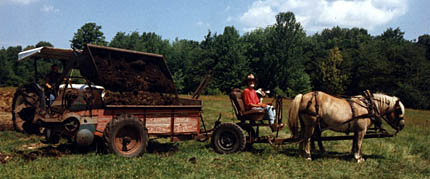 Loading our horse-drawn manure spreader. Animal traction helps us minimize off-farm inputs.
|
An equally strong focus on resource self-sufficiency has led us to a dairy operation that aims to minimize off-farm inputs of fuel, fertilizer, feed, and machinery. Features of our system now becoming more widely adopted include seasonal grass-based dairying, intensive grazing management, animal breeding for hardy, 100% grass diet efficiency, the use of animal traction power where appropriate, and a shift in perspective to see the primary function of animals as soil builders. As such, grazing animals have come to represent for us the driving engine of a sustainable agriculture; consequently we pay close attention to every step of their carbon and other soil nutrient cycling function, from maximizing manure production per acre, to efficient aerobic composting.
A third emphasis from the outset has been to maximize independence from a wholesale agricultural marketplace that is generally predatory toward family farmers and destructive of local foodsheds that are essential to food security and community prosperity. Key to the success of this effort have been: our choice of sheep as the dairy animal with the most product diversity potential, our on-farm cheese-making aiming for artisan quality dairy products, and our involvement in building an attractive local farmers market in order to sell all our products (dairy, meat, yarn, sheepskins, and apple cider) direct to consumers in retail form.
Lastly we have always tried to manage the farm as an integrated whole, partly because as organic farmers we recognize such a complex whole to be the reality we must work with, but also because of the synergistic potential in looking at all parts of the enterprise as an integrated system. In an attempt to further wean ourselves from an academic agricultural paradigm largely based on isolated disciplines and piece-meal problem solving, we have taken formal educator training in Holistic Management, a unique decision-making model that recognizes social and ecological concerns as crucial to ultimate success in any enterprise.
Northland Sheep Dairy