












Posted: Monday, Oct 09, 2006 - 01:33:00 am
By KATIE HARP
A Princeton resident is hoping a dog will become more than her son's best friend.
Cody Morrison is working to raise $5,000 for a service dog for her 2 1/2-year-old son Rylan, who suffers from autism and epilepsy. She had donation table set up Friday outside Buehler's Buy-Low, in Princeton, to promote a candle fundraiser that will help pay for training for the dog.
Morrison said Rylan has had Global Developmental Delays since birth and has received assistance from Indiana First Step program since he was 9-months-old. First Step is a state program that provides assistance to families with babies or toddlers who have disabilities.
Global developmental delay occurs when a child has the delayed achievement of one or more milestone. This may affect a child's speech and language, motor skills, or personal and social skills.
Rylan's development is somewhere between 18-24 months.
“He's had it rough from the get go,” Morrison said. “He has behavioral and sensory issues. His vocabulary is very limited.”
As autism is a relatively new disease, Morrison said many insurance companies do not cover people diagnosed with it. The family has taken out three insurance policies to help cover all Rylan's therapy, which includes four different therapists that come to the family's Princeton residence to help Rylan.
When Rylan was diagnosed with autism, Morrison began to research the disease on the Internet and discovered the benefits a service dog could bring to her son. That's when she found Rachel Miller with Northern Indiana Service Dogs, who agreed to train a dog for Rylan.
The service dog, a Golden Retriever named Bert, will undergo 372 hours of training and the family expects to get him sometime in July 2007.
“I chose a Golden Retriever for him because they are better with children,” Miller said.
Bert will go through intense training to be ready for Rylan which will include being around small children and the public, Miller added.
“It's very time consuming to train a dog,” she said. “I work with the dogs seven days a week.”
Morrison said she is hopeful the dog will help her son with his special needs. She said hopefully Rylan will develop a bond with the dog so the dog will be able to predict a seizure before it happens and alert her.
Rylan's seizures aren't as severe as most people would think, she said, which makes them harder to detect.
“They're not the type where a person falls down,” she said. “He just shakes a little and gets clingy.”
Morrison said doctors hope the dog can also help Rylan with his development.
“With Rylan being so young, we hope the dog will help him come out of some of the things he does now,” she said.
A service dog may also help Rylan with his communication skills.
“He'll want to talk to the dog and tell other people about his dog,” Morrison said.
In addition to aiding Rylan in his development, he dog will also be a “physical therapist” for Rylan.
“Rylan has to do deep pressure exercises,” Morrison said. “He likes to bounce a lot and spin. The dog will be able to sense when he needs that.”
Once the family gets the dog, Morrison Bert will be able to go with Rylan wherever he goes. Rylan has a tendency to “escape” from his play area and Morrison said she has to keep her home locked “like Fort Knox” so he will not get out of the house.
And when he gets out of his play area, Morrison's 1-year-old son is quick to follow him.
“He's not a bad kid, but what he does, he does really well,” Morrison said. “I always joke and tell people that I have an autistic child and a one that thinks he is.”
She said the dog will be like an extra set of eyes for her.
“Rylan is so quick he can scale his baby gate in seconds,” Morrison said.
And Rylan is excited about getting his dog.
“He tries to say ‘dog' now,” she said. “We're working on teaching him to say ‘Bert.'”
Morrison stay home with her sons and takes online classes offered by Western Governor's University in Utah, while her husband, James, works the second shift at TISA.
She said she just found it to be easier with Rylan's conditions. She added that when she worked, Rylan had nine asthma attacks in five months. But Rylan has not had an attack in a year and is not allergic to dogs.
The candle fundraiser for Rylan's dog will go through Oct. 15.
Donations can be made on the Northern Indiana Service Dog Web site at northernindianaservicedogs.com or by contacting Morrison at 812-961-0060.
A
dollar here and there could fetch her a doggie
COMMENTARY
BILL MOOR
Tribune Columnist
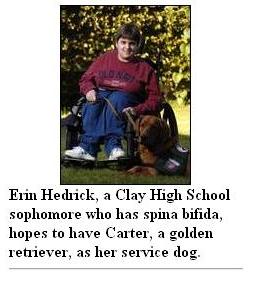
Erin Hedrick is in love. Some would call it puppy love since the object of her affection is an 8-month-old golden retriever named Carter. But also it is about her love for life -- and how a devoted dog could help her live each day with more zest ... with more opportunities ... with more fun. Erin, 15, has spina bifida. She has been in a wheelchair since she was 3. If she can raise $6,000, Carter will become her service dog.
"Carter would give her a chance to be more independent and also make me feel a lot better about her safety," says Amy Hedrick, a single mom with Amy and 9-year-old Bryar.
He would be a wonderful companion, too.
"He is such a great dog," says Erin, an honor roll student and choir member as a Clay High School sophomore.
Carter and Erin share their weekends together, learning to work as a team. During the rest of the week, he continues to be trained as a service dog by Rachel Miller, of Plymouth, who is the director of Northern Indiana Service Dogs.
Sunday nights can be pretty sad around the Hedrick household when goodbye kisses and licks are exchanged.
"We hope to have Carter all the time by Christmas," Erin says.
What a great gift that would be under the tree.
Of course, that depends on how well Carter continues to do in his training and if the Hedricks can continue to raise funds.
Amy, a respiratory therapist for Memorial Home Care, makes ends meet for her family but a service dog, sometimes costing more than $20,000 because of all its hundreds of hours of training, is beyond her means right now.
"We are just asking people who want to help to give a dollar," Amy says. "We know that there are so many good people out there when others are in need."
The goal is $6,000.
"People already have given about $2,000, so we need about $4,000 more," Erin says.
Is it worth a dollar to you to see a darling of a girl smile?
Actually, it has been difficult for Erin to smile these days. Her spina bifida -- a birth defect in which the spine isn't completely formed -- has given her a lot of recent back pain.
Surgery may be needed, which could include a spinal fusion and rods inserted.
"Although that may relieve some of her pain, it would also cut down on her mobility," Amy says.
Erin doesn't even want to talk about that possibility now.
She does like talking about Carter and the Clay Colonials.
"I'm a big Colonials fan," says Erin, who wore purple on her arms last week before Friday's football game.
"But it hasn't worked out that I can go to the games," she says.
Carter might be able to change that -- serving as both a partner and a protector.
"I have some really good friends at school and sometimes I wish I could go to the mall or a movie with them," Erin says.
That doesn't seem too much to ask.
Having Carter would make life easier -- but having a service dog certainly isn't easy.
"Erin and Carter must totally bond," Amy says. "So it's up to Erin to take care of him, feed him and clean up after him."
She does all this from her wheelchair, which Carter could help pull in the future.
Erin dreams of the day that Carter can be her full-time buddy. On the weekend, Carter dreams right beside her.
Besides a partner and a protector, he makes a pretty good pillow, too.
Community helps ex-Ada woman get service dog
By LARRY D. SPRADLIN
ADA - Epilepsy can be a devastating disease for many people, who never know when they might have a seizure.
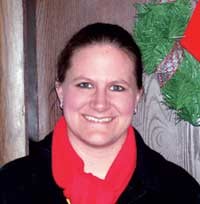
Jenny Harris, 27, who attended Ada and Hardin Northern schools, has had this disease since she was six-years-old and the medication she takes to control her seizures has become less effective over the last two years.
Jenny's mom, Pat Harris, stated that Jenny is having up to 20 seizures a month.
Harris was diagnosed with three different types of seizures and reached the point where she was unable to work, drive, or even be by herself.
One way to improve Harris's quality of life is for her to receive a specially trained service dog that can work and perform tasks for her.
Harris has been accepted into the program at Northern Indiana Service Dogs in Plymouth, Ind.
The dog will provide companionship and after bonding with the person, the dog often notices on-coming seizures and urges the person to sit or lie down.
The dog also assists with balance, opens and closes doors, will lay beside the person seizing and protect them.
The dog is also trained to retrieve the phone and activate emergency call buttons.
Harris has been teamed with a black lab named Maddie, and will be ready to be placed with her next May.
The Sugar Grove United Methodist Women have figured out a way to help Harris- they are holding a fundraiser to help raise the money needed for the dog.
"We are making a homemade quilt as a fundraiser to help with this cause," said Sue Allen of the Sugar Grove United Methodist Women. "I am also looking into seeing if we can get some matching grants from some area businesses and if ONU will look into help as a service project."
She said the quilt will be ready by spring and hopes people find it in their hearts this Christmas and New Year season to help get this seizure dog that can help make a difference in Jenny's life.
"Every dog is a little different to train," said Rachel Miller, of Northern Indiana Service Dogs.
She noted they get the dogs when they are about five weeks old and the time it takes to train can vary.
"We have seizure dogs that can be trained in about seven and one half months," noted Miller. "It sometimes takes four or five months before they know and understand their partner's seizure activities."
Miller said the cost to Jenny will be $5,000 and it takes close to $7,200 to train and get a dog ready.
"If there is a village of 2,500 people, if each person would donate one dollar it would cover half of the cost of Jenny and Maddie to team up," stated Miller.
Miller said if anyone is interested in helping with this project, they can send donations to Northern Indiana Service Dog, 1913-F N. Michigan St. PMB 190, Plymouth In., 46563.
Miller said
seizure dogs have improved the lives of many people.
Pup's mission: See her safely through her seizures
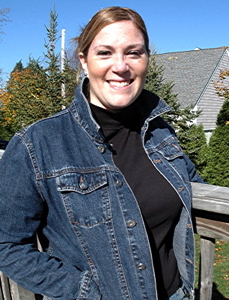
Heidi Lee Dias at
her Westport home.
WESTPORT - The seizures are bad, hitting hard enough to knock her to
the ground — helpless until someone arrives or she can gather
her senses. But worse, says Heidi Lee Dias, is never knowing when the
next one will hit, or where.
Sometimes days will pass without one, "but yesterday I had two ... I had three last week." It has happened when she was on the stairs and when she was out in town.
"There's never a good time or place but some places are really bad," she said. "It's really scares me and it worries my family all the time."
The seizures have dominated her life since she suffered a stroke out of the blue seven years ago at age 29. She had undergone a doctor-recommended hysterectomy and was recovering in the hospital two days later when it hit.
"At first I could hardly do anything. I couldn't talk — the only word I could say for awhile was 'no.'"
Gradually her strength and speech returned but there are still good days and bad.
Telling her story last week, she spoke clearly about what she'd endured.
"But some days I can hardly say a thing. My daughter can always understand me but sometimes she's the only one."
It's the same with her strength. Her right side is weakened but she can usually get about reasonably well, except on the bad days. Or when a seizure strikes.
Veteran, EMT, now housebound
All this is quite a change for a young woman who had set a career path of helping others. After high school in Fall River she entered the Navy and was shipped off to serve in Operation Desert Storm when her daughter Bianca Lee Cardoza, now a senior at Westport High School, was but nine months old.
During the war she was among a special few selected to be a Marine Corpsman, tending to wounded soldiers. Back home she continued that line of work, becoming an EMT for private ambulance services.
"It was work I really liked," she said. "I miss it, I was doing something important."
These days the tables have turned. Since the stroke, she can't work, can't drive, can't go out without fear of the seizures for which doctors can forecast no end.
She's 36 now and gets help from her daughter, husband George Dias and daughter-in-law Kayla Dias.
"They are great about it (the experience has even played a part in guiding her daughter toward a career in nursing or similar field). But I know it's hard on them, someone calling me every 10 minutes to make sure I'm all right."
"I just want my life back, to be able to go places without being afraid of what might happen."
It has been heart-wrenching to see the changes in her daughter, said Heidi's mother Sandra Amarello who lives in Florida but makes trips north to help out.
"She went from a very outgoing, active person who loved to play sports outside with her daughter to someone who is afraid to leave her house," Ms. Amarello said. "She doesn't like to go out to her mailbox alone ... one time she had a seizure right out there in Route 177." And whereas she used to take care of her daughter, "now it's the other way around. Her daughter does so much for her."
Seizure dog
Awhile back, Heidi learned from doctors about something that might help.
"I had never heard of seizure dogs before so I looked it up on the internet." There she found a wealth of information about special dogs trained to help owners who suffer from seizures, dogs that can perhaps even alert them before the seizure hits.
Her research led her to Northern Indiana Service Dogs, a firm that trains dogs for the specific and varying needs of clients. Some are companions and helpers for wheelchair-bound and partially paralyzed people, and others are trained as seizure response dogs.
Ms. Dias is especially hopeful about the possibility that some seizure response dogs may actually sense the onset of a seizure before it begins.
"It may be something to do with their sense of smell, or with the fact that they know their companions so well but they can actually give warning before it starts." This, she adds, would make all the difference and offer a measure of protection from falls or worse.
Northern Indiana Service Dogs makes no assurances along these lines:
"There is no guarantee that a seizure response dog can predict a seizure. However, we would expect that in time, and after bonding ... they will notice oncoming seizures and will alert you to them."
The firm does say the dogs are trained to assist with balance, retrieve dropped or out-of-reach objects, open doors and even bring a phone to a fallen person.
Although she hasn't yet raised anything close to the $5,000 she'll need for her dog (actual cost is higher but a donor program provides some assistance) she has begun the process. Stevie, a yellow lab puppy, has begun training for her specific needs and will be available in several months.
She says she calls the trainers often to find out how it's going.
"They say he's going to be wonderful. I can't wait to meet him," she added.
By Bruce Burdett