






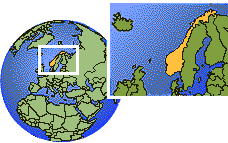
Forests
cover slightly more than one-quarter of Norway’s land area. Deciduous forests
are found in the coastal districts of southern and south-western Norway. The
principal species are oak, ash, hazel, elm, maple, and lime. In favoured
locations birch, yew, and holly may be found. To the east and north the forests
have increasing numbers of conifers.These forests are dominated by Scotch pine
and Norway spruce, but also contain birch, alder, aspen, and mountain ash. Wild
berries, such as blueberries, cranberries, and cloudberries, grow in most
woodland areas. In the far north and at high elevations are tundra regions. The
tundra is a treeless heath, with vegetation consisting mainly of hardy dwarf
shrubs and wildflowers.

Sognefjord
Animals
Reindeer,
polar fox, polar hare, wolf, wolverine, and lemming are common in the north and
in the higher mountain areas. Elk, deer, fox, otter, and marten are found in the
south and south-east. Both freshwater and salt-water fish abound.
European
elk, or moose.
The
moose is the largest member of its family. In Europe it inhabits forests in
Siberia, Sweden, Norway, and the Baltic region, usually near water. In North
America it is found in wooded areas of Canada and the northern United States
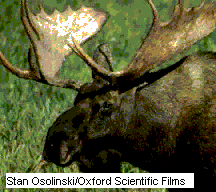
An
adult may stand 1.4 to 2.35 m (4.6 to 7.7 ft) high at the shoulder and weigh 200
to 825 kg (440 to 1,820 lb). The males bear enormous, broad, flattened antlers
with marginal prongs, or tines. The antlers are shed each year after the autumn
mating season, by which time they can attain a spread of 1.5 m (5 ft) or more.
The
body colour of the moose varies from almost black to light brown, becoming grayish
in winter. The protruding muzzle enables the animal to browse on brush and its
long legs allow it to wade into lakes and ponds to feed on aquatic plants. The
shoulders of the moose are higher than the hindquarters, giving it a humpbacked
appearance that is accentuated by the short neck. In order to reach low-growing
plants or to drink from a shallow pool, the moose is forced to kneel. It is an
excellent swimmer.
In Norway Elk are hunted by
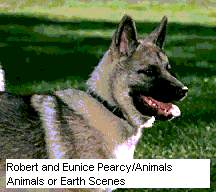
Norwegian
Elkhound,
is a breed of sporting or hunting dog that originated in Norway more than 6,000
years ago. The breed is noted for its ability to hunt big game, including bears
and elks (especially in Norway), lynxes, and raccoons. It is also used as a
draught animal and is valued as a pet of unusual intelligence, friendliness, and
loyalty. The breed is of medium size, with a short, strongly-built body. The
male is about 51 cm (20.5 in) tall at the shoulder, the female about 49 cm (19.5
in); the dog weighs about 20 kg (45 lb)
It
has a short head; pointed ears; brown eyes; a powerful neck; a broad and deep
chest; straight legs; a thick, fairly smooth coat, grey in colour; and a short,
curled tail that is carried high
.
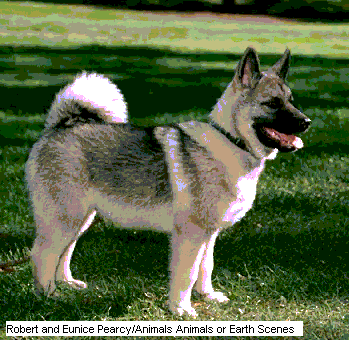
Norwegian
Elkhound
The Norwegian elkhound is a breed of hunting dog that
originated in Norway more than 6,000 years ago. The dog is characterized by a
short, strong body, a broad chest, a thick coat, and a curled tail.