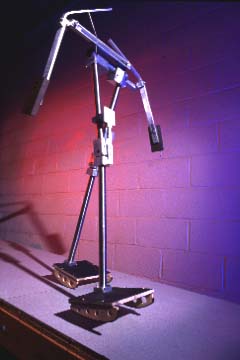
By now you're probably wondering why are we so dumb to make a walker that can only walk down-slope. The idea is that before you learn how to fly, you need to learn how to glide. So I guess these walkers are the gliding equivalent of walking. Once you got the gliding working, you can gradually add engines and controls to make it fly. At least that's the theory. But with today's supercomputers (something we don't have), most people decides to skip the "gliding" phase. Oh well, if all else fails, we can always sell these walkers in Toys R'Us. Yeah engineers may be dumb but not that dumb!!
The walker I worked on is an "unkneed" version of the above walker. The reason: less joints = less complexity. I guess the advisor could sense I'm stupid at that time. Despite that you should see the pages and pages of annoying formulas for the equations of motion, and that's only 3 joints (ankles and hip)! Honda was building the P3 series humanoid robots (or something with that name), and I heard they've 26 joints! I feel sorry for the poor engineers (or supercomputers) assigned to come up with the equations. My job is to make the walker active, allowing it to walk on level floor. Motors are to be mounted on the ankles (to push to feet against the floor), and sensors are to be able to detect leg crossing and foot collision. Believe it or not, in theory you can still walk with all leg muscles minus the calves paralyzed. Starting or stopping is a different story however. Hehe!
Although my predecessor has already produced the simulations for the passive walking mode, my advisor insists that I reproduce the same simulations myself. That's the equivalent of working from the beginning, quite pointless to me. In any case I ran into some troubles that bogged me down for some months, and they turned out to be just numerical imprecision. In case you don't know what that means, it's something that can be ignored to be a certain extent. By the year's end I could push the walker to walk on level floor ... for like 10 steps in the computer. It seems to do fine walking down-slope without motors, but with motors on it starts to take bigger and bigger steps until it does the split. Oh well, too bad. It's the end of the school year, so I left the college with a poor project grade for not able to solve the problem (not so poor to prevent me from getting my degree ... PHEW!!).
Anyway, this is probably my least favorite project. That trouble with numerical imprecision really frustrated me to the point to killing all my interests in the project. The advisor professor doesn't seem to really like me either, but I was grateful of him for not failing me. He assigned a grad student to overlook my project, and though he's an overall nice guy, all too often he's as clueless as me when something goes wrong, especially the imprecision problem. Still I did learn something useful, like drawing cartoons! No I'm not kidding, I had to animate the walker in computer to see how it performs. Apparently it seems not many people know how to do that (not that it's hard to learn), and it can be visually impressive. Once I impressed a professor into giving me an A with animation on an otherwise barely satisfactory term project. Hehe! |