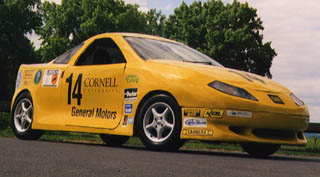
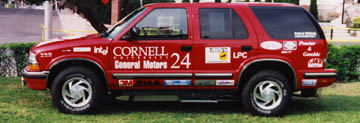
The Slipstream has a mileage of around 40 mpg, slightly lower for the Blazer. While this may seem low for other HEVs on the market (Prius got like 60 mpg?), please remember that we're a bunch of dumb undergrads building the cars while taking classes and without pay (now THAT's stupid). Besides those auto companies got these super computerized machining tools to help out, while we used ... what ... flintstones, chisels, hammers, abacus? OK, we're not that primitive, but it's close enough. Maximum speed is theoretically 79 mph for Slipstream, somewhat slower for Blazer. We've never reached this speed cuz that'll be breaking the speed limit, and the project budget doesn't include speeding tickets (though it does include pizzas). Acceleration from 0-30 mph is around 4 sec for both cars, which is not that worse off from an ordinary car. But time for 0-60 mph is (you're going to love this) around 14 sec!! The reason: electric motors suck at high speed. It is possible to fix this problem by using parallel powertrain which allows the gas engine to turn the wheels directly when necessary, but that would mean more complexity and much more work for the powertrain guys. Being a powertrain member myself, I can assure you we would've rebelled, possibly assassinate the guy who came up with this idea. .
Looking back I never regret joining that team, though there's a bit too much machining than I could bare. I think most of the team think I was the lazy one, but I think they're the ones who work too hard (they practically live in the office/garage!!). That's a good thing if you're a slacker. Lots of hands-on experience since the cars have a strong tendency to break down on the road. Some fun moments, like that time when I was stuck in Slipstream's "trunk" (which houses the electric motors). Still by the year's end I decided to move on, but not before I immortalized myself with the team by etching my name on Blazer's rear drive shaft. I wonder what happened the shaft. Hopefully not in the junkyard. |