
 |
| During the late 1970's, the area surrounding Mount St. Helens had become a popular recreational and vacation destination. In 1979, the United States Forest Service estmated that over half a million people visited the Mount St. Helens/Spirit Lake area. Few of these campers, hikers, scouts, and boaters realized that this veritable garden of Eden had an active volcano at it's heart. The majestic Mount St. Helens, dubbed the "Mount Fuji of North America" for it's beautifully symetrical cone shape, had been dormant since 1857. However, evidence of increased geological activity beneath the moutain was observed as far back as the 1930's. Despite these reminders of Mount St. Helens violent past, few of those who frequented it's environs could imagine what would happen when the volcano awoke from it's long sleep. In mid-March, 1980, earthquakes and other telltale signs of geological activity began under and on the mountain. Over the next two months, the earthquakes and small explosions on the volcano increased, as did the concerns of the USGS experts who were monitoring the situation. The local populace remained mildly concerned at best, with some, like the now famous Harry Truman, dismissing the entire situation as "overexagerated". Mr. Truman refused to evacuate the lodge he has lived in for more than 50 years despite growing fears of an imminent eruption on the volcano. He was not alone in those sentiments. The vulcanologists worst fears were realized on May 18, 1980, at 8:32 am PST, when a 5.1 magnitude earthquake shook Mount St. Helens. The earthquake loosened the large bulge at the volcano's summit, causing a landslide, which sent approximately 23 square miles of the mountainside into the North Fork Toutle River valley at speeds reaching 150 mph. The removal of the material above the bulge released the pressure building under the volcanic dome unleashing a major eruption of ash and pumice. This massive explosion tore the top and most of the north face off of the mountain, removing 1314 feet from the height of the summit. (Click here to see pictures of the mountain before and after the eruption.) This superheated blast (660 degrees F) swept out into the surrounding woodlands at over 300 mph, instantly leveling enough timber to build 150,000 houses. The even more dangerous pyroclastic flow followed, with temperatures over 1300 degrees F spreading over 6 square miles. Further havoc was wreaked by numerous mudflows and floods from melting ice and snow. An enormous column of smoke and ash rose from the volcano, rising 80,000 feet into the air with 15 minutes of the first explosion. Huge amounts of ash were thrown into the atmoshpere, spreading across the United States in 3 days, and circling the entire planet with two weeks. By this time, noone in the United States, or the world, could doubt that the cataclysm that scientists had feared was coming to pass before their eyes. Many of the stalwart few, like Mr. Truman, who remained on or near the mountain despite numerous warnings, never lived to regret their mistake. Fifty seven people were killed as a result of the eruption. The eruption and resulting events caused over a billion dollars in damage. Mount St. Helens is still considered to be in an "active" phase to this day. It remains a beautiful, yet dangerous reminder of the awesome and destructive power of nature. |
| The 80's History Project Disasters Mount St. Helens Eruption May 18, 1980 |
 |
 |
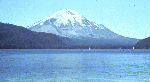
| Mount St. Helens before the 1980 eruption. (click picture for a larger image.) |
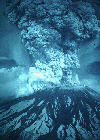
| Mount St. Helens during the 1980 eruption. (click picture for a larger image.) |