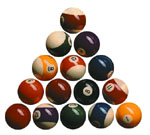
POOL FUN STUFF

TOP 10 BILLIARD MYTHS
- 10. Only guys can play pool.
- 9. I missed because the table wasn't level or the cue wasn't straight or I was
too drunk or ...
(In fact, I missed because I failed to take everything into consideration.)
8. Hitting the cueball violently will cause it to stand still
after it hits the object ball.
(No; Hitting the cueball so as to impart just the right amount
of backspin causes it to stop dead after hitting the object ball.
Of course, that assumes the shot was perfectly straight and the
cue ball and object ball have the same weight.)
7. Balls bounce off the rails like light off a mirror.
(No. The angle of incidence does not equal the angle of 'reflection'
in pool bank shots. Learning how to predict the angle is a science,
not a mysterious art.)
6. Great pool players win because they can make impossible shots.
(No. Well, actually, they can do this. But, more importantly,
they use tactics to place spin on the cueball so as to position
it for the next shot. This is why top-notch pool players seem to
face a larger number of easy shots.)
5. Heavier cue sticks necessarily break better than lighter ones.
(No. Work out the physics; what really matters is how much energy
can be imparted to the cue ball, which depends on how much energy
can be put into the cue stick. The energy in the moving cue stick
is equal to one half its mass times the square of its velocity.
Using a slightly lighter cue stick means you can achieve a higher
acceleration with the same force of your arm. The slightly increased
speed has a squared effect in the energy equation and yields more
energy. Switching from 21oz to 19oz makes a world of difference.)
4. If the cue is kept level, contacting the cueball purely
left or right of its center
will make it curve as it rolls.
(No. The rolling cue ball can have two completely independent
components to its angular momentum. Basically, this means that
it can rotate in the manner of a top while rolling slowly forward
along a straight line. In general, spin on a cue ball is of two types;
follow/draw is the spin like tires on a car, while English is the
spin like a child's toy 'top'. Seperately, neither one will make
a ball curve! If they are combined - e.g., strike low-left giving left
English and draw - then the spin is called masse (mass-ay), and
the ball will curve as it travels.)
3. Cut shots are harder than straight shots.
(No. Work out the geometry; if one considers how slight changes
in the initial cue ball direction affect the object ball's final
path, it can be seen that cutting the object ball about 35 degrees
from the path of the cue ball is the easiest shot. Straight shots,
and cuts shots close to 90 degrees, are the most difficult shots.
This may be the single most useful factoid in pool.)
2. Stance, grips, bridges, mental state, wishing, follow through,
etc...
affect the shot.
(No. The following is about all that matters: spacial orientation
of the cue stick at the moment of contact, velocity of the cue stick,
geometry of the cue (is it cylindrically symetric and does its center
of mass lie on the center-line of its geometry), the flexibility and
resilience of the cue stick, the coefficient of friction between the
tip and cue ball, the size of the surface area over which the cue tip
and cue ball are in contact, the duration of the contact, the
elasticity of the collision, the relative weights of the cue stick
and cue ball, and the location of the contact point on the ball and
on the cue tip. Everything else improves your chances of getting these
things right, but has no real effect.)
1. Skill can beat pure luck.
(I've been on the wrong end of this fact several times. :)