Amateur Radio
Amateur Radio is an FCC-licensed service which allows ordinary people to learn-by-doing with two-way radio. It is really a license to play, and isn't that how we all really learn? License holders are able to transmit on a variety of frequency bands and talk with other licensed Amateurs wherever they may be. They can even build or modify their own equipment if they desire. It is a very portable hobby.
The most important (and visible) component of any radio station is the antenna. They say, "If little antennas really did work as well as big ones, nobody would spend the effort to put up the big ones."
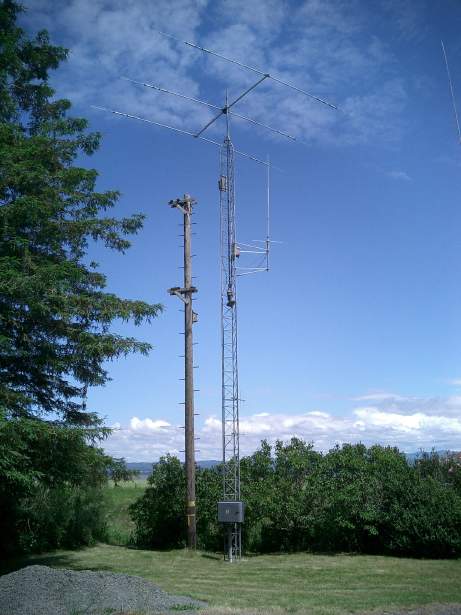
In my yard I have a 50-foot tower to hold some of my antennas. At the top is a 3-element, 3-band rotatable directional Yagi for the 20, 15 & 10-meter (14, 21 & 28 MHz) bands. These are HF (shortwave) frequencies and support worldwide communications.
Below that, side mounted on the tower is a vertical antenna for the 2-meter (144-148 MHz) VHF band. This supports line-of-sight communications out to 60-100 miles, limited more by the surrounding mountains than the distance.
Just above the bushes are two small Yagi antennas that support a duplex link with a repeater I own about 17 miles away. The upper one transmits a signal to the repeater on the 1.25-meter (222-225 MHz) VHF band. The one just below it receives a signal from the repeater on the 70-centimeter (420-450 MHz) UHF band.
The duplex control link supports IRLP operations on the repeater. Internet Radio Linking Project uses VoIP (Voice over Internet) to connect multiple repeaters together all over the world.
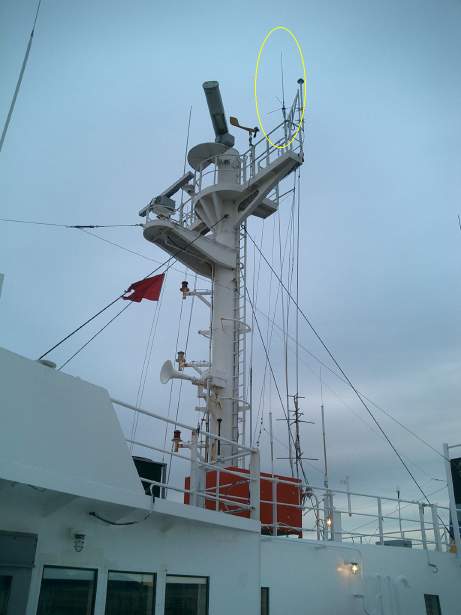
Aboard the ship on which I work, I use coastal IRLP stations to "phone home" whenever one is in range. I access them using a standard mobile radio in my office, connected to a dual-band (2-meters and 70-cm) antenna on the radar mast catwalk (circled in yellow), about 100 feet above the sea. This is used frequently for conversations spanning several hundred miles, well beyond cell-phone range.
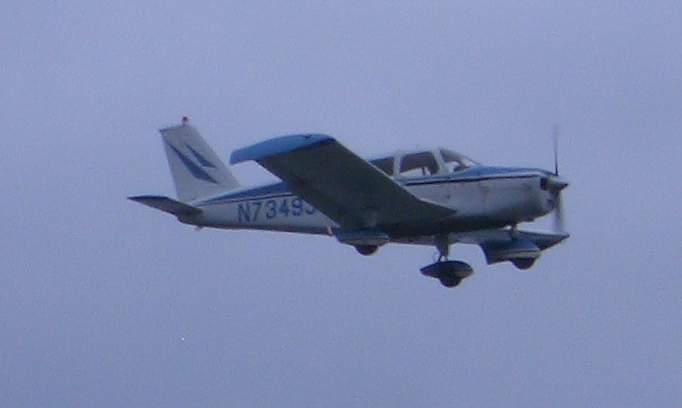
Yes, I have Ham radio in the airplane, too. I use a handheld radio, running a fraction of a watt of power. The antenna is a 19-inch long whip on the belly of the plane. Using VHF & UHF frequencies, which tend to travel over straight, line-of-sight paths, exploits altitude to realize substantial range. I have talked with other Hams more than 200 miles away, helped by 7-8000 feet of altitude (a very tall tower). On a miles-per-watt basis, this can be impressive.
In addition to voice communications, Hams also have digital modes available. One mode that I use while on the ship is Winlink2000. This is a system of Amateur stations all over the world, voluntarilly set up and maintained, using the Internet to pass email traffic to/from mobile HF stations. Having email available anywhere on Earth, even in the middle of a jungle, desert or the ocean, has become quite popular with sailors, cruisers, RV'ers, missionaries, and all sorts of folks who find themselves "away from it all". Hams use readilly available technology to help others.
Aside from Emergency Communications, Hams are known for their innovation. Licensed Amateur Radio Operators can build their own equipment, leading to striking advances in technology.
Have an interest in radio, computers or electronics? Maybe you should investigate Amateur Radio. Information is available at arrl.org.
73, Frank