
Chinook WA (Megler Site)
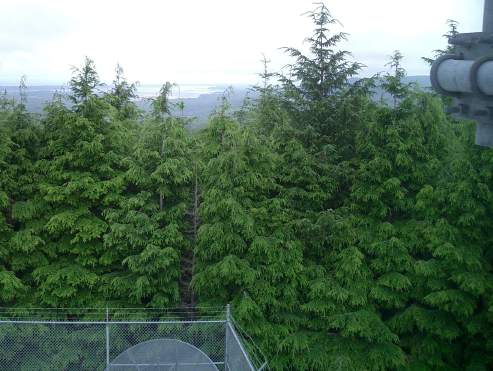
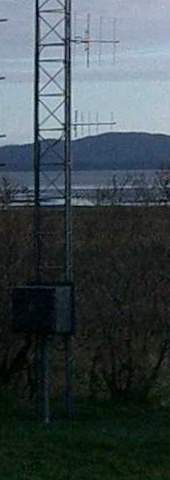
A pair of antennas at my home station (left below) support the IRLP link. The upper one is a 220 MHz yagi, just like the one at the repeater site. The lower one is a 6-element, 440-MHz yagi, listening to the repeater on the output frequency.
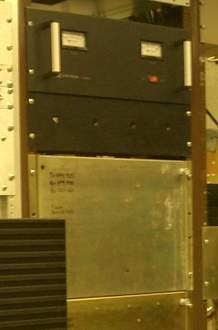
When the IRLP computer receives audio from the distant station over the Internet, it keys the 220 MHz transmitter and sends it to the repeater (for retransmission). The repeater controller is a CAT-200B, with a built-in link port, taking care of the audio switching and carrier control.
The computer stays at home where the DSL connection is, and the repeater is at an elevated site where coverage is good. Another advantage is the full-duplex nature of the link. Even when someone from the Internet is talking out of the repeater, a local user can still key up, muting the link audio, and send a command (ie: "hang-up"). This is not possible with many simplex nodes, or repeaters operated using a simplex node tied in as a 'user'. In these cases the local user must wait until the channel is clear before sending commands.
Node 3105 is a WIN System Affiliate station, and its normal condition is connected via the Dallas Reflector 9453. You are welcome to use it to connect to another node if you wish, if no one is using it locally.
Normally, any connection that is idle for 20 minutes will automatically disconnect. I have set up a special, single digit command, a "star" (*), that connects to the WIN System (Reflector 9453) with no time-out. The "star" command is the preferred method of reconnecting Node 3105 to the WIN System when done playing.
The solder pads that encode the specific tone are pulled to ground to select (and allowed to float to de-select) the digit. In my set up some of the pads are permanently soldered, to select the "off" tone. Then when the repeater receiver is active, it pulls one more pad to ground, switching the PL tone to the "on" tone.
It turns out that, as far as the decoder at the other end of the monitor circuit is concered, changing the tone closes the decoder faster than just turning the tone off.