|
|
|
|
|
|
|
|
|
| Name |
Distance From
Earth (000 km) |
Diameter (km) |
Period
(days) |
Orbital
Period (days) |
Inclination |
| Moon (aka Luna) |
384 |
3476 |
27.32 |
29.5 |
5.14 |
|
| |
|
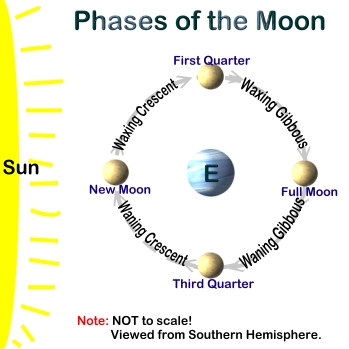 |
| The above diagram represents the phases of the moon as viewed from the Earth. The Earth and the moon are illuminated by the sun as you can see. Remember that the moon has no light of its own so what we see at night is due to the presence of our solar systems largest |
|
As you can also see in the diagram above, as the moon travels in its orbit, each quarter of the orbit is named - Waxing Crescent -> Waxing Gibbous -> Waning Gibbous -> Waxing Crescent. |
|
You would think, by looking at the diagram above, that we would not see the "New Moon" because the Earth is in the way. In fact, the Moon's orbit is inclined about 5.14 degrees. So light is shed on both the earth and the Moon. If the Earth was totally blocking the Sun's light from the moon, we would get an eclipse. |
| |
|
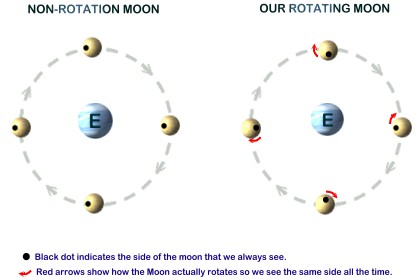 |
| When you stare at the moon day after day, you quickly realise that the moon always looks the same. That's because we see the same side of the moon every day. (The moon actually wobbles a little in its orbit so we see a little bit more than 50% of the moon over time from earth.) |
| The fact that we see the same side of the moon DOES NOT mean that the moon doesn't rotate about its own axis. Look at the diagram above. The moon rotates about its own axis once in 27 earth days. The black dot on the moon in the diagram is a fixed point in the middle of the Moon on the side that we see. On the left, you see that if the moon did not rotate we will actually see the other side of the moon. On the right, you see what is actually happening right now. For us to see this "dot" the moon must spin as indicated with the red arrows. This phenomenon is called "synchronous" or "phase-locked" rotation. The moon is not the only satellite in the solar system that demonstrates this property. |
| |
|
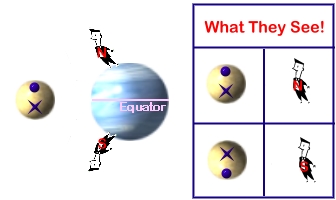 |
| The moon orbits close to the Earth's equator with a small inclination. As you can see in the diagram above, the "N" and "S" people are standing on the opposite sides of the globe and are "upside down" to each other! So they see the Moon from different views and hence the moon appears to what the other would see "Upside Down". In fact, when you look at the stars, most of them appear quite differently on both sides of the equator. |
| |
|
| A Lunar Eclipse is when the Earth is positioned between the Moon and the Sun, casting a shadow over the Moon. This is not so obvious to the untrained eye. A Total Eclipse is when the Earth casts a complete shadow over the Moon making it look extremely dark. |
| A Solar Eclipse occurs when the moon comes between the Earth and the Sun. Again there are partial and total solar eclipses. One should not look at a solar eclipse (or at the sun in general) directly or indirectly through a camera or telescope without a filter as the sun is still emitting UV (ultraviolet) rays and you could be blinded. |
| |
|
| Apogee is when the moon's orbit (which is elliptical) is furtherst away from the earth and Perigee is when it is the closest. This happens at different times each month and at different days in the year. |
| Consequently, the moon will look smaller at apogee and a lot bigger and brighter at perigee. You would have noticed perigee when it co-incides with a full moon, and would look like a huge orange "ball" in the sky. |