
Sun & the Planets
|
|
|
|
| Name | Distance from Sun |
Diameter (000 km) |
Density | Moons | Length of Day | Length of Year | Incline | Surface Temp(K) |
| Sun | --- | 1390 | 1.41 | --- | 24.6 | --- | --- | 5800 |
| Mercury | 57,910 | 4.88 | 5.43 | 0 | 58.6 | 87.97 | 7.00 | 90-700 |
| Venus | 108,200 | 12.104 | 5.24 | 0 | -243 | 224.70 | 3.39 | >740 |
| Earth | 149,600 | 12.756 | 5.52 | 1 | 0.99 | 365.26 | 0.00 | 308 |
| Mars | 227,940 | 6.794 | 3.93 | 2 | 1.03 | 686.98 | 1.85 | 140 - 300 |
| Jupiter | 778,330 | 142.984 | 1.33 | 16 | 0.41 | 4332.71 | 1.31 | --- |
| Saturn | 1,429,400 | 120.536 | 0.69 | 18 | 0.45 | 10,759.5 | 2.49 | --- |
| Uranus | 2,870,990 | 51.118 | 1.32 | 21 | -0.72 | 30685 | 0.77 | --- |
| Neptune | 4,504,300 | 49.532 | 1.64 | 8 | 0.67 | 60,190 | 1.77 | --- |
| Pluto | 5,913,520 | 2.274 | 2.06 | 1 | -6.39 | 90,800 | 17.15 | 38 - 63 |
Note:* Temperature in Kelvin(K): 0�C = 32�F = 273K. 0K is known as absolut zero, where all matter stops moving, ie, electrons, protons and neutrons stop spinning in the atom.* Incline is the orbittal inclination of the planet relative to the earth. * Negative values for length of day indicate that the rotation is in the opposite direction (retrograde) to the rotation of the earth; where the earth rotates counter-clockwise when viewed from the North-pole * The first four planets are known as Terrestial planets because they are solid. * The outer planets are known as Gas Planets. | ||||||||

| Layer | Depth (km) | Composition | Info |
| Crust | 0 - 40 | Primarily quartz (silicon dioxide) and other silicates like feldspar | Solid layer - thinner under the oceans, thicker under the continents |
| Upper Mantle | 40 - 400 | olivene and pyroxene (iron/magnesium silicates), calcium and aluminum | Plastic or semi-fluid layer |
| Transition region | 400 - 650 | ||
| Lower mantle | 650 - 2700 | Mostly silicon, magnesium and oxygen with some iron, calcium and aluminum | Plastic or semi-fluid |
| D'' layer | 2700 - 2890 | ||
| Outer core | 2890 - 5150 | Mostly of iron (or nickel/iron) | Plastic or semi-fluid layer |
| Inner core | 5150 - 6378 | Mostly of iron (or nickel/iron) | Solid layer - temperature at centre of core may reach 7500K, hotter than surface of the Sun |
| Name | Distance (000 km) |
Diameter (km) | Discoverer, Date |
Distinguishing Feature |
| Phobos | 9 | 22.2 | Hall, 1877 | Phobos is son of Ares and Aphrodite. Heavily cratered carbon-rich rock; Rises in the west and sets in the east on Mars, twice a day. |
| Deimos | 23 | 12.6 | Hall, 1877 | Phobos' brother in Greek mythology. Heavily cratered carbon-rich rock; Smallest known moon in our solar system. |
| Name | Distance (000 km) |
Diameter (km) | Discoverer, Date |
Distinguishing Feature |
| Metis | 128 | 40 | Synott, 1979 | Named after first wife of Zeus, closest moon to Jupiter |
| Adrastea | 129 | 20 | Jewitt, 1979 | Named after Jupiter's daughter. It and Metis' orbit around Jupiter = Jupiter's rotation around its own axis (Synchronous Orbit Radius). |
| Amaltea | 181 | 196 | Barnard, 1892 | Named after the nymph who nursed Jupiter. Reddest object in solar system, rotates synchronously with long axis pointed to Jupiter. |
| Thebe | 222 | 100 | Synott, 1979 | Named after a nymph, the daughter of the river god Asopus. Rotates synchronously around Jupiter. |
| Io | 422 | 3630 | Galileo, 1610 | Named after a lover of Zeus who transformed into a heifer. Third largest of Jupiters moons. Bulk composition similar to terrestrial bodies. One of only two moons (Triton is the other) that currently have volcanic activity, its eruptive material is probably sulfur or sulfur compounds driven by tidal interactions with Jupiter. |
| Europa | 671 | 3138 | Galileo, 1610 | Named after a Phoenician princess abducted by Zeus. Fourth largest of Jupiters moons. Similar to Io in composition, but with a thin outer layer of ice. |
| Ganymede | 1070 | 5262 | Galileo, 1610 | Named after a Trojan boy who became cup-bearer to the Greek Gods. Largest known moon in solar system. May be similar to Io in composition. |
| Callisto | 1883 | 4800 | Galileo, 1610 | Named after a nymph, beloved by Zeus. Second largest moon. May be similar to Io in composition. Oldest, most cratered surface of any body yet observed in the solar system |
| Leda | 11094 | 16 | Kowal, 1974 | Named after queen of Sparta, mother of Helen of Troy with Zeus. Smallest of Jupiters moons, one of the smallest in solar system. |
| Himalia | 11480 | 186 | Perrine, 1904 | Named after a nymph who bore three sons of Zeus. Its orbit is inclined about 28� to Jupiter's equator. |
| Lysithea | 11720 | 36 | Nicholson, 1938 | Named after daughter of Oceanus and one of Zeus' lovers. Its orbit is inclined about 28� to Jupiter's equator |
| Elara | 11737 | 76 | Perrine, 1905 | Named after mother by Zeus of the giant Tityus. Its orbit is inclined about 28� to Jupiter's equator. |
| Ananke | 21200 | 30 | Nicholson, 1951 | Named after mother of Adrastea by Jupiter. Its orbit is retrograde and inclined about 150� to Jupiter's equator. |
| Carme | 22600 | 40 | Nicholson, 1938 | Named after mother, by Zeus of Britomartis, a Cretan goddess. Its orbit is retrograde and inclined about 150� to Jupiter's equator. |
| Pasiphae | 23500 | 50 | Melotte, 1908 | Named after wife of Minos and mother of the Minotaur. Its orbit is retrograde and inclined about 150� to Jupiter's equator. |
| Sinope | 23700 | 36 | Nicholson, 1914 | Named after woman said to have been unsuccessfully courted by Zeus. Its orbit is retrograde and inclined about 150� to Jupiter's equator. |
| Name | Distance (000 km) |
Diameter (km) |
Discoverer, Date |
Distinguishing Feature |
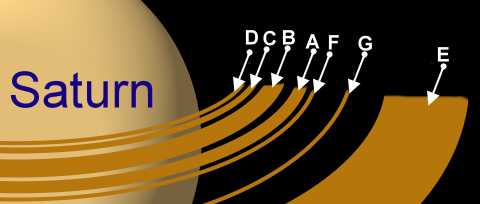
| Pan | 134 | 20 | Schowalter, 1990 | Pan was the god of woods, fields, and flocks; half human and half goat. Wave patterns in the edge of Saturn's rings predicted Pan's size and location, leading to its discovery. |
| Atlas | 138 | 28 | Terrile, 1980 | Atlas was a Titan condemned by Zeus to support the heavens upon his shoulders! "Shepherd satellites" of A ring. |
| Prometheus | 139 | 92 | Collins, 1980 | Prometheus was a Titan who stole fire from Olympus and gave it to humans. Inner shepherd satellites of F-ring. |
| Pandora | 142 | 92 | Collins, 1980 | Pandora was the first woman, bestowed upon humankind by Zeus, as a punishment for Prometheus' theft of fire. Entrusted with a box, she opened it and released all the evils of human life. Outer shepherd satellite of F-ring |
| Epimetheus | 151 | 114 | Walker, 1980 | Atlas's brother and Pandora's husband. It and Janus are co-orbital, their orbital radii differ by only 50 km. Their orbital velocities are nearly equal. As they approach each other they exchange a bit of momentum to boost the lower one into a higher orbit and to drop the higher one to a lower orbit. They exchange places about once in 4 years. |
| Janus | 151 | 178 | Dollfus, 1966 | Janus was the god of gates and doorways, depicted with two faces looking in opposite directions. Orbital partner of Epimetheus, but appears to be its elder. |
| Mimas | 186 | 392 | Herschell, 1789 | Mimas was one of the Titans slain by Hercules. The surface is dominated by an impact crater 130 km across, called Herschel, almost 1/3 of the moon's diameter. |
| Enceladus | 238 | 498 | Herschell, 1789 | Enceladus was a Titan who was defeated in battle and buried under Mount Etna by Athena. It has the highest albedo {ratio of incident light to reflected light (>0.9)} of any body in the solar system. |
| Tethys | 295 | 1060 | Cassini, 1684 | Tethys was a Titaness and sea goddess, sister and wife of Oceanus. Surface dominated by a huge impact crater 400 km across, called Odysseus, nearly 2/5 of the moon's diameter. |
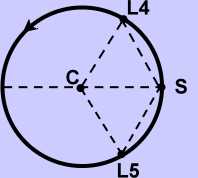
| Telesto | 295 | 30 | Reitsema, 1980 | Telesto was a daughter of Oceanus and Tethys. Orbital partner of Tethys, leads by 60�. |
| Calypso | 295 | 26 | Pascu, 1980 | Calypso was a sea nymph who delayed Odysseus on her island for seven years. Orbital partner of Tethys, trails by 60�. |
| Dione | 377 | 1120 | Cassini, 1684 | Dione was the mother of Aphrodite, by Zeus. Composed primarily of water ice and denser material like silicate rock. Shares its orbit with Helene. |
| Helene | 377 | 32 | Lasques, 1980 | Helene is the name of an Amazon who battled with Achilles. Orbital partner of Dione, leads by 60�. |
| Rhea | 527 | 1530 | Cassini, 1672 | Rhea was the sister and wife of Cronus. Second largest of Saturn's moons. Composed primarily of water ice with rock making up <1/3 of its mass. |
| Titan | 1222 | 5150 | Huygens, 1655 | Titans were a family of giants, who sought to rule the heavens but were overthrown Zeus' family. Largest of Saturns moons. Only moon in solar system that has a significant atmosphere (its pressure is 50% higher than Earths). |
| Hyperion | 1481 | 286 | Bond, 1848 | Hyperion was a Titan. Most irregularly shaped moon in the solar system and has the lowest albedo of all Saturns moons. |
| Iapetus | 3561 | 1460 | Cassini, 1671 | Iapetus was a Titan, son of Uranus, father of Prometheus and Atlas. Iapetus is inclined almost 15 degrees to Saturns equator. Its albedo is significantly different on its two hemispheres that Cassini noted he could see Iapetus only on one side of Saturn and not on the other. |
| Phoebe | 12952 | 220 | Pickering, 1898 | Phoebe is the daughter of Uranus and Gaia. Albedo is very low (.05). Its orbit is inclined almost 175�. Phoebe is so different to Saturn's moons, that it may be a captured asteroid or Kuiper Belt object. Only irregular satellite of Saturn. |
| Name | Distance (000 km) |
Diameter (km) |
Discoverer, Date |
Distinguishing Feature |
| Cordelia | 50 | 26 | Voyager 2, 1986 | Cordelia is a daughter of Lear in Shakespeare's King Lear. Appears to be the inner shepherd satellite for the Epsilon ring |
| Ophelia | 54 | 32 | Voyager 2, 1986 | Ophelia is the daughter of Polonius in Shakespeare's Hamlet. Appears to be the outer shepherding satellite for Uranus's Epsilon ring. |
| Bianca | 59 | 44 | Voyager 2, 1986 | Bianca is the sister of Katherine in Shakespeare's Taming of the Shrew. Very dark (albedo < 0.1). |
| Cressida | 62 | 66 | Voyager 2, 1986 | Cressida is the daughter of Calchas in Shakespeare's Troilus and Cressida. Very dark (albedo < 0.1). |
| Desdemona | 63 | 58 | Voyager 2, 1986 | Desdemona is the wife of Othello in Shakespeare's Othello. Very dark (albedo < 0.1). |
| Juliet | 64 | 84 | Voyager 2, 1986 | Juliet is the tragic heroine in Shakespeare's Romeo and Juliet. Very dark (albedo < 0.1). |
| Portia | 66 | 110 | Voyager 2, 1986 | Portia is a rich heiress in Shakespeare's Merchant of Venice. Very dark (albedo < 0.1). |
| Rosalind | 70 | 54 | Voyager 2, 1986 | Rosalind is a daughter of the banished Duke in Shakespeare's As You Like It. Very dark (albedo < 0.1). |
| Belinda | 75 | 68 | Voyager 2, 1986 | Belinda is the heroine in Alexander Pope's The Rape of the Lock. Very dark (albedo < 0.1). |
| 1986U10 | 76 | 80 | Karkoschka 1999 | Yet to be named, its orbit is nearly identical to Belinda. |
| Puck | 86 | 154 | Voyager 2, 1986 | Puck is a mischievous fairy in Shakespeare's Midsummer-Night's Dream. Very dark (albedo < 0.1). |
| Miranda | 130 | 472 | Kuiper, 1948 | Miranda is a daughter of the magician Prospero in Shakespeare's The Tempest. Pictures taken by Voyager 2 showed that its surface is very irregular, young and old, with lots of canyons and terraced layers. |
| Ariel | 191 | 1158 | Lassell, 1851 | Ariel is a mischievous airy spirit in Shakespeare's The Tempest. Its surface is a mixture of cratered terrain and interconnected valleys hundreds of kilometers long and more than 10 km deep. |
| Umbriel | 266 | 1170 | Lassell, 1851 | Umbriel is a character in Alexander Pope's The Rape of the Lock. Has a heavily cratered surface and is very dark. |
| Titania | 436 | 1578 | Herschel, 1787 | Titania is the Queen of the Fairies and wife of Oberon in Shakespeare's Midsummer-Night's Dream. Largest of Uranus' moons. Relatively young surface thats heavily cratered and has interconnected valleys, like Ariel. |
| Oberon | 583 | 1522 | Herschel, 1787 | Oberon is the King of the Fairies and husband of Titania in Shakespeare's Midsummer-Night's Dream. Heavily cratered surface and has large faults. |
| Caliban | 7169 | 80 | Gladman, 1997 | Caliban was the slave of magician Prospero in Shakespeare's play The Tempest. Irregular moon, red in colour, may be a captured asteroid from Kuiper Belt. The orbits are retrograde and highly inclined. |
| Stephano | 7948 | 30 | Gladman, 1999 | Stephano was a butler on Ariel's ship who plotted with Caliban to murder Prospero in Shakespeare's play The Tempest.Irregular satellite of Uranus. |
| Sycorax | 12213 | 160 | Nicholson, 1997 | Father of Caliban, he imprisoned Ariel for disobedience in Shakespeare's play The Tempest. Irregular moon, red in colour, may be a captured asteroid from Kuiper Belt. The orbits are retrograde and highly inclined. |
| Prospero | 16568 | 40 | Holman, 1999 | Prospero was a powerful magician who enslaves Ariel in Shakespeare's play The Tempest. Irregular satellite of Uranus. |
| Setebos | 17681 | 40 | Kavelaars, 1999 | Setebos was the god of Sycorax. Irregular satellite of Uranus. |
| Name | Distance (000 km) |
Diameter (km) |
Discoverer, Date |
Distinguishing Feature |
| Naiad | 48 | 58 | Voyager 2, 1989 | Naiads were nymphs who lived in and presided over brooks, springs, and fountains. Irregularly shaped. |
| Thalassa | 50 | 80 | Voyager 2, 1989 | Thalassa is the greek word for sea. Irregularly shaped. |
| Despina | 53 | 148 | Voyager 2, 1989 | Despina was a nymph, the daughter of Poseidon. Irregularly shaped. |
| Galatea | 62 | 158 | Voyager 2, 1989 | Galatea was a Sicilian Nereid loved by the Cyclops Polyphemus. Irregularly shaped. |
| Larissa | 74 | 192 | Reitsema, 1989 | Daughter of Pelasgus. Heavily cratered, irregularly shaped moon. |
| Proteus | 118 | 418 | Voyager 2, 1989 | Proteus was a Sea god who could change his shape at will. Very dark, heavily cratered and irregularly shaped moon. |
| Triton | 355 | 2706 | Lassell, 1846 | Triton is a god of the sea, the son of Poseidon; portrayed as having the head and body of a man and tail of a fish. Only large moon with a retrograde orbit, and its axis is tilted such that its poles face the sun, like Uranus. One of two moons that currently have volcanic activity, its eruptive material is probably liquid nitrogen, dust, or methane compounds. |
| Nereid | 5513 | 340 | Kuiper, 1949 | Nereid was a sea nymph. Its orbit is the most eccentric of all planets or satellites in the solar system, its distance varying between 1.4 to 9.6 million kilometres to Neptune. |
| Name | Distance (000 km) |
Diameter (km) |
Discoverer, Date |
Origin of Name? |
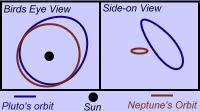
| Charon | 20 | 1172 | Christy, 1978 | Charon was the mythological figure who ferried the dead across the River Acheron into Hades (the underworld). |
| Eduk8 Home Page | || | Eduk8 Science Page | || | Eduk8 Astronomy Page | || | Back to Top |
| Physics & Astronomy Links | ||||||