Nitrogenase
Dedicated to Science-Lovers Everywhere
(this
site is best viewed at 800x600 resolution or greater)
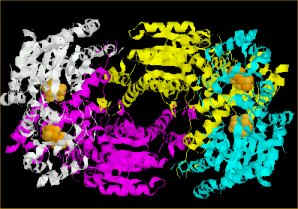
Fe and FeMo clusters visible in the tetramer structure of Nitrogenase, PDB code: 1FP6
Introduction
The enzyme nitrogenase catalyses the conversion of atmospheric, gaseous dinitrogen (N2) and dihydorgen (H2) to ammonia (NH3), as shown in the chemical equation below:
N2 + 3 H2
 2 NH3
2 NH3
The above reaction seems
simple enough and the atmosphere is 78% N2, begging the question: Why
is this enzyme so important?. The incredibly
strong  (triple) bond
makes this reaction very difficult to do efficiently. Biological NH3
creation, also called nitrogen fixation, accounts for an estimated 170 x 109
kg of ammonia every year1. Human industrial production
amounts to some 80 x 109 kg of ammonia yearly1.
The Haber-Bosh process is used to manufacture ammonia and consists of a Fe
catalyst to dissociate N2 to atomic nitrogen on the catalyst surface,
followed by reaction with H2 to form ammonia. The reaction is
typically run at around 723K (842 F) and at 500 atmospheres pressure.
These conditions require a huge amount of energy, especially considering the
sheer scale at which NH3 is produced. If a way to mimic
nature's method, done at 0.78 atmospheres N2 pressure and ambient temperatures
huge amounts of energy could be saved (and thus money, as well).
(triple) bond
makes this reaction very difficult to do efficiently. Biological NH3
creation, also called nitrogen fixation, accounts for an estimated 170 x 109
kg of ammonia every year1. Human industrial production
amounts to some 80 x 109 kg of ammonia yearly1.
The Haber-Bosh process is used to manufacture ammonia and consists of a Fe
catalyst to dissociate N2 to atomic nitrogen on the catalyst surface,
followed by reaction with H2 to form ammonia. The reaction is
typically run at around 723K (842 F) and at 500 atmospheres pressure.
These conditions require a huge amount of energy, especially considering the
sheer scale at which NH3 is produced. If a way to mimic
nature's method, done at 0.78 atmospheres N2 pressure and ambient temperatures
huge amounts of energy could be saved (and thus money, as well).
In the next few pages I hope to provide some insight into the structure of Nitrogenase and the most reccently proposed mechanism of N2 reduction. I also have a references page detailing many excellent articles and reviews I used to prepare this page and are an excellent starting place for further research into this topic.
Next: An overview of the structure of nitrogenase.
Please feel FREE to contact me about the page
This page was put together to be useful to both younger students as well as members of the scientific community at large. The most recent references available are included. Many are reviews which contain literally hundreds of further references, giving insight into just HOW much work has been done in an attempt to understand this amazing protein. They also show just how much remains to be done. . .
-Adam
intro structure mechanism references

Disclaimer: To the best of my knowledge I have given credit to all authors and references. If anything has been inadvertently used without permission, please notify me and I will remove or modify whatever is necessary! Thank you!
