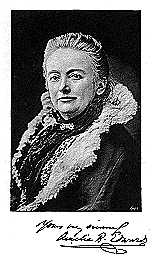
 Amelia Ann Blanford Edwards (1831-1892), English author and Egyptologist,
the daughter of one of Wellington's officers, was born in
London on the 7th of June 1831. At a very early age she displayed considerable literary and
artistic talent. She became a contributor to various magazines and newspapers, and besides many
miscellaneous works she wrote eight novels, the most successful of which were Debenham's
Vow (1870) and Lord Brackenbury (1880). Amelia Ann Blanford Edwards (1831-1892), English author and Egyptologist,
the daughter of one of Wellington's officers, was born in
London on the 7th of June 1831. At a very early age she displayed considerable literary and
artistic talent. She became a contributor to various magazines and newspapers, and besides many
miscellaneous works she wrote eight novels, the most successful of which were Debenham's
Vow (1870) and Lord Brackenbury (1880).
In the winter of 1873-1874 she visited Egypt, and was profoundly impressed by the new openings
for archaeological research. She learnt the hieroglyphic characters, and made a considerable
collection of Egyptian antiquities.
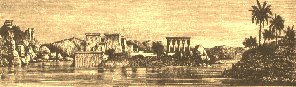
In 1877 she published A Thousand Miles up the Nile,
with illustrations by herself (see her painting of
Philae from the south).
Convinced that only by proper scientific investigations could the
wholesale destruction of Egyptian antiquities be avoided, she devoted herself to arousing public
opinion on the subject, and ultimately, in 1882, was largely instrumental in founding the Egypt
Exploration Fund, of which she became joint honorary secretary with Reginald Stuart Poole. For the
business of this fund she abandoned her other literary work, writing only on Egyptology. In
1889-1890 she went on a lecturing tour in the United States.
The substance of her lectures was
published in volume form in 1891 as Pharaohs, Fellahs, and Explorers. (See her excerpts here as Rameses' Great Horses.)
She died at Weston-super-Mare, Somerset, on the 15th of April 1892, bequeathing her valuable
collection of Egyptian antiquities to University College, London, together with a sum to found
a chair of Egyptology. Miss Edwards received, shortly before her death, a civil pension from the
British government.
Encyclopedia Britannica A Dictionary of Arts, Sciences, Literature and General
Information, Volume IX, Cambridge, England, University Press 1910.
|