Home

Resume

Projects

Publications

Academics

Personal


  DyIReS:  Dynamic  Information  Retrieval  System
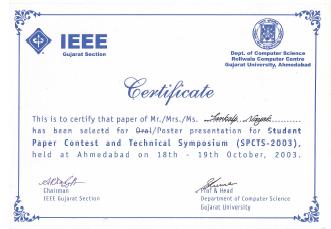
                              Presented and published in the proceedings of IEEEE SPECTS -2003, October 18-19, Gujarat University Ahmedabad

An effective paper on Dynamic Information Retrieval System (DyIReS) is being proposed here, which shows how information can be retrieved from another entities, which is somehow associated with our desired entity. The system searches for desired information using dynamic attributes and dynamic linking amongst different entities. The entire things in this world are broadly divided into three categories: person, place, or thing. Any entity –out of these three categories– will be created in memory and its address is stored in its “primitive look-up table” –which are three in number, one for each entity type: person, place, or thing. These entities can be linked to other entities through “dynamic reference attributes”, which can be created and appended to any entity at run time. There is another type of attributes in each entity, termed as “dynamic inherent attributes”, which are used to store some basic properties of that entity. Any entity is directly accessible via these “primitive look-up tables”. Hence, we must know at least one entity, or its property, through which our desired entity is linked, so that its information can be retrieved dynamically. This paper illustrates the Dynamic Information Retrieval System for searching information at run time, based on the knowledge of the entity or its property through which the desired entity is associated.


   Generalized Workflow System for E-Governance

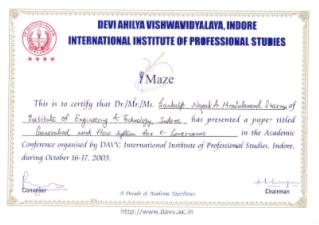
                                                                                   Presented and published at IMaze-2003, October 15-16 2003 IIPS, Indore

Workflow system is the part of E-Governance –electronic governance which delivers government services and information to the public using electronic means— where work is physically distributed at different locations or departments according to the work sequence. These systems are organization oriented, i.e. Workflow system of one organization cannot be implemented at another. We suggest the concept to remove this dependency and make a Generalized Workflow System which can be used in Electronic Governance for any organization and can work according to the governmental rules. This is the system which at the time of deployment asks the relevant information, and connects the whole distributed Government and Governmental work together. This enables a System, which can be implemented in any governmental department irrespective of its governing rule. This paper describes the concept of generalized Workflow System in Electronic Governance, which enable us to deploy a Workflow System according to the Organization Specific details and modifies itself to suit their desired requirements.

Secured Data Transmission using Steganographic techniques

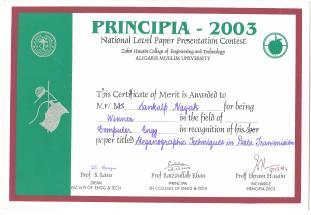
                                          Presented and published at Principia2003, March 07-08 2003 Aligarh Muslim University, Aligarh

As we enter the age of universal electronic connectivity, electronic eavesdropping and electronic fraud threaten the prosperity of corporations and individuals. Thus, the role of digital security has become increasingly important. The security requirements within an organization have undergone major changes in the last few decades. Before the widespread use of data processing equipment, data and information valuable to an organization were made invulnerable primarily by physical and administrative means. With the advent of computer networks and the internet however, the design of automated tools which ensure security and privacy of information transferred across networks was inevitable. Though there are several security techniques in use, steganography is quite prominent among them. In this paper, we aim to present a general introduction to steganography, or data hiding, as it is sometimes just known. We then turn to data-hiding in three different media: that of text, images, and audio signals. Each offers different challenges, and solutions to those challenges. We then discuss software for steganography in images which we have developed using the “Least Significant Bit Insertion” method in Visual Basic 6.

Secure E- Transactions Using Biometric Techniques

                                                                                                                                     Presented at Tryst 2003, February 20-23, IIT-Delhi

The advent of information age has revolutionized the way transactions are initiated & completed. Every day actions are increasingly being handled electronically and this growth in electronic transactions has resulted in a greater demand for the fast and accurate automatic user identification and authentication The Internet represents an interesting area as regards personal privacy and identity authentication. On the one hand, legitimate users are deeply concerned about privacy issues and the amount of information that may be captured about them as an individual and their usage habits. Authentication and encryption are crucial to network security. With the increasing growth of the Internet, there is a need to restrict access to sensitive data on the Web to authorized users. We have developed a prototype system that uses biometrics techniques to authenticate users to restrict access to web pages. Before we can verify an individual’s identity via a biometric we must first capture a sample of the chosen biometric. This ‘sample’ is referred to as a biometric template and is the reference data against which subsequent samples provided at verification time are compared. A number of samples are usually captured during enrolment (typically three) in order to arrive at a truly representative template via an averaging process. The template is then referenced against an identifier (typically a PIN or card number if used in conjunction with existing access control tokens) in order to recall it ready for comparison with a live sample at the transaction point. The actual verification process begins when a client logs on the Internet and demands for a particular information. The server responses by asking the user for authentication. The user will provide the biometric data, say for example his fingerprint on a fingerprint scanner on a modified keyboard or iris-scan on the attached web cam. A verification template would be generated which would be encrypted and sent over to the server. The server decrypts this template, asks for the enrollment template from the template database and compares them on the basis of proprietary algorithms or matching algorithms. if the score is above the threshold then access is granted.

  Applications of AI in Education –ITS (Intelligent Tutoring Systems)
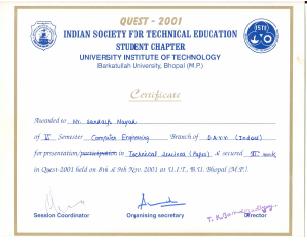
                                  Presented and published at ISTE Quest2001, November 8-9 2003 UIT, Barkathullah University Bhopal

Computers have been used in education for last several years. Computer based training (CBT) and Computer aided instruction (CAI) were the first such systems deployed as an attempt to teach using computers. In these kinds of systems, the instruction was not individualized to the learner's needs. Instead, the decisions about how to move a student through the material were script-like, such as ``if question 21 is answered correctly, proceed to question 54; otherwise go to question 32.'' The learner's abilities were not taken into account. Both CBT and CAI  do not provide the same kind of individualized attention that a student would receive from a human tutor. For a computer based educational system to provide such attention, it must reason about the domain and the learner. This has prompted research in the field of intelligent tutoring system (ITS). ITSs offer considerable flexibility in presentation of material and a greater ability to respond to idiosyncratic student needs. These systems achieve their ``intelligence'' by representing pedagogical decisions about how to teach as well as information about the learner. This allows for greater versatility by altering the system's interactions with the student. I In designing these systems, it is useful to view them as being composed of five components: the student model, the pedagogical module, the domain knowledge, the communications module, and the expert model. Research has been done on each of these modules, but only a few are very well understood. Specifically, incorporating multiple teaching strategies in the pedagogical module is a large open research question.

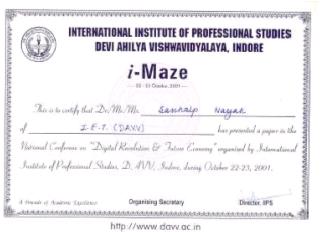
   An Overview of Computer Viruses and their detection alternatives

                                                                                     Presented and published at I Maze 2001,October 18-19 2001 IIPS ,Indore

All of us have been talking about them. Many of us have actually felt them. Almost each one of us has been protecting ourselves from them. They are the very familiar ‘COMPUTER VIRUSES’. There are myths about how widespread they are, how dangerous they are, and even myths about what a computer virus really is.Ever since the first virus was made a whole new field of virus recognition and detection emerged. From the earliest “Pakistani brain” to the very latest “nimbda” the viruses became not only more intelligent but also much more destructive. Their detection and elimination became an emerging and vibrant field of software industry-antivirus. In this paper we discuss some of the basic techniques used to detect viruses such as signature scanning, integrity scanning, vaccination, bait programming and heuristic techniques, which are the basis of antivirus software. A brief evaluation of these techniques is also discussed. But before that we define some of the basic terminologies related to viruses such as logic bomb, worm ,Trojan horse, stealth virus etc. and their classification, activation routines such as code insertion  and how they attach themselves to the existing software and programs i.e. virus code addition . We also discuss in brief how viruses avoid detection and about retroviruses, which could be defined as anti-antivirus programs.

 Biometrics – Authentication and Identification

                                                                                                                      Presented at IET, DAVV  January 2003

Traditionally, two major types of personal identification approaches have been used: knowledge-based and token based. The weakness of these systems is the fact that passwords can be forgotten, shared or observed and tokens can be lost, stolen or duplicated. In addition, they are unable to differentiate between an authorized person and an impostor using the token or the knowledge fraudulently acquired from the authorized person. Biometric authentication, in the context of this presentation, refers to automated methods of identifying, or verifying the identity of, a living person. Several of the biometric characteristics of an individual are unique and do not change over time. These properties make biometrics well suited for authentication. This presentation was an introductory talk on biometrics covering various types and methods such as fingerprint recognition, face recognition, hand recognition, iris scan, voice recognition etc. It discussed the pros and cons of these techniques as well as latest research in these fields

Hosted by www.Geocities.ws

1