
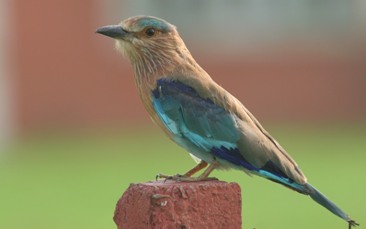
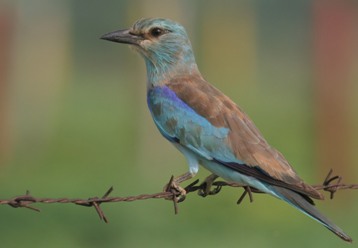
Delhi, says birder Dr Vivek Tiwari and the California-based director of engineering, Intel Corporation, presents a fascinating mix of birds ranging from the rufous-necked hornbill to the brown rock-chat to spiderhunters and sunbirds. At a recent illustrated presentation at the India International Centre, titled 'Birds of India: East meets West', Dr Tiwari gave a rundown of birds he has viewed in habitats as diverse as Banni Grasslands, Kutch, the Yosemite National Park, California to his favourite birding spot—the rooftop of his parents’ apartment in Paschim Vihar, New Delhi.
The gardens, parks, in fact wherever there is greenery in Delhi, such as Lodhi Gardens and Buddha Jayanti Park, are a treasure trove for birders, he pointed out. In his words, 'Delhi is one of the birdiest if not the most birdy of the metropolises in the world'. Dr Tiwari has seen over 2,500 bird species over a quarter of the total number in the world. Here he spoke to me about his long innings as a birder, his favourite species and a range of other subjects on birding. 'My presentation is sub-titled "East meets West" because the bird-life of India has a distinctive flavour—a blend of the East and West. East, as in birds that typify the Oriental region and West as in birds that typify the Palearctic (European and North Asian) and African regions. We can view it as a meeting point for several ecoregions—the dry habitats and vegetation of the Thar and Kutch are somewhat similar to those of the Saharan and Arabian regions, the wet forests of the Himalayan foothills are contiguous with and similar to those of South East Asia and the upper reaches of Himalayas have temperate and alpine habitats and vegetation similar to those of Europe and Northern Asia.'
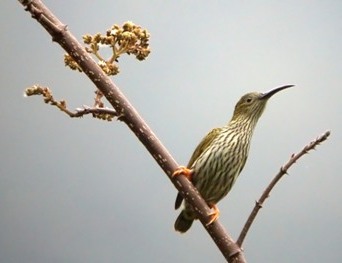
'There are many species that hold a particular fascination for me such as the majestic birds like the greater hornbills, for example the rufous-necked hornbill of wet, tall forests of the North East—a spectacular bird to look at and now also threatened from hunting and loss of nesting trees, birds with a very limited distribution and thus hard to see—like the Grey Hypocolius that winters in Gujarat (breeds in Iraq and Iran) or the Black-naped tit, the Brown Rock-Chat and the Streaked Spiderhunters and Sunbirds. Streaked Spiderhunter is a species that is widely distributed over Southeast Asia, but it reaches only the northeastern prt of India . However, ever since I first leafed through Salim Ali’s Pictorial Guide to the Birds of India, there was something about this bird and its name that stuck with me and I developed a great desire to see this bird. I also use this bird as my icon in online forums. When I finally made it to the North East, at Namdapha National Park, this gratifyingly turned out to be the most common and visible birds there!'
'My interest in birds and nature started when I was at IIT, Delhi. In fact my interest in birding happened almost by accident. In my third year in college I heard about a trip to Chilla near Haridwar organised by the IIT Delhi Nature Club. Never having spent any significant time in forests, I expected to see all kinds of wild animals at every corner. But a whole day of trekking inside the forest on foot yielded only an elephant and some lizards. This was not turning out to be too much fun. We camped by the river at night and in the morning I saw a group of people heading off into the forest with a pair of binoculars. I asked them what they were planning to do and they said—look for birds. That sounded strange but since I did not seem to have anything better to do, I decided to follow them. This turned out to be life-changing. One of the first birds I ever saw through a pair of binoculars was a Golden Oriole, a beautiful yellow and black bird that I had never seen before, or did not even know that it existed. As I watched, it opened its beak to give its melodious call and I was hooked from that point on.'
'When I went to Princeton for my graduate studies, I again, just by luck, heard about an adult education class on birdwatching being offered at the Princeton High School . That experience opened my eyes to how much there was to learn about birds and birding and how it could be a rewarding lifelong passion. Ultimately though my interest in birding is sustained since I am fascinated by the natural world in general, enjoy the outdoors and love to travel. In birding I have found an activity that combines the best of all of these.'
'In the future, I do hope to see as many birds in India as possible. Increasingly I am also interested in improving my skills in bird photography and ideally would like to be able to photograph every new species I see. I also hope to continue to visit and bird in Central and South America, the only regions of Earth that exceed India in bird diversity. In the end though, my main goal is to do more to protect birds and bird habitats.'