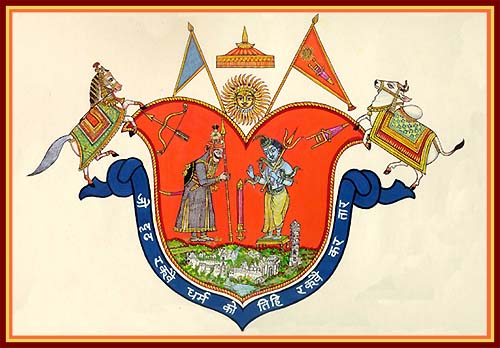
Coat of Arms
|
Rana Udai Singh |
1537-1572 |
|
Rana Pratap Singh |
1572-1596 |
|
Rana Amar Singh |
1596-1607 |
|
Rana Sugra |
1607-1615 |
|
Rana Karan |
1620-1628 |
|
Rana Jagat Singh |
1628-1652 |
|
Rana Raja Singh |
1652-1680 |
|
Rana Jaya Singh |
1680-1699 |
|
Rana Amar Singh II |
1699-1711 |
|
Rana Sangrama Singh II |
1711-1734 |
|
Rana Jagat Singh II |
1734-1752 |
|
Rana Pratap Singh II |
1752-1754 |
|
Rana Raja Singh II |
1754-1761 |
|
Rana Ari Singh II |
1761-1771 |
|
Rana Hammir II |
1771-1777 |
|
Maharana Bhim Singh |
1777-1828 |
|
Maharana Jawan Singh |
1828-1838 |
|
Maharana Sardar Singh |
1838-1842 |
|
Maharana Sarup Singh |
1842-1861 |
|
Maharana Sambhu |
1861-1874 |
|
Maharana Sujjan Singh |
1874-1884 |
|
Maharana Fateh Singh |
1884-1930 |
|
Maharana Sir Bhupal Singh |
1930-1955 |
|
Maharana Bhagwat Singh |
1955-1985 |
|
Maharana Mahendra Singh |
1985-Present |
|
|
|
|
|
|
|
Maharana Arvind Singh ji
(Present Ruler of Udaipur) |
|
|
|
|
|
|
Maharana Bhagwat Singh
(1955-1985) |
|
|
|
|
|
|
Maharana
Bhopal Singh
(1930-1955)
|
|
|
|
|
|
 |
Royal House of Mewar:
Legend has it that the Sisodias of Mewar
are descended from Lord Rama whose life story is told in India's great
epic, the Ramayana. They came from the borders of Kashmir and by the
second Century B.C. they had moved south to what is now Gujarat,
founding, as they went, several cities along the coast, one of which was
called Vallabhai.
The chronicles of the bards tell us that in the sixth century Vallabhai
was sacked by strangers from the west. The Queen of Vallabhai,
Pushpavati, who was on a pilgrimage offering prayers for her unborn
child, heard of the destruction of Vallabhai and the death of her
husband while traveling through the Aravalli hills in the north.
Despairing, she took refuge in a cave, and there gave birth to a son
whom she called Guhil, or "cave born." Then, entrust her child to a
maidservant, the queen ordered a funeral pyre lit, and walked into it to
join her dead husband's soul. Guhil, or Guhadatta, was befriended by the
Bhils, tribal aborigines who had lived in the Aravalli hills since well
before 2000 B.C. Amongst the Bhils, Guhadatta grew in power, and became
a chieftain. His progeny came to be known as Guhilols.
In the seventh century the Guhil moved north, and down to the plains of
Mewar, changing their name to Sisodia, after a village they encountered
on the way. The descendants of Guhadatia were the great Ranas, Rawals
and Maharanas of Mewar, builders of forts and palaces, whose exploits in
peace and war are unmatched in valor and chivalry.By the time of India's
independence, the royal line of Mewar had ruled for 75 generations,
1,400 years; the oldest of Rajasthan's ancient dynasties.
The Founding of Udaipur: In 1
567, the capital of Mewar, Chittor, was sacked for the third time by the
armies of the Mughal Emperor Akbar; Rana Udai Singh 11 withdrew into the
hills and ravines of the Aravalli. One morning, the rana was out by Lake
Pichola hunting. While mounted and on the move he performed the
difficult feat of spearing a fast-moving rabbit. Then, a short distance
away, he saw a sage meditating. The Rana dutifully paid full respects to
the holy man. "Where, 0 Revered One," the rana asked the sage, having
recounted the fall of Chittor, "should 1 build my next capital city?"And
the sage answered, as sages will, "Why, right here of course, where your
destiny has brought you to ask such a question."And that's what Udai
Singh did.Surrounded by forests , lakes and the protective Aravalli
range, the new capital of Mewar was certainly less vulnerable location
then Chittor.Maharaja Udai Singh died in 1572 and was succeeded by his
son, Pratap, who bravely defended Udaipur from subsequent Mughal
Attacks.
Rana Pratap (ruled 1572-97) was palace one of the great warrior kings of
right, Mewar. He lived in troubled times
Emperor Akbar, the
Great Mughal ,emblem was expanding his domains, irresistibly in and,
across the subcontinent. He had already sacked the Mewar
stronghold,richly Chittor, driving Pratap's father, Rana Udai Singh II,
out towards a new life in the new capital, Udaipur. Rana Pratap gallery
was imbued with stories of the lost em greatness of Mewar and obsessed
with pieces a desire to recover its territories, and the the the fort of
Chittor, the soul of Mewar. The indomitable Pratap threw him- is the
self against the might of the Mughal armies again and again, losing the
battle of Haldighati, losing every fort, including Kumbalgarh,
retreating to the hills and ravines of the Aravallis where sometimes his
family hadn't enough to cat. In these years of adversity, they were
sustained by loyal Bhil tribesmen, whose ancestors had, centuries
earlier, supported the rana's ancestor, Guhadatta.
Rana Pratap was one of
the two Rajput kings who refused to accept Mughal suzerainty or
compromise with Akbar: no daughter of Mewar was ever given to a Mughal
emperor or prince in marriage. The other Rajput ruler similarly to hold
out against the Mughals was the king of Bundi. Akbar allowed both states
to survive and the next generation of rulers had to accept reality and
sign treaties with the Mughals. eventually, Pratap freed Udaipur and much
of Mewar from the Mughals Niwas, grip but he failed to win his heart's
part of the desire: Chittor.
After struggling
against the Mughals, Udaipur was later attacked by the Marathas.An end
to the bloody battles and instability came with British Intervention in
the early 1900 century, when a treaty was signed which pledged to
protect Udaipur from invaders. Along with all other Princely states,
Udaipur surrendered its Sovereignty and became a part of a United India.
USEFUL Resources:
http://www.mewarindia.com/ency/chistory.html
http://www.geocities.com/rajput_world
http://www.rajputvivaaha.com/
http://www.atributetohinduism.com/
http://www.geocities.com/rajput_world/adval.htm
http://www.amarchitrakatha.com/
http://www.ranayouth.com/
http://www.rajputindia.com
http://www.rajputra.org/
http://www.rajputsamaj.co.uk/
http://www.rajputs.org.uk/
http://www.rajputmatrimonial.com/
http://www.geocities.com/lavlesh/contents-sudheer.html
http://www.rajputsamaj.net
http://www.geocities.com/lavlesh/casteprotectors.html
http://en.wikipedia.org/wiki/Rajput
http://sanjaysuryavanshi.itgo.com
http://kshattriyasena.freeservers.com
http://kshatryas.tripod.com/
http://www.geocities.com/rajput_world/allrajputs1.htm
|