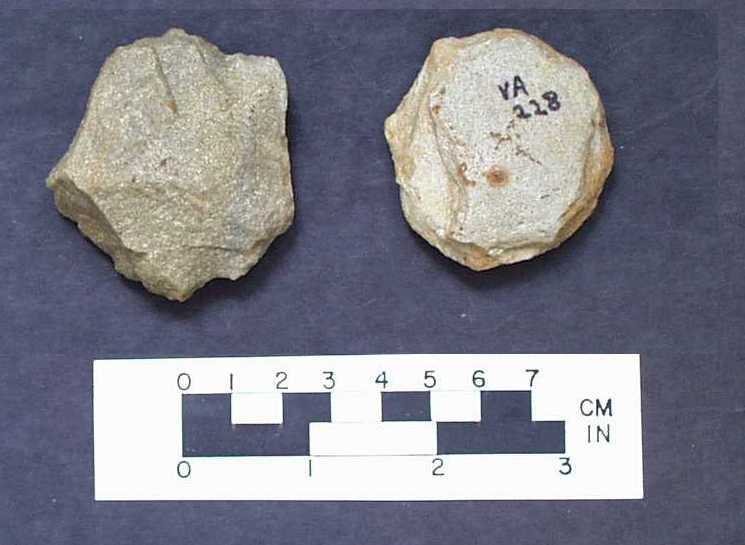
Defining Characteristics: This type is usually made on a medium to thick flake often with cortex still remaining. It is usually unifacially flaked around its entire edge into a discodial shape. Thicker examples may be mistaken as cores.
|
Total Number |
14 |
|
Weight(oz) |
3.6 |
|
Circumference(cm) |
17.4 |
|
Thickness(cm) |
23.7 |
|
Min. Angle(average) |
65.9 |
|
Max. Angle(average) |
88.0 |
Notes: This type has been clearly used throughout most of human antiquity. Diagrams of identical specimens have been reported from Africa dating to at least 36,000 B.C.(Clarke 1970). Coe (1964) reported these planes as oval scrapers that were made on a thick exterior spall that retained large areas of cortex. He reported two specimens, he thought were in context with other Hardaway artifacts (Coe 1964).
Description
of Figures:
a1:
Two examples of Circular Type Scraper-Planes.
Left: Notice example without flaked area where the original platform is. This occurred occasionally from difficulty in flaking or could
have been on purpose for grasping. Right:
Well used specimen of poor quality quartzite.
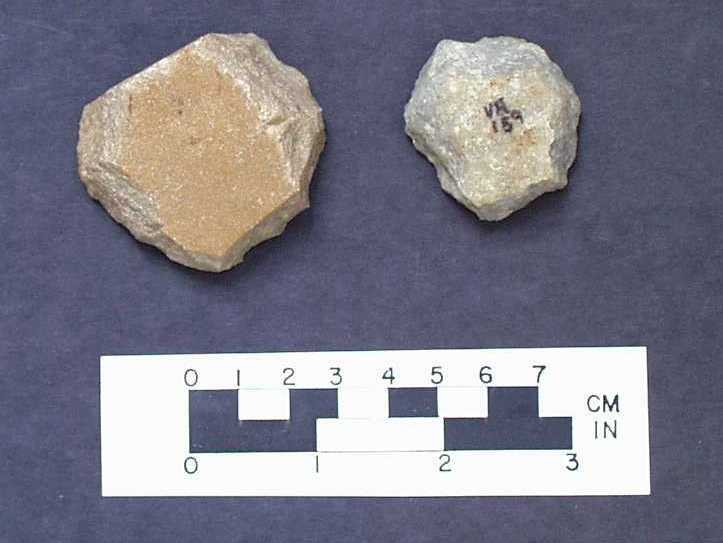
a2:
Examples of Circular Type Scraper-Planes.
Left: Classic example of type with cortex still remaining.
Right: Possibly a well used example, indicated by its smaller size from
resharpening.
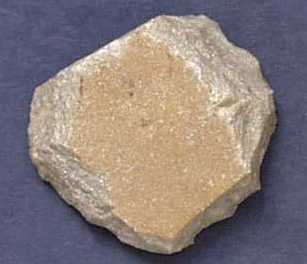
a3:-Closeup
of Circular Type Scraper-Plane, showing retouched edges. Average number of edges
used per plane: 1.8
|
Total |
Percent |
|
|
Convex |
16 |
76% |
|
Concave |
2 |
10% |
|
Straight |
3 |
14% |
Number of working surfaces totaled for type and percentages