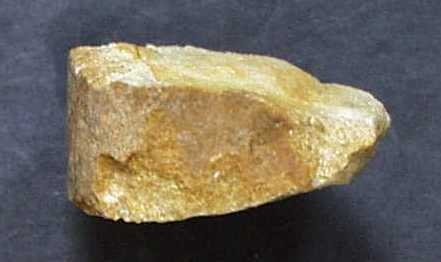
Defining Characteristics: This type was usually made on a large sized flake. In some attributes, the Teshoa and flake type are similar. The Flake type did not always have more than one working edge. It did not always have cortex. They, as with the other types, always were flaked unifacially to produce the planing edge. This type when thin merges into steep edged scrapers.
|
Total Number |
40 |
|
Weight(oz) |
3.7 |
|
Circumference(cm) |
20.7 |
|
Thickness(cm) |
23.3 |
|
Min. Angle(average) |
64.0 |
|
Max. Angle(average) |
77.6 |
Notes: This is probably the broadest category and could be sub typed when more specimens are studied. This was also was one of the most expedient types. Any thick flake with a somewhat flat surface would have sufficed.
Description
of Figures:
a1:
A reproduced example of a Flake Scraper-Plane made by the author.
It was made on poor quality quartzite.
This is one of several reproductions made to help determine types and
begin to work on production sequences.
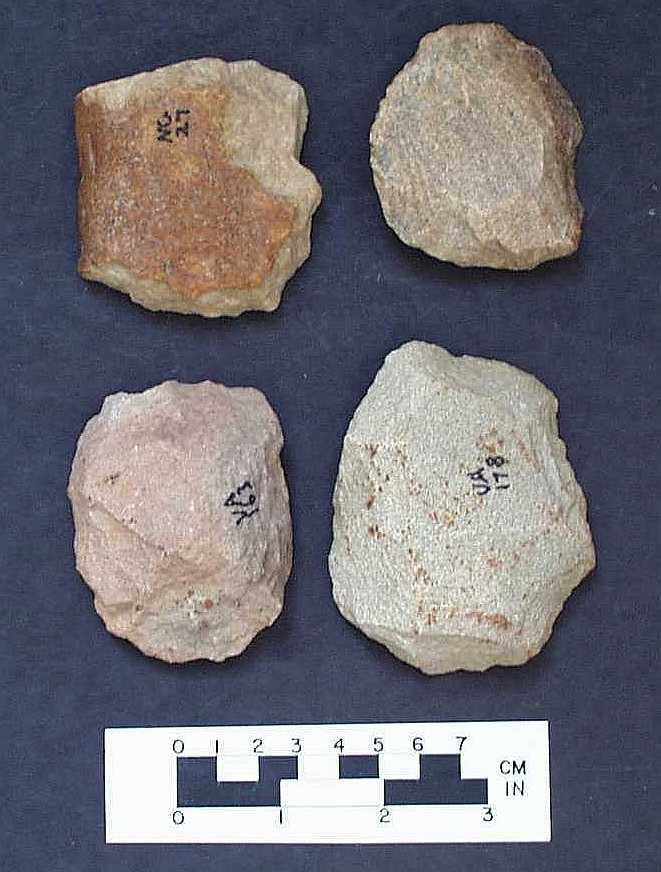
a2:
Four examples of Flake Scraper-Planes.
Top left: Flake of quartzite with one working edge.
Top right: Flake of quartzite with multiple working edges.
Bottom: Two typical examples of types usually found on Paleo-Indian
sites.
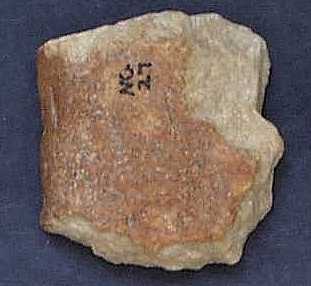
a3: Close-up
of Flake Scraper-Plane, showing retouched edges. Average number of edges used
per plane: 2.4
|
Total |
Percent |
|
|
Convex |
35 |
35% |
|
Concave |
21 |
21% |
|
Straight |
45 |
45% |
Number of working surfaces totaled for type and percentages
.