Page 3
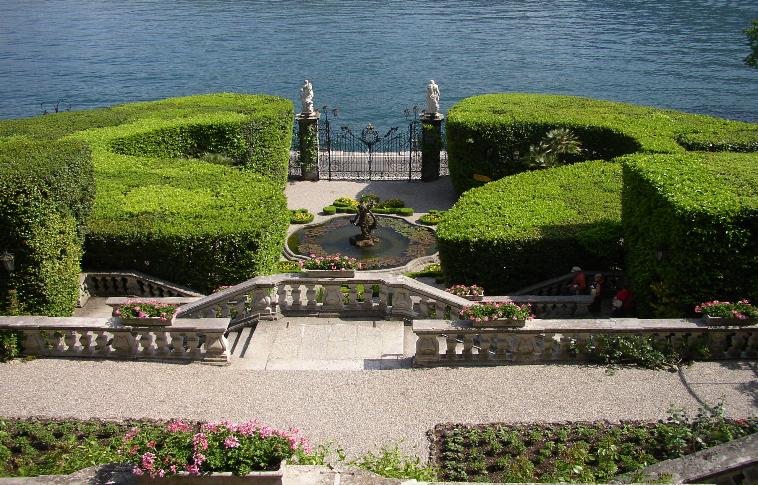
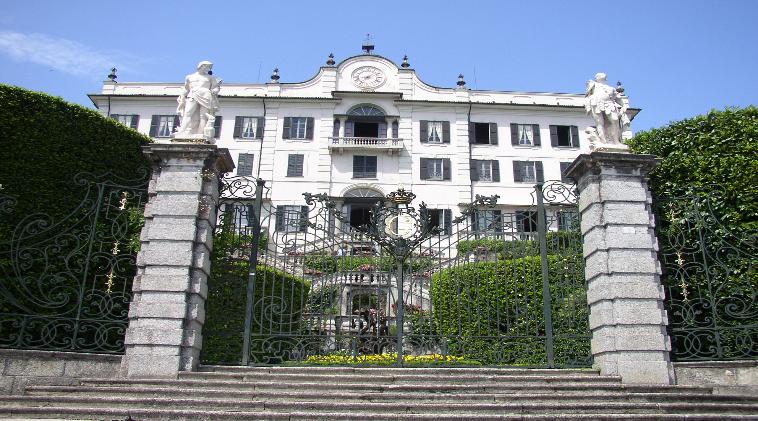
Villa Carlotta outside Cadenabbia on Lake Como
Magnificent!
The gardens of Villa Carlotta - Breath takingly beautiful!
Villa Carlotta
Can you imagine living in this villa with the lake at your front door? I want to move in!
Alpe di Siusi via Verona
Verona (day stop)
Well, we leave our quiet little village and start our adventure on the bus! We are off to the Dolomites and the Alpe di Siusi via Verona. Romeo and Juliet made Verona a household word. But, alas, a visit here has nothing to do with those two star-crossed lovers. Or does it? R and J fans will take some solace in the fact that two real feuding families the Montecchi and the Capellis, were the models for Shakespeare’s Montagues and Capulets. And, if R & J had existed and were alive today, they would recognize much of the “hometown.”
History lesson #1 regarding village walls and how a village is laid out. The Groeths and Gibelings (sp?) were two large families that occupied various territories throughout Italy. Now, we get a lesson in navigating our first major village! Yes, I had a map, but that did not always work either! All medieval and Roman villages seemed to have at least one side on a river (for several obvious reasons) and were surrounded by a wall. Now, if the village was controlled by the Groeths, then the top of the wall had sections of brick in rectangular shape every so many feet. If the Gibelings occupied the village, then the top of the wall looked like bird wings. Also, you immediately knew if the village was medieval or Roman by the streets. A medieval village went from the central plaza out like spokes in a wagon wheel. A Roman village was done in grid fashion. Believe me, the Roman villages were much easier to navigate and you were less likely to get lost! However, remember that you could not go too far because of the wall or river. So, if you left the village it was very obvious! Well, only if you are paying attention and not gawking at the sights and scenery!
Verona’s main attractions are its wealth of Roman ruins, its 21st century, quiet, pedestrian only ambience, and a world class opera festival. The most enjoyable core of Verona is along Via Mazzini between piazza’s and the market square since Roman times. And, of course, there is a Roman arena which was the third largest in the Roman world. Dating from the 1St century A.D., it looks great in its pink marble. Over the centuries, crowds of up to 25,000 spectators have cheered Roman gladiator battles, medieval executions, and modern plays. It should be noted that the acoustics in all the arenas are fantastic!
Piazza Erbe, Verona’s market square is a photographer’s delight, with pastel buildings corralling the stalls, fountains, pigeons (not if one shits on your head!), and people that have come together here since Roman times when this was a forum. And, there is a Venetian lion hovering above the square reminding locals since 1405 of their conquerors. During medieval times, the stone canopy in the center held the scales where merchants measured the weight of things they bought and sold, such as silk, wool, and even wood. The fountain has bubbled here for 2,000 years. Its statue, originally Roman, had lost its head and arms, but a sculptor replaced them – viola- the statue became Verona’s Madonna. She holds a small banner that reads: “I want justice and I bring peace.”
From the Piazza Erbe, I headed toward the river on Via della Costa. The street is marked by an arch with a whale’s rib suspended from it. The whale’s rib has hung there a thousand years, but don’t worry about it falling. According to legend, it will fall when someone who’s never lied walks under it.
The street soon opens up to a square, Piazza di Signori, which has a white statue of Dante. Dante was expelled from Florence for political reasons and was granted exile in Verona by the Scaligeri family. With the whale’s rib behind me, I was facing the brick crenellated, 13th century Scaligeri residence. And behind Dante was the yellowish, 15th century Venetian Renaissance style Protico of the Counsel. In front of Dante and to his right was the 12th century Romanesque Palazzo della Ragione.
As you continued down the whale bone street, the very strange and Gothic tombs of the Scaligeri family appear. They were to Verona what the Medici family was to Florence. On the top of the first tomb is a dog’s head peering over a shield displaying a ladder. The story goes that the Scaligeri family got rich making ladders, but money can’t buy culture. When Marco Polo returned from Asia boasting of the wealthy Kublai Khan, the Scaligeris wanted to be associated with this powerful Kan by name. But misunderstanding “Khan” as “Cane” (dog), one Scaligeri changed his name to Can Grande (big dog) and another to Can Signori (lead dog).
I left the village and walked across a Roman bridge. Yes, this was actually built by the Romans and I walked on the very same stones! Pretty amazing! What a feeling! Actually, I walked across the bridge to get to the Teatro Romano (Roman Theater). Dating from the 1st century A.D., this ancient theater was discovered in the 19th century and restored. There was also a museum which displayed Roman artifact (mosaic floors, bust, and clay and bronze votive figures) and a model of the theater which I found to be most helpful in understanding what I was experiencing!
After visiting the theater, I headed toward the striped (Moorish influence) Duomo, one of Verona’s historic churches. Started in the 12th century, it was built over a period of centuries, showing with its bright interior the tremendous leaps made in architecture. Then, there was the ghostly white Porta Borsari, stretching across the road. This sturdy 1st century Roman gate was one the original entrances to this ancient town.
Well, we climbed back onto the bus (I was almost late because I got lost and finding my way around was getting very frustrating to say the least!) outside the wall at the Golden Arches (Yes, McDonald’s!). With all the piazza’s, you can see why it was very easy to get lost! God bless the wall and the river! To hell with the map! Amen! But, I was so excited to have walked across a Roman bridge!