
Page 16
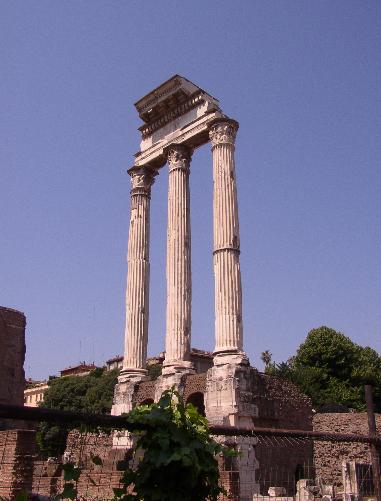
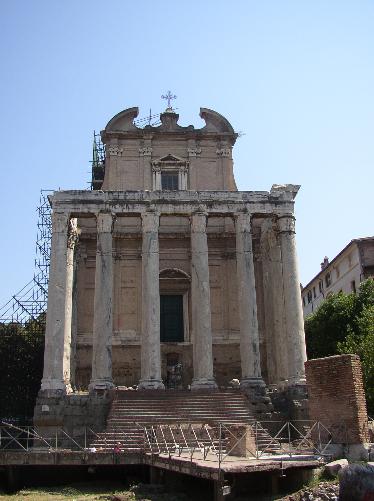
This is an excellent example of Rome continually building on top of old ruins.
The Basilica of Constantine - Notice the Christian church built within the Roman columns.
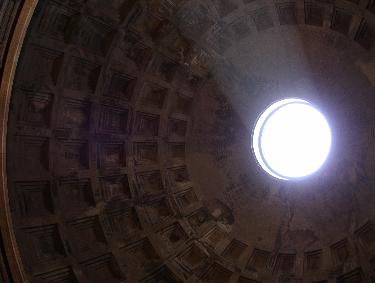
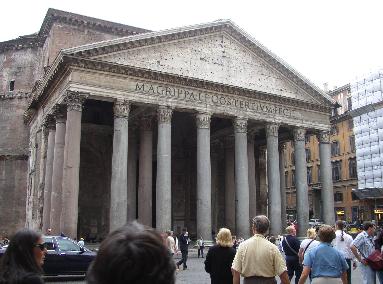
Pantheon – It is a circular temple completed in 27 B.C. and dedicated to all the gods of ancient Rome. The temple provides the greatest look at the splendor of Rome, antiquity’s best preserved interior. Because it became a church dedicated to the martyrs just after the fall of Rome, the barbarians left it alone, and the locals didn’t use it as a quarry. The portico is called Rome’s umbrella because it is a local gathering place in a rainstorm. Its one piece granite columns (biggest in Italy, shipped from Egypt) and the bronze doors are most impressive! The dome at 142 feet high and wide was Europe’s biggest until the Renaissance. Michelangleo’s dome at St. Peter’s, while much higher, is about 4 feet smaller. The brilliance of this dome’s construction astounded architects through the ages. During the Renaissance, Brunelleschi was given permission to cut into the dome to analyze the material. The concrete dome gets thinner and lighter with height – the highest part is volcanic pumice. This wonderfully harmonious architecture greatly inspired Raphael and other artists of the Renaissance. Raphael, along with Italy’s first two kings, chose to be buried here.
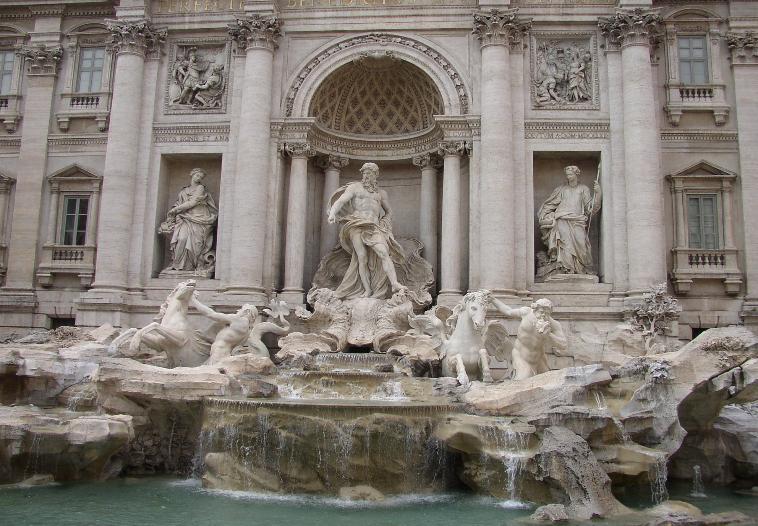
Trevi Fountain – This bubbly Baroque fountain of Neptune with his entourage is absolutely spectacular! It is an example of how Rome took full advantage of water brought into the city by its great aqueducts (a spring about 80 miles away – the water is not recycled.). This watery avalanche was built in 1762 by Nicola Salvi, hired by a pope celebrating his reopening of the ancient aqueduct that powers it. Salvi used the place behind the fountain as a backdrop for Neptune’s entrance into the square. Neptune surfs through his watery kingdom while Triton blows his conch shell.
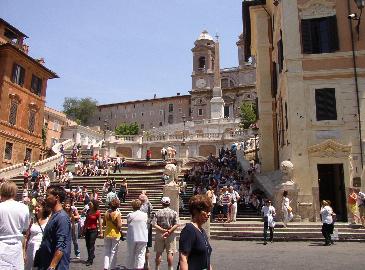
Spanish Steps – The Piazza di Spagna with the very popular Spanish Steps, got it name 300 years ago, when this was the site of the Spanish Embassy. The Boat Fountain at the foot of the steps, which was done by Bernini’s father, Pietro Bernini, is powered by an aqueduct.
Villa Borghese and Gallery - This was without a doubt my all time favorite museum! More than just a great museum, Galleria Borghese is a beautiful villa set in the greenery of surrounding gardens. We got to see art commissioned by the luxury loving Borghese family displayed in the very rooms they were created for. It is a gathering of beautiful objects from every age and culture inside a lavish 17th century villa built by Cardinal Borghese. (The Borghese’s were a Roman noble family, originally of Siena.) He wanted to prove that the glories of ancient Rome were matched by the Renaissance. Thus, the essence of the collection is the connection of the Renaissance with the classical world. This museum was a favorite because I am partial to Baroque style and Bernini sculpture!
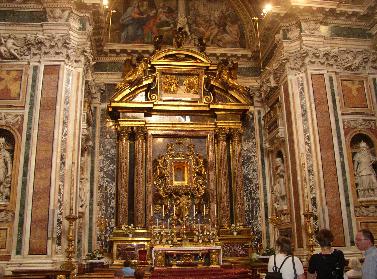
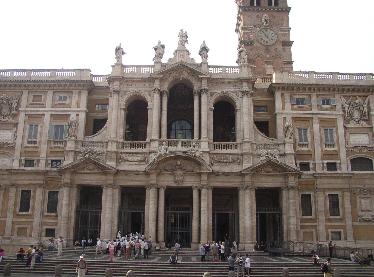
Santa Maria Maggiore Basilica (St. Mary Major Basilica)
The title of this church is confusing to many because it means that this is Rome’s major or principal church dedicated to St. Mary. The first church here was founded in 350 by Pope Liberius, and financed by a Roman patrician and his wife. They were childless and had decided to leave their fortune to the Blessed Virgin. She appeared to them in a dream and told them to build a church in her honor. It lies on the summit of the Esquiline Hill, which was mainly laid out as gardens in ancient times. Legend claims that the plan of the church was outlined by a miraculous snowfall (also know as Our Lady of the Snow) in August of 358. The legend is commemorated every year on August 5th, when white rose petals are dropped from the dome. The Romanesque bell tower is the highest in Rome at 246 feet.
Pope Sixtus III had it restored, or more likely rebuilt, to commemorate the declaration of St. Mary’s Divine Motherhood by the Council of Ephesus in 432. The church was damaged in the earthquake of 1348, and restored again some years later.
As in other patriarchal basilicas, there is a Chapter of Canons here. In addition, Redemptorists assist as sacristans, and a ‘college’ of Dominicans, speaking several different language, hear confessions most of the day.
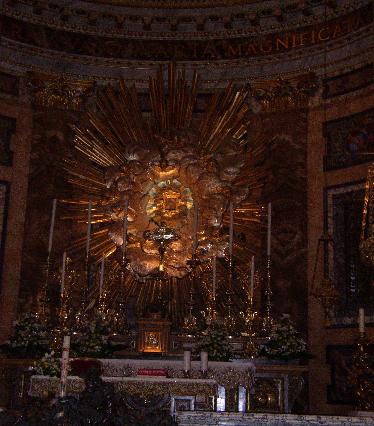
Santa Maria della Vittoria – This church houses Bernini’s statue of a swooning St. Teresa in Ecstasy. Teresa has just been stabbed with God’s arrow of fire. Now the angel pulls it out and watches her reaction. Teresa swoons, her eyes roll up, her hand goes limp, she parts her lips…and moans. The smiling, Cupid like angel understands just how she feels.
Bernini, the master of multimedia, pulls out all the stops to make this mystical vision real. Actual sunlight pours through the alabaster windows; bronze sunbeams shine on a marble angel holding a golden arrow. Teresa leans back on a cloud and her robe ripples from within, charged with her spiritual arousal. Bernini created a little stage setting of heaven.