|
|
|
|
|
|
|
|
|
|
|
|
|
|
|
|
|
|
|
|
|
|
|
|
|
|
|
Page 17 |
|
|
|
 |
|
|
Vatican City
“The smallest state in the world at the center of the largest spiritual kingdom.” This tiny walled independent country of 108.6 acres contained entirely within Rome, has its own postal system (The mail goes to the Switzerland postal system. We were told Italian stamped mail is discarded at the Vatican.), armed Swiss guards, helipad, mini-train station, and radio station. Politically powerful, the Vatican is the religious capital of 800 million Roman Catholics. |
|
|
|
|
|
|
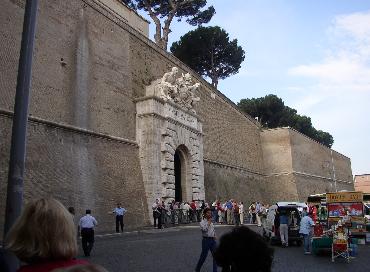
The Vatican City wall. Wow! Notice it's height! |
|
|
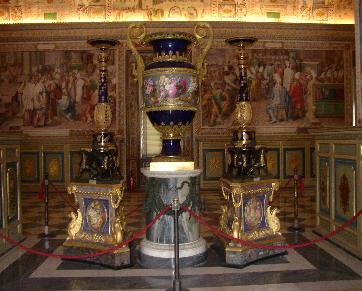
Vatican Museum – This is a 3.75 mile museum displaying ancient statues to Christian frescoes to modern paintings and of course, Michelangelo’s glorious Sistine Chapel. You could stay in here for days and still not see everything! I was once again amazed that you can get right up close and personal with the majority of the art. We were in the museum for about 4 hours and of course you start to get tired and everything runs together. But, there are two things that really stand out in my mind and I can picture so clearly. There was a tapestry of Christ (and I am talking huge – perhaps the size of my family room) lying on the ground and as you walked past he seemed to follow. It was the most amazing thing I have seen! How in the world did they do that? The second item was a vase or urn. This urn was about 6 feet tall and the deepest cobalt blue I think I have ever seen. And, of course it was etched in gold! Once again, it was right out there for you to admire and touch if desired. How in the world can all this art work and magnificence be in one place?! Ah yes, money and power/control! But, on the other hand, if the people had not been illiterate, then there would have been no need to tell the Biblical story resulting in an absence of all this art. Secondly, if the church were not so powerfully rich, then who could have afforded all this?! So, as with everything else there are positives and negatives to the story! It simply depends upon one’s perspective! The art book I purchased at the Vatican will certainly capture the essence of my feelings and what I experienced! |
|
|
|
|
|
|
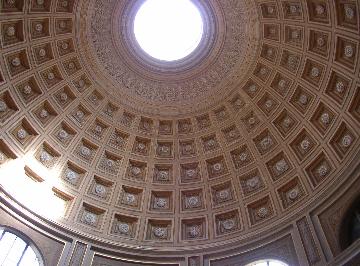
The ceiling of the Round Hall. Notice similarity to Pantheon. |
|
|
|
|
|
 |
|
|
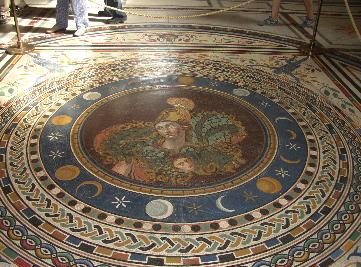
Mosaic floor leading to the Gallery of Candelabras |
|
|
|
|
 |
|
|
 |
|
|
Colbalt blue large than life vase and candle holders! Exquisite! |
|
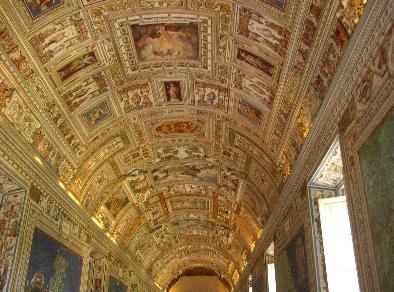
The ceiling of the map room - all gold! Similar to the staircase ceiling in the Doge's Palace. |
|
|
|
 |
|
|
|
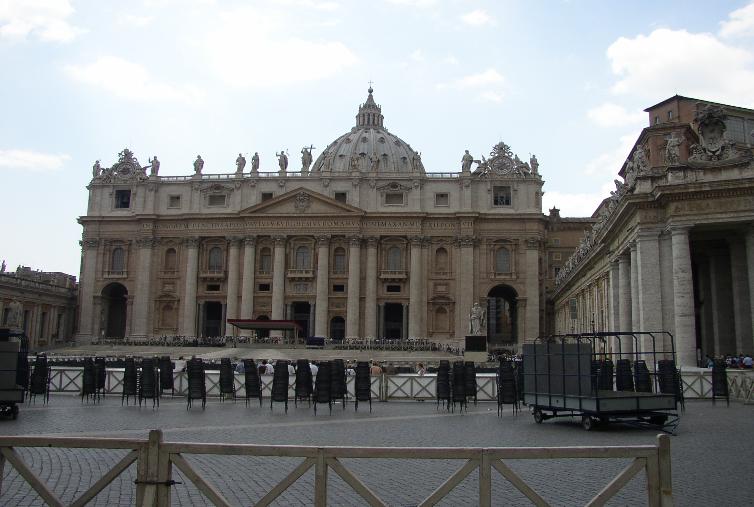
St. Peter's Square - Vatican City |
|
|
|
Next Page |
|
Sistine Chapel – The Sistine Chapel, the pope’s personal chapel, is where, upon the death of the ruling pope, a new pope is elected. The College of Cardinals meets here and votes four times a day until a 2/3’s plus one majority is reached and a new pope is elected.
Before his death, Bramante persuaded the Pope to order Michelangelo to paint the ceiling of the Sistine Chapel. Bramante expected Michelangelo, a sculptor and not a painter, to botch the job. He was wrong! The Sistine is famous for Michelangelo’s pictorial culmination of the Renaissance, showing the story of Creation, with a powerful God weaving in and out of each scene through that busy first week. This is an optimistic and positive expression of the High Renaissance and a stirring example of the artistic and theological maturity of the 33 year old Michelangelo, who spent 4 years on this work. It should also be noted that he painted the latter portion of the story first. So, there is greater detail while they appear smaller from the floor level than the second half. We were told that the pope was in a major hurry for the project to be completed. So I can’t help but wonder if Michelangelo would not have redone the first half. And, contrary to popular belief, he did not paint on his back! He painted standing with his neck bent back! I am not sure which would have been worse!
Later, after the Reformation wars had begun and after the Catholic army of Spain had sacked the Vatican, the reeling Church began to fight back. As part of its Counter-Reformation, a much older Michelangelo was commissioned to paint the Last Judgment behind the altar. The message is as clear as the day Michelangelo finished it: Christ is returning, some will go to hell and some to heaven, and some will be saved by the power of the rosary.
St. Peter’s Basilica – The Basilica of St. Peter is traditionally believed to have been erected over the spot where St. Peter was buried after his martyrdom in Rome. And, his tomb is beneath the canopy altar. Over two hundred years later, in the early 4th century, Emperor Constantine erected a basilica dedicated to St. Peter on the Vatican Hill on the south side of the Tiber River. The Roman cemetery (under the basilica) on Vatican Hill was evidently located next to the Circus of Nero. It is conjectured by some that St. Peter was first martyred (by being crucified upside down) in the circus (Marked by the obelisk now standing in the center of St. Peter’s square.), and then buried in the neighboring cemetery. Constantine's basilica was demolished in the 16th century and the present church was built on the same site.
There is no doubt this is the richest and most impressive church on earth! It is huge!!!!!!!!!! It can accommodate 95,000 worshiper standing on its six acres. Marks on the floor show where the next largest churches would fit if they were put inside. The ornamental cherubs would dwarf a large man. Of course, Michelangelo designed the church and his Pieta is here. Bernini’s altar work, seven story tall bronze canopy (baldacchino), and splendid square and colonnade defies the imagination!
Michelangelo planned a Greek-cross floor plan rather than the Latin-cross standard in medieval churches. A Greek cross, symbolizing the perfection of God, and by association the goodness of man, was important to the humanist Michelangelo. But, accommodating large crowds was important to the Church in the fancy Baroque age, which followed Michelangelo. So, the original nave length was doubled.
Michelangelo designed a dome that would actually dwarf the nearby Pantheon. It would be smaller than the Pantheon in diameter (142 feet), but stand much, much higher. Made almost entirely of heavy masonry, the dome stretches 138 feet in diameter and rises 452 feet above the street. To support such a giant dome, builders placed three iron rings within the masonry of the dome. But even the rings couldn't hold back the outward thrust of tension; significant cracks eventually developed around the dome's base. By the early 18th century, the cracks became serious enough for Vatican engineers to add several more tension rings as an emergency fix. Fortunately, this solution has stood the test of time. The gold lettering within the dome is 6 feet tall. Despite designing the majority of St. Peter's Basilica, the 71-year-old Michelangelo refused to be paid for his work on the church.
Now, for a quick walk through the Basilica. The Holy Door (bricked shut) at the entrance is only opened every 25 years (2025) to celebrate an especially festive year derived from the Old Testament idea of the Jubilee Year. Originally every 50 years, Jubilee Year encourages new beginnings and the forgiveness of sins and debts. The purple circular porphyry stone marks the site of Charlemagne’s coronation in 800 A.D. The magnificent dome of Michelangelo is a vision of heaven with Jesus, Mary, a ring of saints, rings of angels, and on the very top, God the Father. The statue of St. Peter, with an irresistibly disable toe (Yes, people were actually kissing the toe ~ no me!) is one of the few pieces of art that predate this church. It adorned the first St. Peter’s church. St. Peter’s throne and Bernini’s starburst dove window (behind the canopy) is actually the site of a daily mass. The church is filled with mosaics, not paintings. And, you have to get in just the right light to see those tiny, tiny pieces. It simply does not seem possible that anyone could create such fine artwork appearing so real in the form of a mosaic!
Michelangelo sculpted his Pieta when he was 24 years old. His mastery of the body is obvious in this powerfully beautiful masterpiece. Jesus is believably dead, and Mary, the eternally youthful handmaiden of the Lord, still accepts God’s will even if it means giving up her son.