Page
15
Rome and Vatican City via the Amalfi Coast
Amalfi Coast
Talk about a beautiful cliff hanging experience, this certainly had to take first prize! (even over Capri) You can’t believe where and how these villages are built. One village was in a very small cove and at high tide the ocean laps up to their door step. You don’t need a vehicle in this village, just a boat! Amazing! I think I have said that numerous times throughout this dialog. The ocean views dotted by the small villages in the coves or hanging from the cliffs were extremely pleasing to the eye! It seemed as though we were stepping back in time (movie set?) and enjoying an extremely relaxing bus ride! Spices are the big thing along the coast. And, oh yes, we saw Sophia Loren’s home!
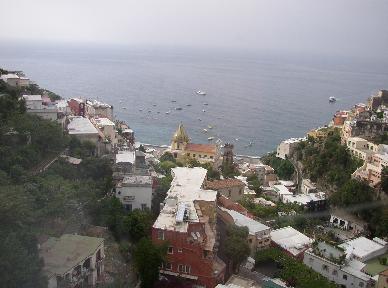
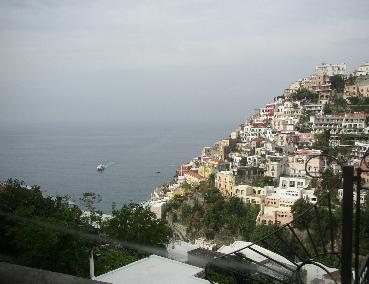
Amalfi coast - Talk about an ocean view and living on the edge of the mountain! Wow!
A typical village nestled at the mouth of the mountain along the Amalfi Coast.
Rome
Rome, at last we have made it to Rome! The capitol of the Roman Empire in all its glory! So, for 3 nights we called the Hotel Sonya our home (along with 2.6 million Roman citizens) which was within walking distance of most of the sights! Perfect! Rome at its peak, meant civilization itself. Everything was either civilized (part of the Roman Empire, Latin or Greek speaking) or barbarian. All roads lead to Rome!
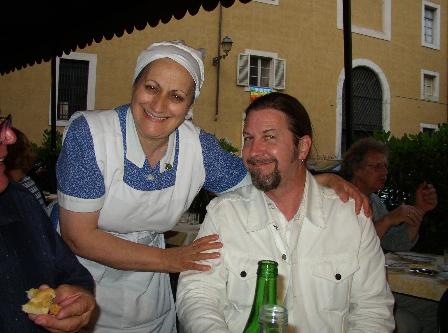
First we eat, then we see the sights of Rome! Donato and our Italian dinner hostess.
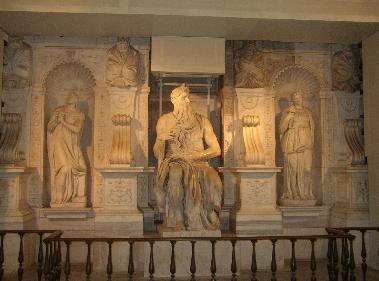
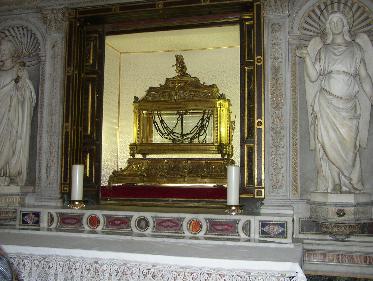
San Pietro in Vincoli (St. Peter in Chains Church) was built in the 5th century to house the chains that held St. Peter. It also contains the statue of Moses by Michelangelo. Pope Julius II commissioned Michelangelo to build a massive tomb, with 48 huge statues, crowned by a grand statue of this egomaniacal pope. The pope had planned to have his tomb placed in the center of St. Peter’s Basilica. When Julius died, the work had barely been started, and no one had the money or necessary commitment to Julius to finish the project. But, Michelangelo did finish Moses.
This powerful statue of Moses, as he holds the stone tablets with his eyes showing determination to win salvation for the people of Israel appears to have horns. Why the horns? Centuries ago, the Hebrew word for “rays” was mistranslated as “horns”.
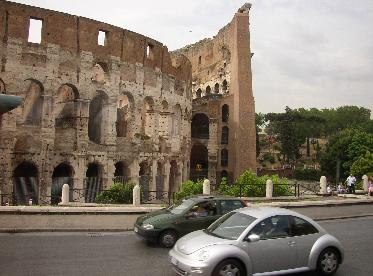
Colosseum – This 2,000 year old building is the greatest example of Roman engineering. Using concrete, brick, and their trademark round arches, Romans constructed much larger buildings than the Greeks. Holes were also drilled in the structure and filled with lead. This made it earthquake safe. Unfortunately, the lead was removed and melted down. They finished their no-nonsense megastructure with all three orders of Greek columns (Doric, Ionic, and Corinthian) as exterior decorations. The Flavian Amphitheater’s popular name, “Colosseum”, comes from the colossal statue of Nero that once stood in front of it.
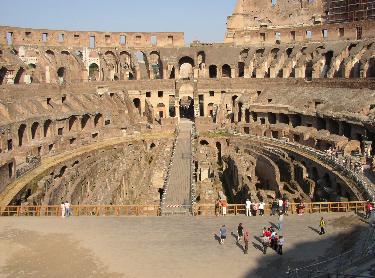
Romans were into “big”. By putting two theaters together, they created a circular amphitheater. They could fill and empty its 50,000 numbered seats as quickly and efficiently as we do our super-stadiums. Teams of sailors hoisted canvas awnings over the stadium to give fans shade. Gladiators, criminals, and wild animals fought to the death in every conceivable scenario. This was where ancient Romans watched beast vs. beast, man vs. beast, and man vs. man. And, of course at noon there was the killing of the Christians! The entire cost of these games was supported by the emperor. It is thought that it was a political move on his part to entertain the people because the majority of the population did not work. The floor of the Colosseum is missing, exposing all the underground passages. Animals were kept in cages here and then lifted up in elevators (a rope with pulleys) where they would pop out from behind blinds into the arena. To make this even more interesting, the gladiator didn’t know where, when, or by what he would be attacked. What fun! Yuck! Oh yes, the pope comes here every Good Friday to do a blessing!
The Roman Colosseum - Flavian Amphitheater
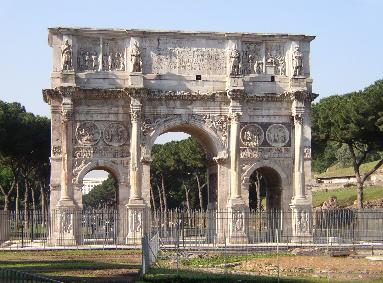
Arch of Constantine – The well-preserved arch, which stands between the Colosseum and the Forum, commemorates a military coup and more importantly, the acceptance of Christianity in the Roman Empire. In 312, the ambitious Emperor Constantine (who had a vision he could win under the sign of the cross) defeated his rival, Maxentius. Constantine, who became sole emperor, legalized Christianity.
Roman Forum (Foro Romano) – This is ancient Rome’s birthplace and civic center, and the common ground between Rome’s famous seven hills. As we ascend the hill, the Arch of Titus comes into view overlooking the remains of what was the political, social, and commercial center of the Roman Empire. The Arch of Titus, carved with propaganda celebrating the 70 A.D. defeat of the Jews, which began the Siapora that ended with the creation of Israel in 1947. And, the gaggle of soldiers are carrying the menorah. Imagine the Roman army marching through this arch after triumphal battle and conquest! The Via Sacra, the main street of ancient Rome, cuts through the Forum from here to Capitol Hill and the Arch of Septimius on the opposite side.
Only the giant barrel vaults remain of the Basilica of Constantine. But, at one point, it was richly clad in marble and fountains! We hiked on to the semicircular Temple of Vesta to the House of the Vestal Virgins. Here, the VV’s (5) kept the eternal flame lit. A set of ponds and a marble chorus line of Vestal Virgins mark the courtyard of the house. After serving 30 years, they were retired to the house and treated like queens. Hence, the desire to maintain employment and remain a virgin! The grand Basilica Julia, a first century law court, fills the corner of the Forum. Here, we notice that the Romans passed their time by playing ancient backgammon type games (the boards are cut into the pavement). The Arch of Septimius Severus from about 200 A.D., celebrates that emperor’s military victories. In front of it, a stone called Lapis Niger covers the legendary tomb of Romulus. To the left of the arch, the stone bulkhead is the Rostra, or speaker’s platform. It is named for the ship’s prows that used to decorate it as big shots hollered, “Friends, Romans, countrymen…”. The Roman senate sat in the Curia. It is a basic brick and concrete building which at one time had a marble veneer. The Basilica Aemilia (2nd century B.C.) shows the floor plan of an ancient palace. The pre-Chrisitan basilica design was later adopted by medieval churches.
Palatine Hill – The hill above the Forum contains scanty remains of the imperial palaces and the foundations of Rome, from Iron Age huts to the legendary house of Romulus. We get our word palace from this hill, where the emperors had to build out. And, behind the Palatine Hill is Circus Maximus, once a chariot course.
Capitol Hill (Campidoglio) – This hill was the religious and political center of ancient Rome. It’s still the home of the city’s government. Michelangelo’s Renaissance square (He designed it.) is bounded by two museums and the mayoral palace. The centerpiece is an equestrian statue of Marcus Aurelius.