
Page 12
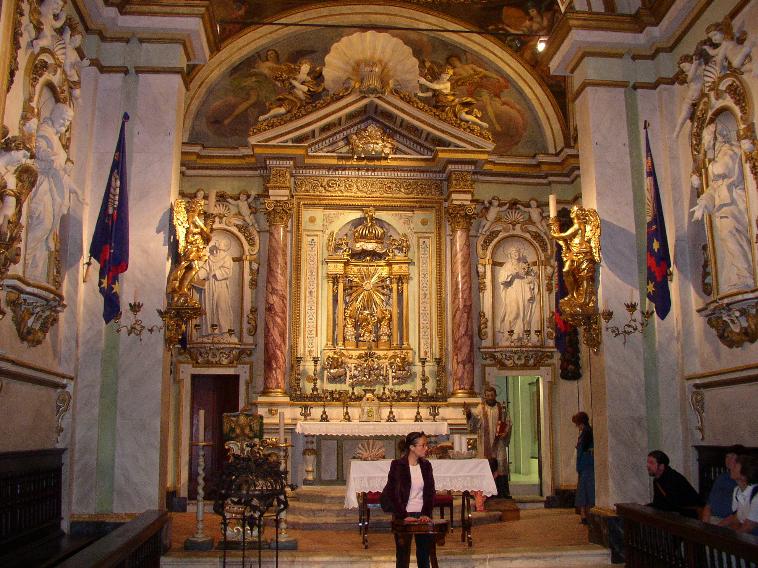
The Palio Shell (nicchio) Contrada Church - Notice all the shell decorations!
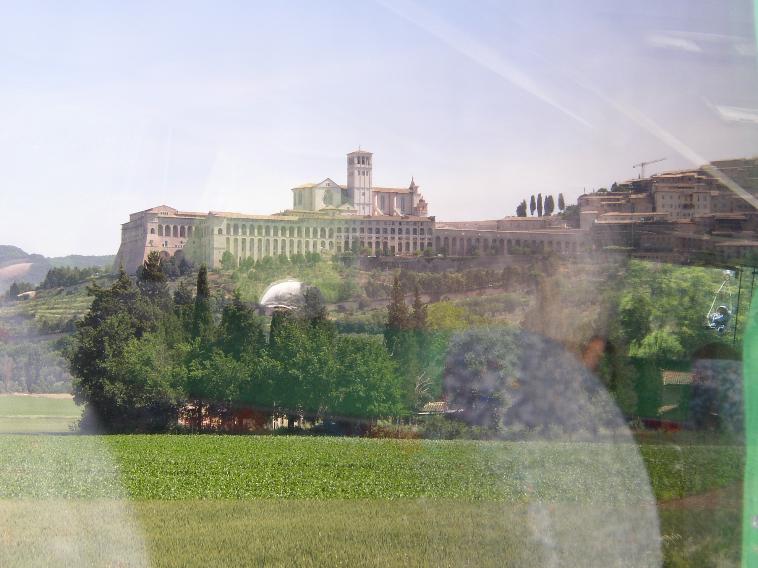
View of Basilica de San Francesco from our bus.
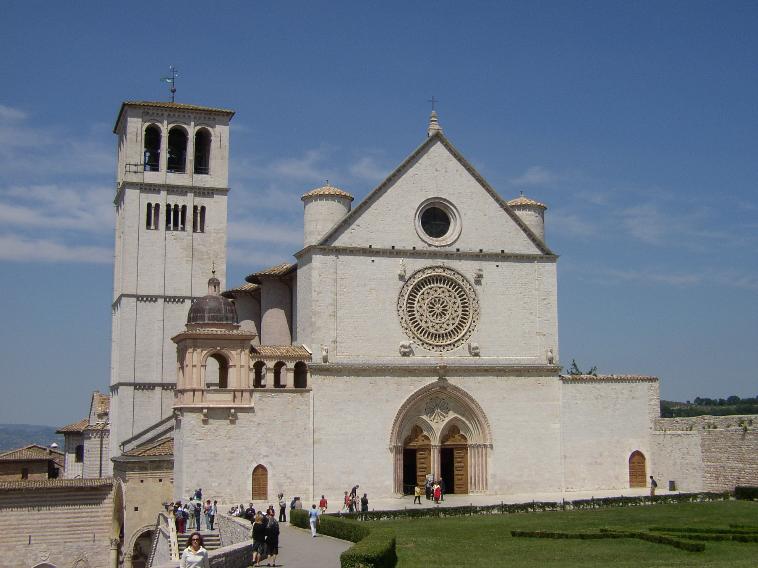
Basilica de San Francesco
|
|
|
|
|
|
|
|
|
|
|
Page 12 |
||||||||||
|
||||||||||
The Palio Shell (nicchio) Contrada Church - Notice all the shell decorations! |
||||||||||
|
||||||||||
View of Basilica de San Francesco from our bus. |
||||||||||
|
||||||||||
Basilica de San Francesco |
||||||||||
Baschi via Assisi
Assisi (day stop)
Assisi is of course famous for its hometown boy, St. Francis. Around the year 1200, a simple friar from Assisi challenged the decadence of Church government and society in general with a powerful message of non-materialism, simplicity, and a “slow down and smell God’s roses” lifestyle. Like Jesus, Francis taught by example. A huge monastic order grew out of his teachings, which were gradually embraced by the Church. Clare, St. Francis’ partner in poverty, founded the Order of the Poor Clares. Catholicism’s purest example of simplicity is now glorified in beautiful churches. In 1939, Italy made Francis and Clare its patron saints.
The Basilica de San Francesco is one of the artistic and religious highlights of Europe. In 1226, St Francis was buried (with the outcasts he stood by) outside of his town on the “Hill of the Damned” – now called the “Hill of Paradise”. The basilica is frescoed from top to bottom by the leading artists of the day: Cimabue, Giotto, Simnone martini, and Pietro Lorenzetti. A 13th century historian wrote, “No more exquisite monument to the lord has been built”.
As you approach, you see the huge arcades supporting the basilica. These were 15th century quarters for the monks. The arcades lining the square leading to the church housed medieval pilgrims. There are three parts to the church: the upper basilica, the lower basilica, and the saint’s tomb. The earthquake of 1997, did not damage the lower basilica with 9 ft. thick walls, but the upper basilica with only 3 ft. thick walls was badly damaged.
In medieval times, pilgrims came to Assisi because St. Francis was buried here. Holy relics were the “ruby slippers’ of medieval Europe. They gave you power, got your prayers answered and helped you win wars. The saint’s remains are above the altar in a stone box with iron ties. His four closest friends are buried in the corners of the room. In the fresco directly above the entry to the tomb, Christ is being taken down from the cross and it looks like the story is over. Defeat! But, in the opposite fresco we see Francis preaching to the birds, reminding the faithful that the message of the Gospel survives.
These stories directed the attention of the medieval pilgrim to the altar, where through the sacraments, he met God. The church was thought of as a community of believers sailing toward God. The prayers coming out of the nave with the triangular sections of the ceiling – sails - with spiritual wind. With a priest for a navigator and the altar for a helm, faith propels the ship. Is this so different from the beliefs of the Egyptians?
At the doorway to the lower basilica St. Francis greets you with a Latin inscription of “Slow down and be joyful, pilgrim. You’ve reached the Hill of Paradise, and this church will knock your spiritual sock off”. Francis’ message caused a stir. He traded a life of power and riches for one of obedience, poverty, and chastity. The Franciscan existence is a space where God, man, and the natural world frolic harmoniously. In an Italy torn by fighting between towns and families, Francis promoted peace and the restoration of order even while the Church was waging bloody Crusades. The lower basilica is appropriately Franciscan, subdued and Romanesque. The nave was frescoed with parallel scenes from the lives of Christ and Francis connected by a ceiling of stars. This church brought together the greatest Sienese and Florentine artists of the day. In 1300, this was radical art- believable homespun scenes, landscapes, trees, real people. For the first time, holy people are expressing emotion. The Franciscans, with their goal of bringing God to the people, found a natural partner in Europe’s first modern painter, Giotto.
The upper basilica was built later than the lower, so it is brighter and nearly wallpapered by Giotto and his assistants. This gallery of frescoes shows 28 scenes from the life of St. Francis.
This rich building seems to contradict the teachings of the poor monk it honor, but it was built as an act of religious and civic pride to remember the hometown saint. It was also designed, and still functions as a pilgrimage center and a splendid classroom. Yet, Francis’ message of love and sensitivity to the environment has a broad and timeless appeal.
Assisi has always been a spiritual center. The Romans went to great lengths to make the Temple of Minerva a centerpiece of their city. The columns cut into the stairway as it was a tight fit her on the hilltop. The church of Santa Maria Sopra over Minerva was added in the 9th century. The bell tower is 13th century. The interior is 17th century Baroque. Flanking the altar are the original Roman temple floor stones. You can even see the drains for the bloody sacrifices that took place here. Behind the statues of Peter and Paul, the original Roman embankment peeks through.
The Basilica di Santa Maria degli Angeli is the spot where Francis lived, worked, and died. This huge basilica in the valley was built around the tiny, but historic Porziuncola Chapel which is now directly under the dome. When the pope gave Francis his blessing, he was given this porziuncola, or “small portion” – a little land with a fixer-upper chapel- on which Francis and his followers established their order. Francis lived here after he founded the Franciscan Order in 1208, and this was where he consecrated St. Clare as the Bride of Christ. Francis, fighting off a temptation that he never named, threw himself onto roses. As the story goes, the thorns immediately dropped off the roses. Ever since, thornless roses have grown here.