Page 13
Baschi
If you want to experience sun-dried tomatoes, homemade pasta, wispy cypress lined driveways following desolate ridges to fortified 16th century farmhouses, and dusty old timers warming the same bench day after day in the sun soaked hill towns of Tuscany and Umbria, then this is heaven on earth! After a very spiritual day at Assisi, we drive through the beautiful olive groves of the Umbria area to our agriturismo Le Casette retreat. This is a working ranch/farm with rooms in a restored stone farmhouse. And, believe it or not there is actually a swimming pool, tennis courts, and lawn bowling. What a cool relaxing wonderful place and it seemed great to hear the melodious cows!
Orvieto (day trip)
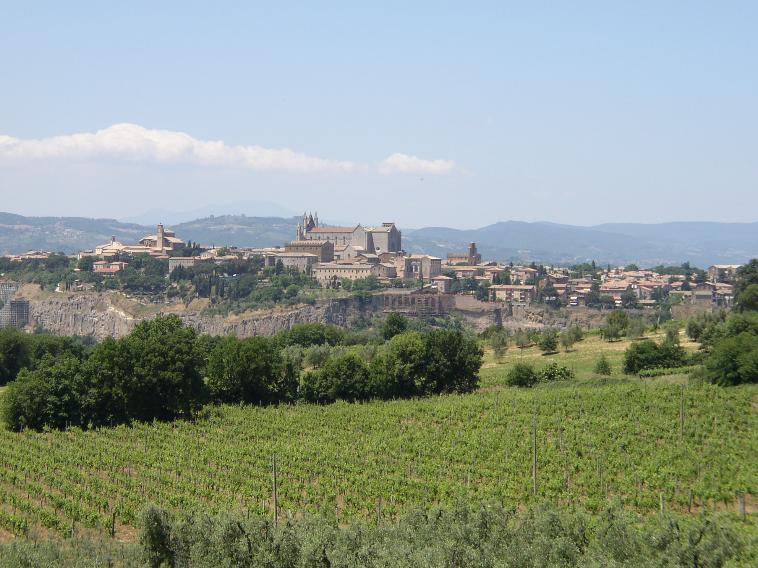
Well, we cross the Tiber River from our agriturismo home to Orvieto. Darn, if this isn’t a comfortable pretty area! This is definitely a wonderful relaxing break from the intensity, traffic, and obligatory museums of big city Italy and our destination of Rome! This is Umbria’s grand hill town! The town sits majestically on a big chunk of tufa rock overlooking the valley. So, we left our bus in the parking lot below and rode the funicular (a short, step railroad) up the hill. Streets are lined with exhaust-stained (the streets are really, really narrow here) buildings made from volcanic rock. The shops were very quaint and we had a delightful time in this medieval village!
The cathedral located of course in Piazza Duomo has Italy’s most striking façade (1330) thanks to architect Lorenzo Maitani and many others. At the base of the cathedral, the broad marble pillars cared with biblical scenes tell the story of the world. The various pillars show Creation (snake and Eve), the Tree of Jesse, the New Testament (Mary and a manger), and the Last Judgment (hell). Each pillar is topped by a bronze symbol of one of the evangelists: angel (Matthew), lion (Mark), eagle (John), and bull (Luke). The bronze doors are modern work by the Sicilian sculptor Emilio Greco. And, the mosaics show Mary being transported to heaven and crowned.
Now, you are probably asking why such an impressive church in a little hill top town? Well, it is all because of a blood stained cloth. In the 1260’s, a Bohemian priest, who doubted that the bread used in Communion was really the body of Christ, came to Rome on a pilgrimage. On his return journey, he worshiped in Bolsena, near Orvieto. During Mass, the bread bled, staining a linen cloth. The cloth was brought to the pope, who was visiting Orvieto at the time. Such a miraculous relic required a magnificent church. And, yes the cloth is displayed magnificently in the opposite nave!
The Chapel of St. Brizio to the right of the altar, features Luca Signorelli’s brilliantly lit frescoes of the Acopalypse (1449-1451). When you step into this chapel you are surrounded by vivid scenes including the Preaching of the Antichrist, the Calling of the Elect to Heaven, the Damned in Hell, and the Resurrection of the bodies. Let me tell you, this is really something to see as people climb out of the earth as skeletons searching for skin. You could really sense the pain and anguish of the people in these frescoes!
Tenuta Le Velette (day trip)
Well, our stomachs are starting to churn so it must be time for lunch! Therefore, we descend the hill via our rail system for a luncheon rendezvous down a long, tree lined drive in the grape vineyards of Tenuta Le Velette. It does not seem possible, but we are actually going to have lunch in an Italian villa located on a small hill that has been in the family for 150 years. Could this be a movie set?
We were greeted by Cecilia Bottai , who is a descendant of the original family. The villa, with two sets of caves, was actually built by monks. You gain entrance to one set of caves via the kitchen. (Yes, we tromped through her kitchen!) Obviously, this was originally built as a hiding place as well as a wine cellar. The second was located on the hillside. Up until a few short years ago, they felt there were two separate caves in the hill. But, due to an increase in their wine production, more storage space was required. A geologist felt there was a good chance that the caves had been linked at one point in time. Then, in talking with the village residents, Cecilia discovered that one of the older gentleman confirmed that the two caves were one. Cecilia commented: “The local village residents are smarter and know more than the geologists”. To make a long story short, the cave was dug out only to discover a very simple altar tucked back in a corner. As the story goes; when the Christians were being persecuted this provided a safe haven for worship while on their journey through the valley. Pretty darn amazing! Oh yes, as you might have guessed there is a chapel next to the villa. Cecilia was baptized and married here! Talk about staying close to home! She has lived in this house her entire life.
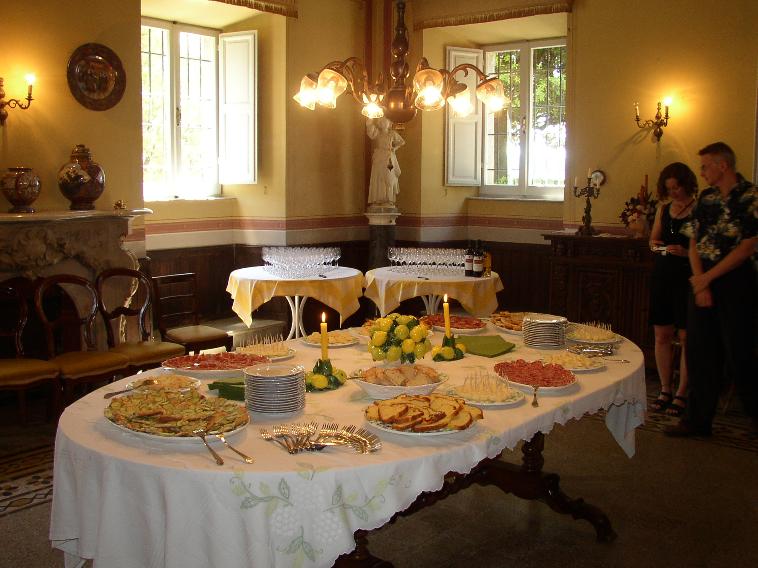
Oh, I almost forgot to talk about the lunch! So, not only do we see her kitchen, but now we are eating buffet style in her dining room. This is a huge room that adequately seats 27 people with room to spare. The table is huge and appears as though it could still be extended. The room has electricity, but the décor remains old Italian. It is very elegant and simply beautiful! It feels as though it is an honor to be in this room. And, indeed she only uses it for Easter and Christmas dinners! I can imagine the entire family getting together for these two occasions with magnificent table settings and beautiful decorations! (Naturally, she served us wine and the glasses were definitely not manufactured by Libby!) I certainly could live here with no problem! Ah, but now it is time to leave our fairytale villa and back to reality! Darn!
Sorrento via Pompeii]
Pompeii (day stop)
Oh my gosh, I am so excited to see Pompeii! I have read about this city since I was in the 7th grade and finally I get to experience the site! I am so, so excited!!!! Is this a dream or is it really happening?!
Pompeii was literally stopped in it tracks by the eruption of Mount Vesuvius in 79 A.D. Without a doubt, Pompeii offers the best look anywhere at what life in Rome must have been like 2,000 years ago. It is an entire city of very well preserved ruins surrounded by Naples with acid rain starting to be problematic. Oh no, modern man can’t ruin this ancient beautiful city! Do something!
It was once a thriving commercial port on the Tyrrhenian Sea of 20,000. Pompeii grew from Greek and Etruscan roots to become an important Roman city. Then, Vesuvius erupted pushing the sea back 2 miles and burying the 164 acre site (about 1 sq. mi.) of Pompeii under 30 feet of hot mud and volcanic ash. The city was rediscovered in the 1600’s, but excavations began in 1748. During this period, archaeologists detected hollows underfoot left by decomposed bodies. So, as they dug they poured liquid plaster into them creating molds of the people. These people were caught during their work day, so the molds helped explain the daily activities of the city.
As with all the towns of this era, it was a walled city. So, when the ships docked all the amenities required by the sailors were located outside the wall. Once the sailors had an opportunity to clean up, then the city could be enjoyed by entering through a small portal in the wall for pedestrians or the larger one which accommodated chariots.
Now, about the city! Pompeii was a booming Roman trading city. Most streets would have been lined with stalls and jammed with customers from sunup to sundown. Chariots vied with shoppers for street space, and many streets were off limits to chariots during shopping hours. In fact, street signs with pictures of men carrying vases meant pedestrians only. You can also still see the oxcart wheel grooves in the street stones.
Fountains overflowed into the streets, flushing the gutters into the sea and also cleaning the streets. Just think about the engineering to accomplish this! Stones in the middle of the streets allowed pedestrians to cross the constantly gushing streets. A single stone designated a one-way street (just enough room for one chariot, stone straddled by its two oxen), and two stones meant a two-way street. There were no posh neighborhoods. Rich and poor mixed it up, as elegant homes existed side by side with simple homes throughout Pompeii.
It has been discovered that each Roman city was built identically. If it works, don’t fix it! There were 40 bakeries, 30 brothels, and 130 bars, restaurants, and hotels to serve the people. The bakery and mill (forno e mulini) looked like a modern day pizza oven. The stubby stone towers were flour grinders which could be inverted when worn down. After grain was poured into the top, donkeys pushed wooden bars that turned the stones, and eventually powdered gains flavored with tiny bits of rock dropped out the bottom as flour.
The brothel (lupanare), depicted by a penis fresco was a simple place with stone beds and pillows. Prostitutes were nicknamed lupas (she-wolves). The ancient graffiti includes stroke tallies and exotic names of the girls, indicating they came from all corners of the Mediterranean. The faded frescoes above the rooms may have served as a kind of menu for services offered. We noted the idealized portrayal of women as white, considered beautiful and man as dark and considered horny. And, next door was the laundry which boiled the sheets to guard against venereal disease.
The forum, Pompeii’s commercial, religious, and political center, stands at the intersection of the city’s two main streets. This is a grand area with temples, lots of pedestals that once sported statues and the basilica (Pompeii’s largest building, the ancient equivalent of law courts and stock market.). The Curia (home of the government) stands at the end of the forum. It is built of brick and mortar, a Roman invention. But, at one point in time, it was faced with marble. It is important to note that while Pompeii was destroyed by the eruption in 79, it was also devastated by an earthquake in 62. Therefore, any brick work dates from between 62 and 79 – restoration work done by Pompeians after the quake.
Such a busy square needed a public toilet. So, just down the street is an ancient public WC. Imagine that! Stone supports once held wooden benches with the appropriate holes with the ditch leading to the sewer. Do you suppose they had to pay back then?
Now that we have checked out the WC, it is time to walk down Via del Foro to the Terme del Foro (bath). You enter through the gymnasium (Yes, they worked out!) and then into a waiting area. From here you could go to a warm bath (tepidarium), hot bath (caldarium), or cold-plunge bath (frigidarium).
The tepidarium was ringed by mini statues or telamones (male caryatids, figures used as supporting pillars), which divided clients’ lockers. They’d undress and warm up here, perhaps stretching out on one of the benches near the bronze heater for a massage while looking up at the fine blue and white stucco work. Next, in the caldarium you’d get hot. The double floor was heated from below so it also kept your feet warm while the double walls with brown terracotta tiles held the heat. Romans soaked in the big tub which was filled with hot water. To keep condensation from dripping annoyingly from the ceiling, the fluting (rigging) was added to carry the drips down the walls. Next came the cold plunge in the frigidarium, a circular marble basin with the spout spewing frigid waster.
At the exit of the bath was an ancient fast food stand. Believe it or not! And, we call ourselves modern! There were holes in the counter for pots. Actually, we saw several of these throughout the city.
A few doors down was the house of the tragic poet (Casa de Poeta Tragico) with its famous “Beware of Dog” (cave canum) mosaic in the entryway. Grooves in the doorway indicated a shop with sliding doors. Another interesting point! The houses also had holes drilled into the curbs to hitch your animal or perhaps to support an awning from your storefront.
As we turned onto Vicolo dei Vetti, we see the House of the Vetti which is Pompeii’s best preserved home. It was the bachelor pad of two wealthy merchant brothers with mosaics and frescoes. This is the house with the entry way displaying the erection. No, this is not pornography. There’s a meaning here: The penis and the sack of money balance each other on the goldsmith scale above a fine bowl of fruit. The meaning: Only with a balance of fertility and money can you have abundance.
The atrium opened to the sky to collect light and rainwater. The homes had no windows because of the street noise. The front door was left open so one could see the opulence of the residence. Oh yes, the merchant had his shops on both sides of the house. The pool, while decorative, was a functional water supply tank. It is flanked by large money boxes anchored to the floor. They were certainly successful merchants and possibly moneylenders too. They had bronze cooking pots in the kitchen and lead pipes to carry the water. And, the Venus Room displayed erotic frescoes.
Behind the atrium was a large colonnaded garden. This courtyard was ringed by richly frescoed entertainment rooms. The dining room was finely decorated in “Pompeian red” (from iron rust) and black with great concern to detail. There was even a lead humidity seal between the wall and the floor designed to keep the wet sensitive frescoes dry. The floors were inlaid with square white stones to reflect the light from the oil lamps.
The Yellow Room shows off the ancient mastery of perspective, which was not matched elsewhere in Europe for nearly 1,500 years.
Ondeeamo (let’s go) to the theater. As is today, the theater was a place to socialize and to show off your latest most fashionable duds! Originally a Greek theater, this marks the spot of the birthplace of the Greek port here in 470 B.C. During Roman times, it sat 5,000 in three price ranges: the five marble terraces up close filed with romantic wooden seats for two, the main section and the cheap nosebleed section. The high profile boxes flanked the stage for guests of honor. Gee, it doesn’t seem as though much has changed! The square stones above the cheap seats used to support a canvas rooftop. Remember these plays were during the heat of the afternoon.
Behind the theater was the colonnaded courtyard utilized by the gladiators. They lived in tiny rooms, trained in the courtyard, and fought in the nearby amphitheater.
So far, this was the highlight of the trip! I had no idea that Pompeii was so large or that it is surrounded by Naples. And, talk about all the modern conveniences! Think about the idea of possibly living during this period of time! I certainly think it would have been ten times better than being a pioneer traveling west! Did our society regress?