Siena
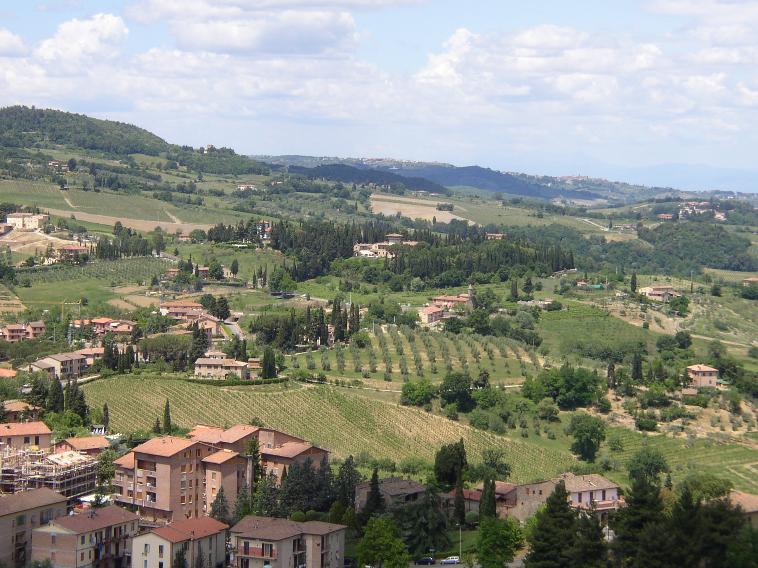
Siena, located in the Tuscany was a major military power in a class with Florence, Venice, and Genoa 700 years ago. With a population of 60,000 (today’s pop. is still 60,000), it was even bigger than Paris. In 1348, a disastrous plague weakened Siena. Then, in the 1550’s her bitter rival, Florence, really salted her, forever making Siena a non-threatening backwater. But, with its red brick lanes cascading down the hills, this allowed Siena to be Italy’s best Gothic city. Off the beaten path, we stayed in Hotel Cannon d’Oro or the golden cannon.
Siena “the Beloved” was officially founded in Roman times; but there is ample evidence of an Etruscan settlement that predates “Siena Julia”. It is the home of the first modern bank, dating from the thirteenth century, but still open for business. Before the Romans or the bankers came the Etruscans, and an abiding reputation as a home for mystics.
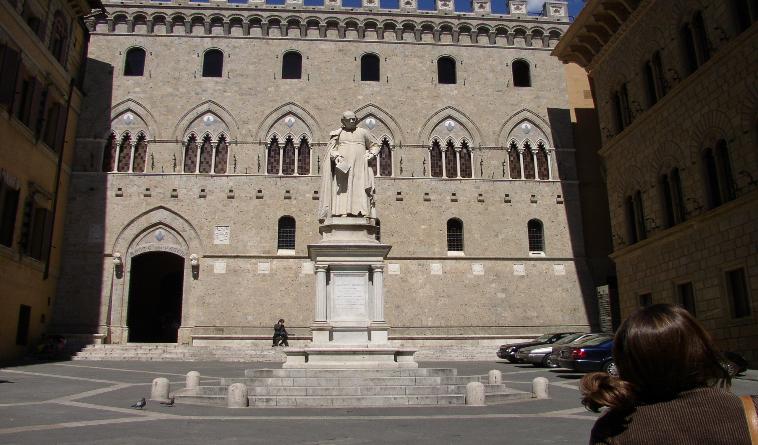
Italians not only invented banking in the 14th century Florence, but today Italy is home to the world’s oldest bank (The Banca Monte dei Paschi di Siena). It was founded in 1472 as a pawnshop intended to help the poor. Now Italy’s seventh largest bank, it has 1/478 branches with 603 in the Tuscany area.
Il Campo, is Siena’s great central piazza. The square is a gently slopping half circle where oddly enough people actually sit down. This is the only piazza in Italy where people sit and enjoy themselves and no one is quite sure why this is done. Il Campo was located at the historic junction of Siena’s various competing districts or contrada on the old marketplace. The brick surface is divided into nine sections, representing the council of nine merchants and city bigwigs who ruled medieval Siena. At the square’s high point is the Fountain of Joy with two naked guys about to be tossed in. At the square’s low point is the city hall and tower. And, believe it or not, someone actually climbs the tower each day to change the date. The chapel located at the base of the tower was built in 1348 as thanks to God for ending the Black Plague (after it killed more than a third of the population).
The market area behind the city hall, a wide open expanse since the Middle Ages, originated as a farming area within the city walls to feed the city in times of siege. Now, the morning produce market is held here.
To say Siena and Florence have always been competitive is an understatement. In medieval times, a statue of Venus stood on Il Campo where the Fountain of Joy is today. After the plague hit Siena, the monks blamed this pagan statue so the people cut it to pieces and buried it along the walls of Florence.
Siena’s cathedral is as Baroque as Gothic gets. The striped façade of is piled with statues and ornamentation, and the interior is decorated from top to bottom. The heads of 172 popes peer down from the ceiling over the fine inlaid art on the floor. This is one busy interior! We saw the Slaughter of the Innocents on the floor, Pisano’s carved pulpit with delicate Gothic story-telling from 1268 which was breathtakingly beautiful, Bernini’s chapel and two statues: Mary Magdalene in a state of spiritual ecstasy, and St. Jerome playing the crucifix like a violinist lost in beautiful music, plus two Michelangelo statues and a Donatello statue. The Piccolomini altar is most interesting for its two Michelangelo statues of Paul (perhaps a self portrait) and Peter resembles his more famous statue of Moses. Originally contracted to do 15 statues, Michelangelo left the project early (1504) to do his great David in Florence. And, since the area was so hilly there wasn’t enough flat ground on which to build a big church. So, they built a big church and propped up the overhanging edge with the baptistery.
The Sanctuary of Saint Catherine is her home. She was Siena’s favorite hometown girl. A simple, unschooled, but mystically devout girl who, in the mid 1300’s helped convince the pope to return from France to Rome. The family were wool dyers, but a chapel was built over the spot where Saint Catherine received the stigmata while praying.
Now about the Palio! In the Palio, the feisty spirit of Siena’s 17 contrada (neighborhoods) lives on. These neighborhoods celebrate, worship, and compete together. Each even has its own historical museum. But, contrada pride is most visible twice a year (July and August) when they have their world famous horse race the Palio di Siena. Ten of the 17 contrada’s compete (chosen by lot), hurling themselves with medieval abandon into several days of trial races and traditional revelry. On the big day, the horse goes into their contrada’s church (It is highly decorated in the symbol of that contrada.) to be blessed (“Go and win”). It’s considered a sign of luck if a horse leaves droppings in the church.
On the big day Il Campo is stuffed to the brim with 15,000 people as the horses charge wildly around the square in this literally no holds barred race. A horse can win even if its rider has fallen off. Of course, the winning contrada is the scene of grand celebrations afterward. The grand prize is simply the banner and proving your contrada is numero uno.
The contrada’s have names such as shell, porcupine, elephant, etc. Winning is everything! In fact, our Siena guide asked us to pray that her contrada (the shell – nicchio) wins! Oh yes, she was a shell and regardless of her residence in the city she will always remain a shell. Two streets were nicknamed the dog and cat corner because 4 contrada’s intersect and the people fight like cats and dogs. Three days prior to the race, the horse is stabled in the contrada and it is considered a great honor to bed down with the horse for this period of time! Notice that the horse is blessed, but nothing was said about the jockey. The people could careless about the jockey who rides bareback. To add insult to injury each contrada has a vet and ambulance for the horse, but nothing for the jockey. Believe it or not, it is true as told from the lips of our Siena guide! What century are we living in?