
Page 10
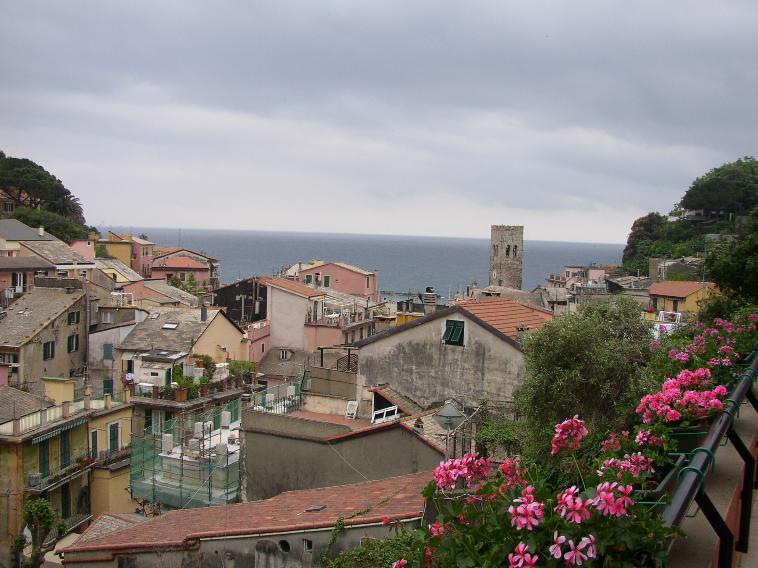
View from my room at Hotel Villa Steno, Monterossa (Cinque Terre) over-looking the Ligurian Sea.
Absolutely BEAUTIFUL and so PEACEFUL!!!!
Siena via Pisa and San Gimignano
Pisa (day stop)
Now that we are all R & R’d, we hop back on the train and our bus bound for Siena via Pisa and San Gimignano. And, on the way to Pisa, we had an opportunity to see a large section of the old Roman aqueduct. My goodness what a system it took to get water to the city! Unbelievable! Pisa was a regional superpower in its medieval heyday (11th, 12th, & 13th century), rivaling Florence and Genoa. Its Mediterranean empire, which included Corsica and Sardinia, helped make it a wealthy republic. But the Pisa fleet was beaten (in 1284 by Genoa) and its port silted up, leaving the city high and dry, with only its Field of Miracles and its university keeping it on the map. Even as the church was being built, the Piazza del Duomo was nicknamed the Campo dei Mriacoli, or Field of Miracles for the grandness of the undertaking. The style throughout is Pisa’s very own “Pisan Romanesque” surrounded by Italy’s tackiest ring of souvenir stands. (Yes, we are talking sexual and I thought it was fun to see what they had come up with!)
Pisa is known world wide for the bell tower or Leaning Tower of Pisa. I have no clue what I thought this tower was built for, but was very surprised when I discovered it was the church bell tower. Started in the 12th century, this most famous example of Pisan Romanesque architecture was leaning even before it completion. You will notice while looking at the tower that the architect attempted to straighten it by altering the angle of the top three sets of columns.
The huge Pisan Romanesque church with its carved pulpit by Giovanni Pisano is artistically more important than its more famous bell tower. The baptistery, the biggest in Italy, is interesting for it great acoustics. And, even the baptistery leans nearly 5 feet!
San Gimignano (day stop)
The epitome of a Tuscan hill town, with 14 medieval towers still standing (out of the original 72), San Gimignano is perfectly preserved. In the 13th century, back in the days of Romeo and Juliet, towns were run by feuding noble families. They’d periodically battle things out from the protection of their respective family towers. Pointy skylines were the norm in medieval Tuscany. But, in San Gimignano, fabric was big business, and many of its towers were built simply to hang dyed fabric out to dry. From the town gate we walked up the hilly traffic free town’s cobbled main drag to Piazza del Cisterna with its 13th century well. This was a shoppers paradise and a good time was had by all! While the ladies shopped, the men enjoyed a museum featuring medieval torture devices.
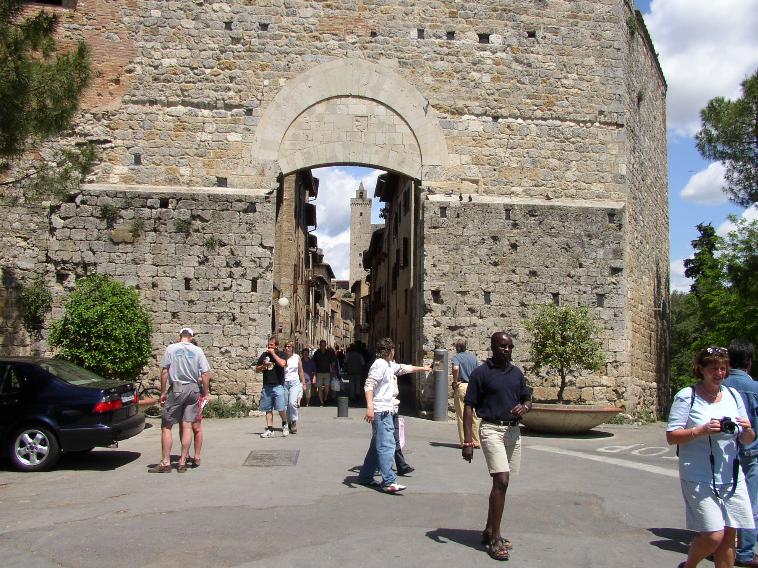
The entrance to the walled medieval town of San Gimignano
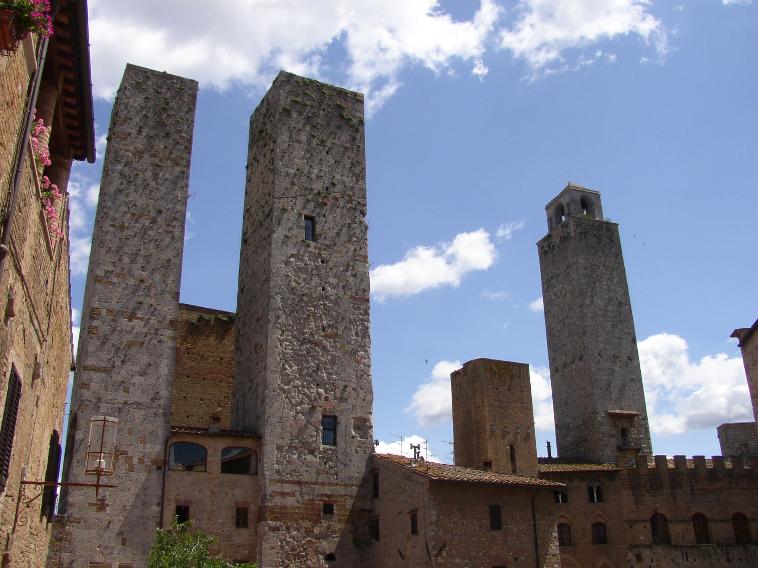
The fabric towers of San Gimignano