
Page 9
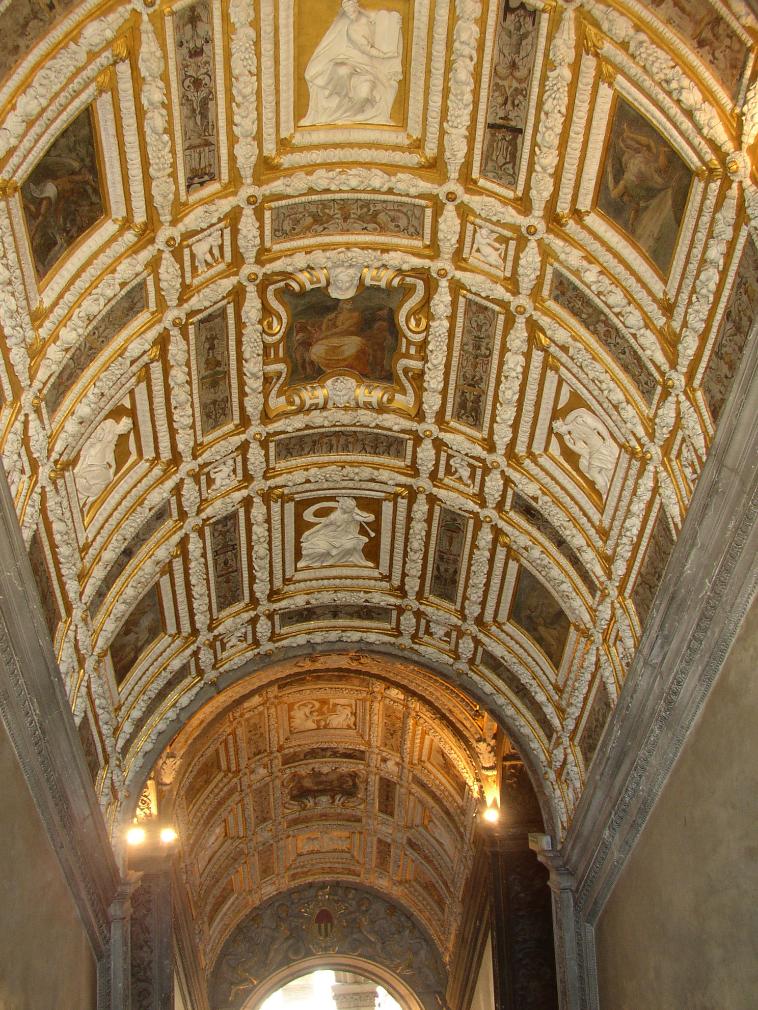
Doge's Palace Grand Staircase
Breathtakingly beautiful! So much gold! Everyone climbed this staircase to meet the Doge!
|
|
|
|
|
|
|
|
Page 9 |
|||||||
|
|
|||||||
Doge's Palace Grand Staircase |
|||||||
|
|
|||||||
Florence (Firenze)
Not to be outdone by Venice is Florence, the home of the Renaissance and the rebirth of ancient Greek and Roman architecture as well as the birthplace of our modern world. This is the period when there were great gains in science, economics, and art. In fact, it is the period when art stepped out of the shadow of the church. We called home Hotel Torre Guelfa. It is topped with a fun medieval tower displaying a panoramic rooftop terrace and only two blocks from the Ponte Vecchio (old bridge over the Arno River).
Navigating Florence was much easier than Venice. No dead in streets without bridges to cross canals! This city was laid out on a grid and it quickly became easy to find home from the piazza utilizing a duck and green awnings as guides! Thank goodness! Confidence restored! However, our schedule was tight because of time and the museum schedules. It is important to remember that the posted opening and closing times are only approximations as the Guardians come and go according to Italian time!
Even during the Dark Ages, people knew they were in a middle time. It was especially obvious to the people of Italy – sitting on the rubble of Rome – that there was a brighter age before them. The long awaited rebirth, or Renaissance, began in Florence for good reason. Wealthy because of its cloth industry, trade, and banking; powered by a fierce city-state pride and fertile with more than its share of artistic genius like Michelangelo, Raphael, and Leonardo, Florence was a natural home for this cultural explosion.
The Accademia museum houses Michelangelo’s David and powerful although unfinished five Prisoners. (He did not finish the Prisoners because he was commissioned to paint the Sistine Chapel.) More than with any other work of art, when you look into the eyes of David, you’re looking into the eyes of Renaissance man. Michelangelo believed that God created the sculptures and it was merely his job to chip away the marble. This was a radical break with the past. Hello humanism! Man was now a confident individual, no longer a plaything of the supernatural. And life was now more than just a preparation for what happened after you died. The Renaissance was the merging of art, science, and humanism. David’s large and overdeveloped right hand is symbolic of the hand of God that powered David to slay the giant and enabled Florence to rise above its crude neighboring city-states.
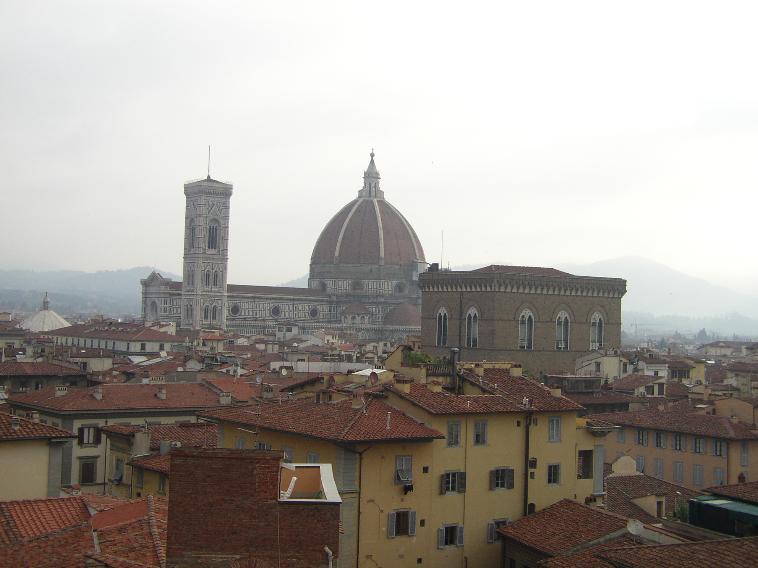
The Duomo, Florence’s Gothic Santa Maria del Fiori cathedral has the third longest nave in Christendom. The church’s neo-Gothic façade from the 1870’s is covered with pink, green, and white Tuscan marble. The Duomo was built with a hole awaiting a dome in its roof. This was before the technology to span it with a dome was available. They knew that someone soon could handle the challenge and the local architect Brunelleschi did just that. The cathedral’s claim to artistic fame is Brunelleschi’s magnificent dome – the first Renaissance dome and the model for domes to follow. In fact, it was the first dome in over 1000 years and the beginning of Renaissance architecture.
Giotto’s Tower is actually the church bell tower. It is 270 feet or 400 steps high (I counted them). It offers a beautiful view of the city, but one should avoid the bell ringing if at all possible! My ears, oh my ears!
Michelangelo said the Baptistery bronze doors were fit to be the gates of Paradise. There was a design competition between Ghiberti and Brunelleshci to construct the doors with Ghiberti winning and leaving the Duomo construction to Brunelleshci. Making a breakthrough in perspective (three dimensional art), Ghiberti used mathematical laws to create the illusion of receding distance on a basically flat surface. These doors are an amazing work of art and so very beautiful! It is important to note that one could not enter the church until they had been baptized. Therefore, the Baptistery was across the street from the Duomo. This is Florence’s oldest building. The Medieval mosaic ceiling depicts Judgment Day and Jesus is giving the ultimate thumbs up and thumbs down. You could sit for hours and still not see the entire story!
The Uffizi Gallery is the greatest collection of Italian paintings with plenty of works by Giotto, Leonardo, Raphael, Caravaggio, Rubens, Titian, and Michelangelo plus a roomful of Botticellis, including the Birth of Venus. The paintings are displayed in chronological order from the 13th to 17th centuries, but I still could not explain the progression.
The Uffizi square honors the artist of the time: philosopher – Michiavelli, scientist – Galileo, writer – Dante, explorer – Amerigo Vespucci, and the great parton of so much Renaissance thinking, Lorenzo de Medici.
Ponte Vecchio which is Florence’s most famous bridge, is lined with jewelry shops. A statue of Cellini, the master goldsmith of the Renaissance, stands in the center. The “prince’s passageway” or Vasari Corridor allowed the city leaders in less secure times a fortified passageway connecting the Palace Vecchio and Uffizi with the mighty Pitti Palace to which they could flee in times of attack.
Piazza della Repubblica is the large square or the belly button of Florence sits on the site of Florence’s original Roman Forum. The lone column is the only remaining bit of Roman Florence except for the grid street plan. The piazza is framed by a triumphal arch which is really a nationalistic statement celebrating the unification of Italy. Florence, the capitol of the country (1865-1870) until Rome was liberated, lacked a square worthy of this grand new country. So, the neighborhood was razed to open up a grand modern forum surrounded by grand circa 1890 buildings.
Medieval writers described Florence as so densely built up that when it rained, pedestrians didn’t get wet. And, we experienced this walking back from the Accademia museum. Torches were used to light the lanes in midday. The city was prickly with noble family towers and had Romeo and Juliet type family feuds. But with the rise of the Medicis (1300), no noble family was allowed to have an architectural ego trip taller than their tower, and nearly all were taken down.
The church of Santa Croce is a 14th century Franciscan church decorated by centuries of precious art and holds the tombs of great Florentines. I was able to find the tomb of Michelangelo (with the allegorical figures of painting, architecture, and sculpture), a memorial to Dante (no body … he was banished by his hometown over politics), the tomb of Machiavelli (the originator of hardball politics), a relief by Donatello of the Annunication, and the tomb of the composer Rossini. The neighboring Pazzi Chapel by Brunelleschi is considered one of the finest pieces of Florentine Renaissance architecture.
As with Venice, there is simply too much to see in this city and not enough time. We were up at the crack of dawn and visiting the sights as soon as they opened. But, at this point your feet and legs were starting to bark. And, Venice and Florence back to back is a bit much for someone who is not a devout art connoisseur. Yes, I was beginning to get art and churched out! Nonetheless, it was so very beautiful!
Florence skyline with the Gothic Cathedral of Santa Maria del Fiori and Giotto's Tower