Kite Projects |
This is a sort of online journal. All of the kites I have made go on this page. The first ones are at the bottom, and the newer ones are at the top. It is also my hope that people considering making these kites could find some useful information here in the photos and descriptions. |
Experiment #1
This was my first attempt at designing my own foil. I tried three different bridles, but I just could not get it to fly well. Actually, it barely flew at all. The tips had trouble inflating and it was extremely unstable. I think this is mostly due my poor skin tension setting (notice the funny swept forward look) and maybe the thin profile as well. I have since cut it up for scraps. For anyone interested in how not to built a kite, here is the original Surfplan file and the file for the final bridle adjustment.
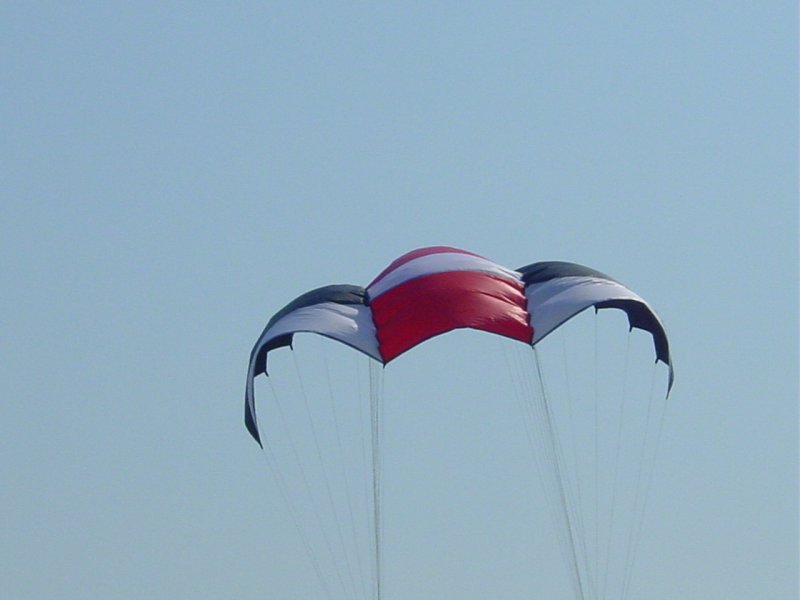
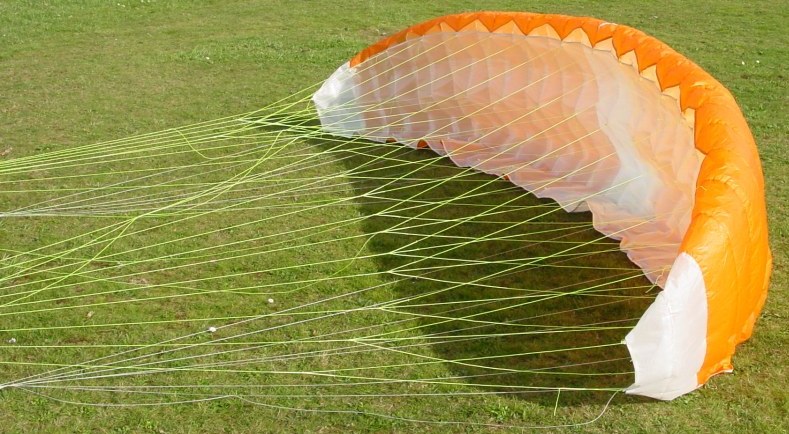
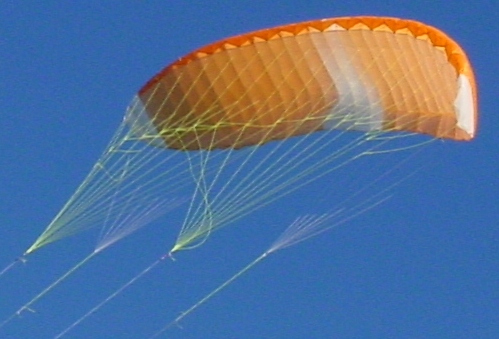
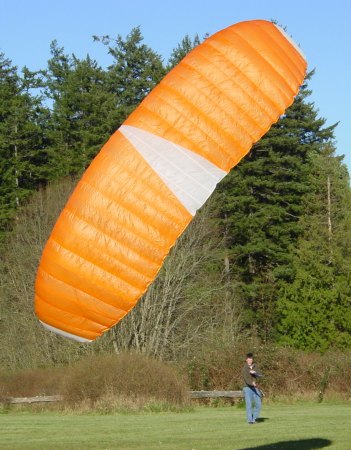
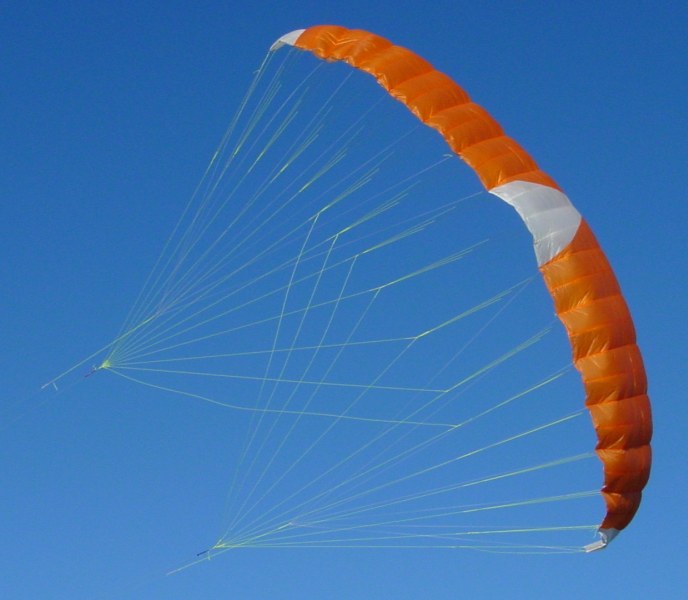
Firecrest v2 5.3 Square Meter, March '05 It took me quite a while but now it's finally finished. I made in entirely out of Bainbridge ripstop (stabilicote 4 I think) from Kite Studio. I used about 19 yards of fabric on this kite. At $7.75 a yard that really adds up! I think I'm going to try to start using seconds for future kites. I sewed this kite cell by cell in four parts, and then sewed each part together. The four cells on each tip are closed. Sewing was rather difficult due to the triangular vents. Every other rib is sewn into the to top and bottom skins in one seam. It's kind of hard to put into words, but basically this meant I spent a lot of time with the bulk of the kite on the right side of the needle-- not where you want it to be! The main bridle is all 100lb. sleeved spectra and the brake is 50lb. dacron. All the loops were sewn, and where the primaries attach to the bridle tabs I used a the knot shown in the construction section of the Chevron website. The first time I flew it, I was surprised by the fact that the brake bridle was about two feet shorter than I thought it should be. I added some extensions and it works fine. The angle of attack was way too high at first. It pulled hard, but it pulled everywhere I put it. I lengthened the A lines and reduced the C lines by 1/4 inch each. It flies much better now, although it is still a little slow. I may adjust it more as I get a chance to fly it more in steady winds (pretty hard to find where I live.) You can find plans for the kite at the Firecrest website. Also check out the Firecrest Yahoo group. Update: As I've been tuning this kite, some problems have appeared. First of all, an ugly wrinkle developed between the A and B points. Also the tips seemed to be dragging and holding back. I decided to re-measure ad mark the entire primary bridle. This time I used a tow point setting of 22% tip and 21% center (originally it was 26% at tip and 25% center). It flies much better now, although it will luff in bad wind. It is still lifty, I think it will do ok with the buggy. The wrinkle is still present, but not as much. This could be due to the Bainbridge nylon which has proven to be rather floppy and stretchy, especially when damp. |
|
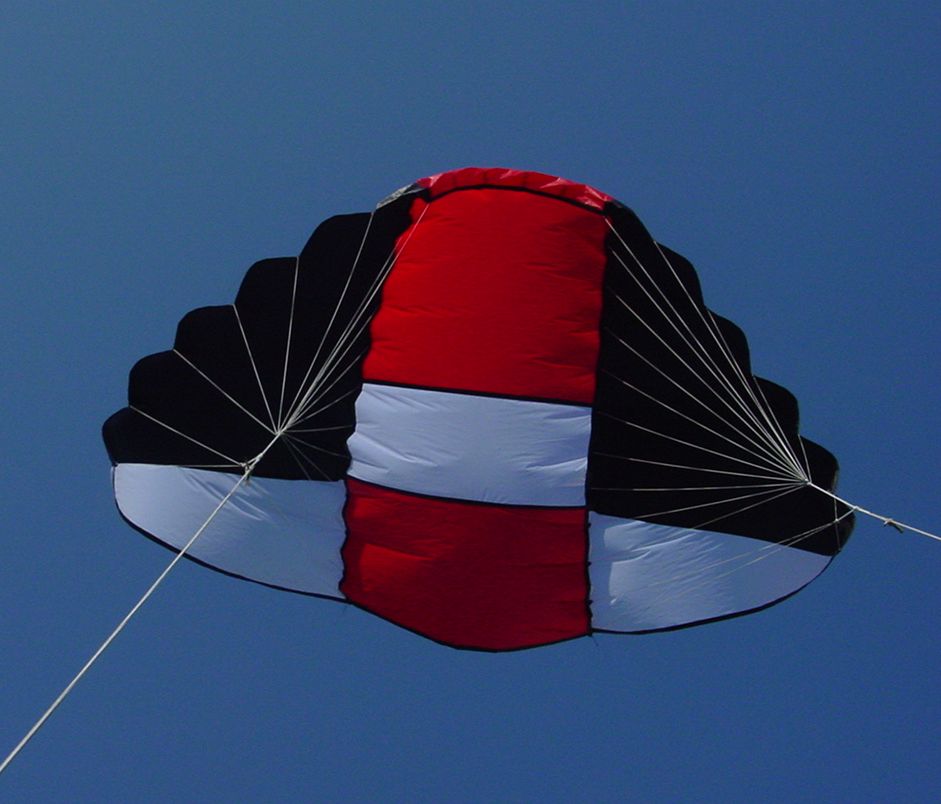
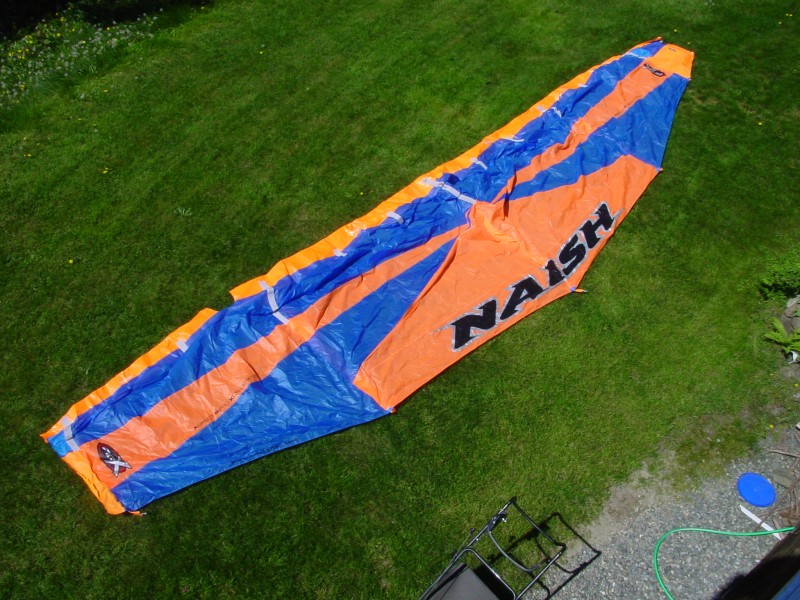
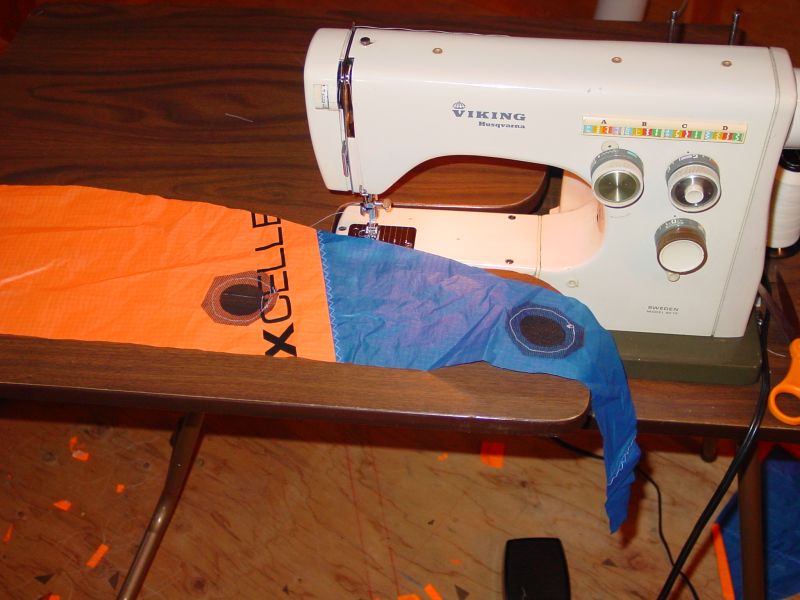
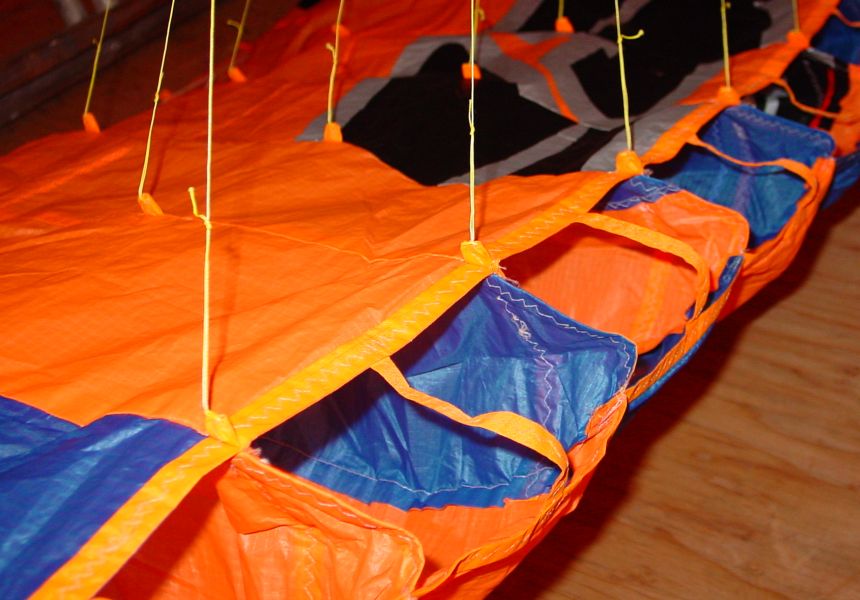
3 Square Meter Eliminator Well, instead of making a 4 meter, I decided to go with a three meter. The Eliminator is a four line traction foil. Someone gave me a trashed 12 meter Naish, under the condition that I did not try to repair it, so. . . My first foil was born! It's a good thing I went for the smaller size, because I just barely had enough material. You can find the plans here. The primary bridle lines are 90lb. spectra fishing line and the secondary lines are 220lb. Dacron. I didn't want to mess around with gauze at vents in the front, so I used single strips of fabric instead. The bridle attachments run all the way up the ribs and are sewn into the top seam. This definitely isn't a light wind kite. I think that is due to the materials I used. The bridle setting also seems to be a little low. I am still waiting for an opportunity to test it in clean, strong winds. |
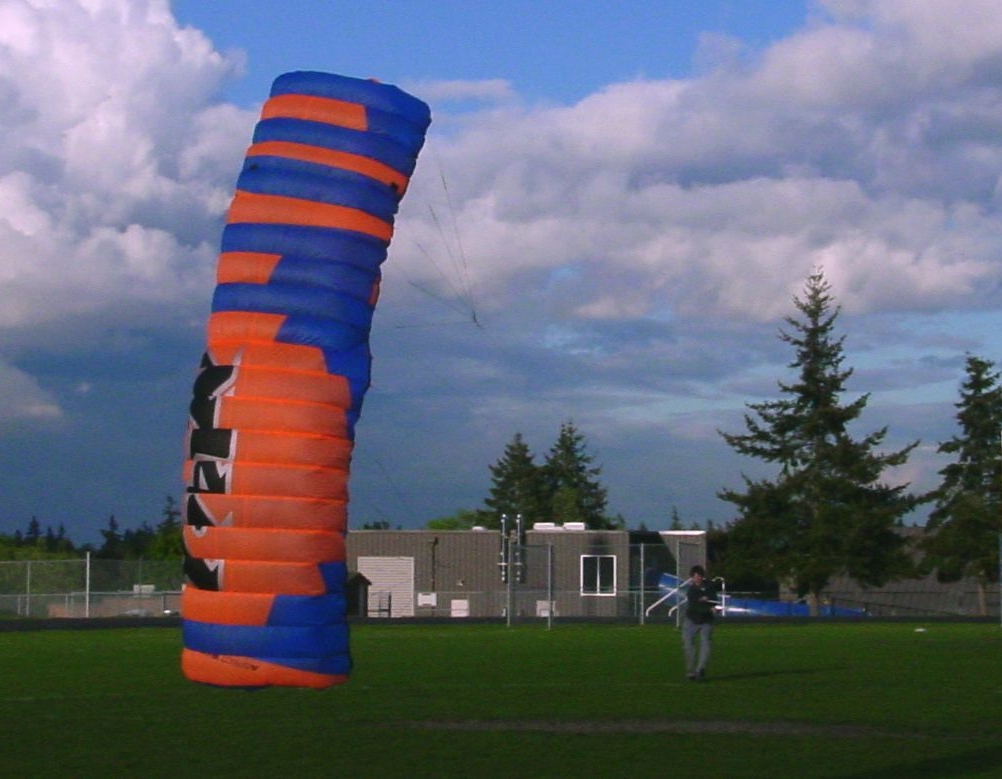 |
| Update: I have since redone the primary bridle lines, this time in 50lb. dacron. I changed the center of lift setting from 25% all the way to 20%. It flies much better in light winds, and climbs to the very top of the window easily. It has lost some power though, and it takes much more effort now to turn with the brakes. I think maybe a setting of 22% be would be about right for my particular kite. |
|
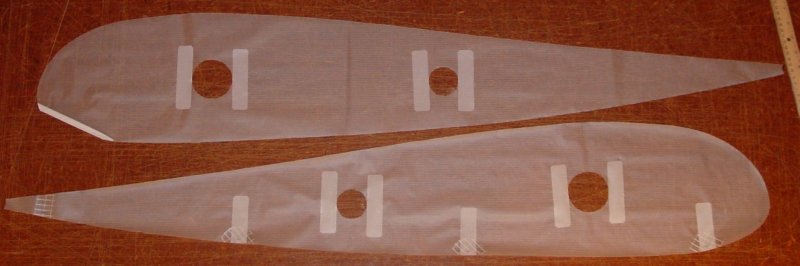
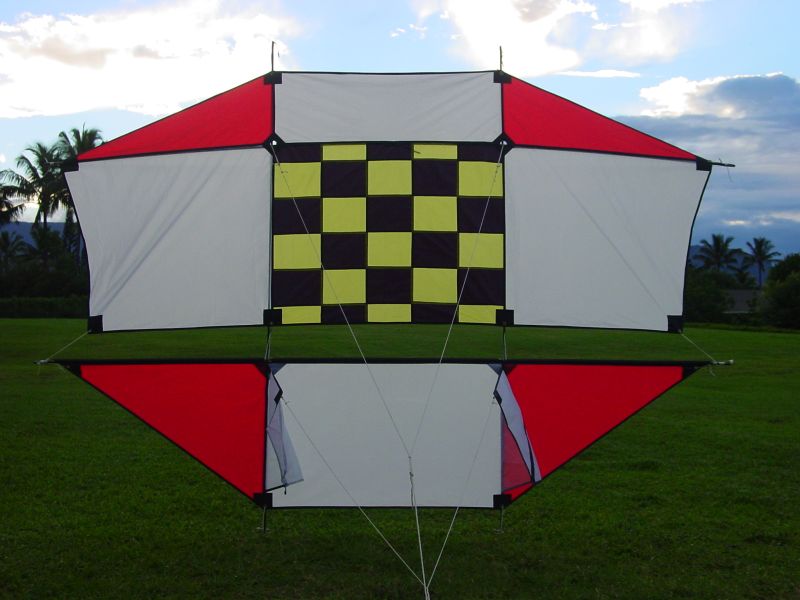
Dopero This was my third kite project. I built is to lift my camera when the wind is too light for the rokkaku or flowform 16. I used Texlon nylon for this one. The checkered part in the middle turned out to be harder to calculate than I thought. It didn't turn out quite the way I wanted it to, but I am happy with it. I initially framed it using .505 inch fiberglass for the verticals and .414 for the cross pieces. It was a powerful lifter in medium winds, but it just wouldn't fly in lighter winds. I ended up re-framing it using .414 inch for the top cross piece and .317 inch for the rest. I found the plans for it here (link updated). There are normally two spars in the fins, but I didn't have them installed for the photo. No, I don't live in Hawaii, I just photographed it while I was there. |
 |
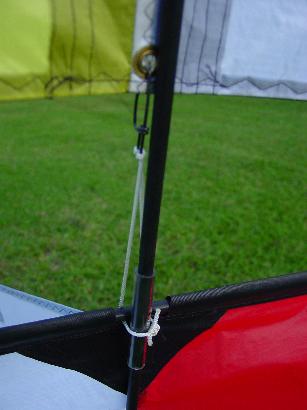
| I though a lot about how attach the lower and upper sail. The plans aren't very detailed. This is what I finally came up with. I would love to see how they are supposed to be made. | 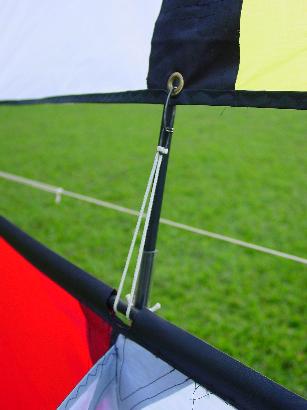
 |
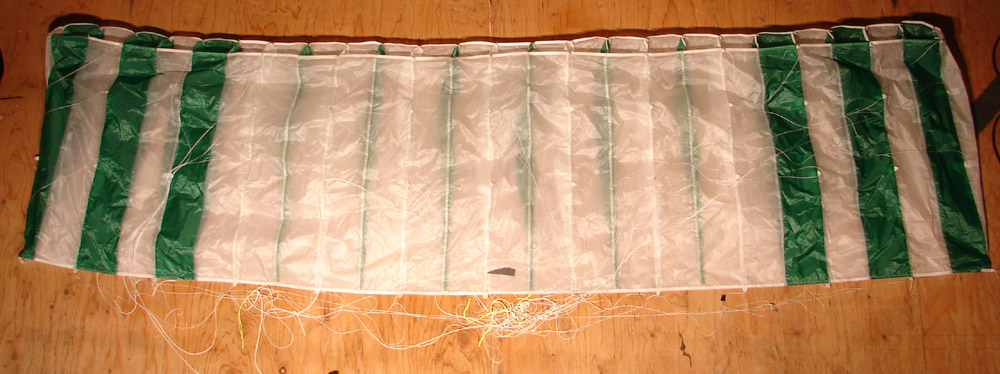
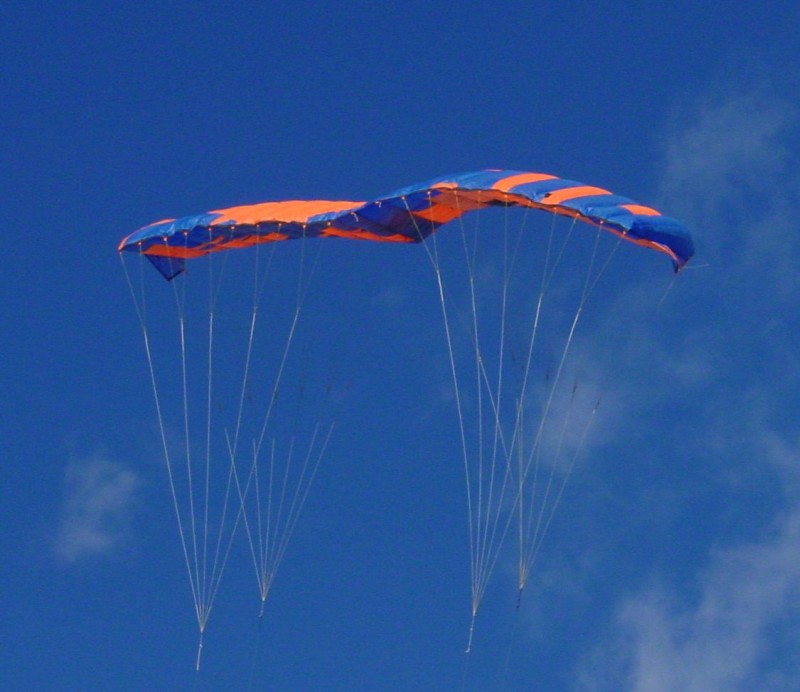
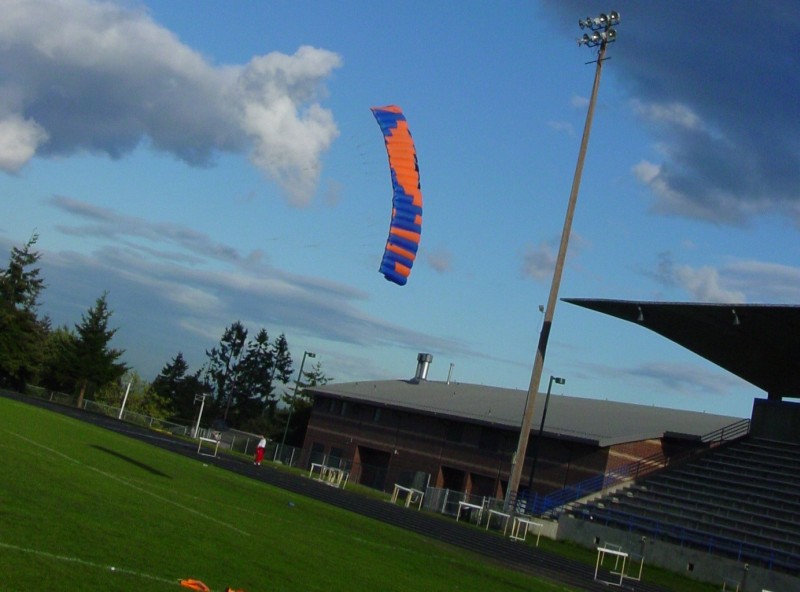
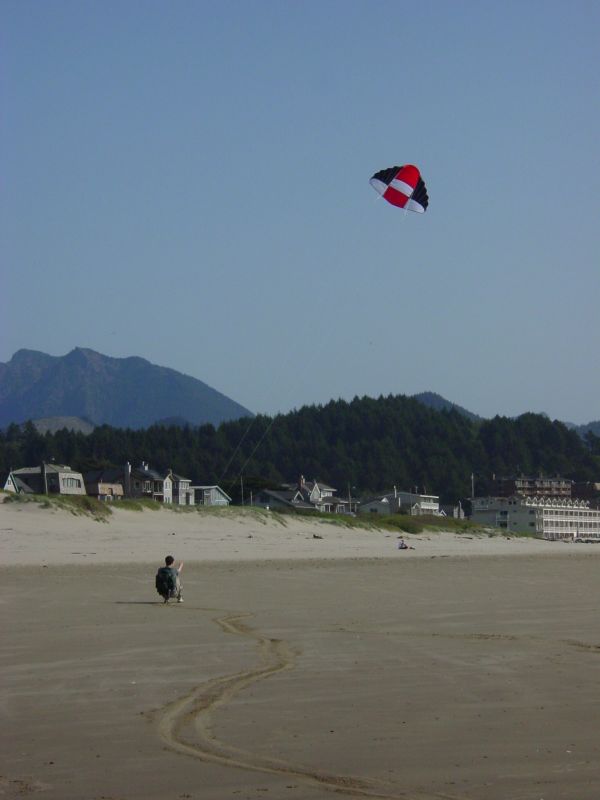
This is an enhanced NASA wing, almost 3 square meters (flat). It is the second kite I made. I used sewing techniques and plans that I found on the internet. The sail is Texlon nylon, and the bridle is 50lb. dacron. If I ever make another one, I will probably use spectra to reduce drag. This kite is unique in that it has only one skin, unlike a foil. The shape of the kite is maintained by 36 bridle lines. The fact that is singled skinned and doesn't have cells (like a foil) means that is is relatively easy to make. I fly it as a dual line kite on 300lb. lines. It will pull me, but only when the wind is really strong. Then it is a lot of fun to fly on the beach, where there is plenty of space and no hard objects downwind. There is nothing like the feeling of being dragged down the beach behind a kite. |
 |
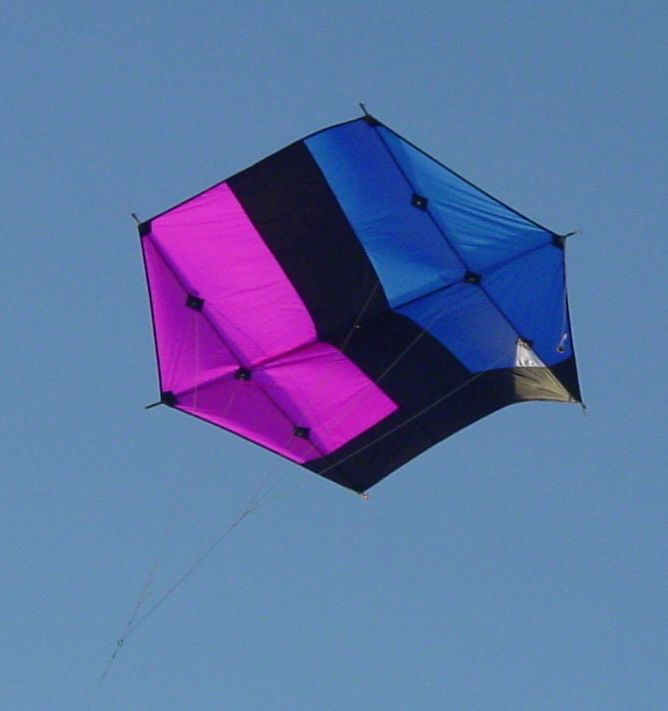
Rokkaku This was the first kite I made. It measures about 6 ft by 5 ft. I was just getting into Kite Aerial Photography, and I needed a kite to lift my camera. The sail is made from spinnaker nylon that I found in a fabric shop. I made a lot of mistakes on this kite. I ended up working in ratios instead of absolute measurements, trying to get the biggest kite out of the fabric I had. That way, when I messed up on t seam, I could just shrink the kite. It ended up shrinking so much that I had to add more fabric (the black). |
 |