is a religious tradition based on the ancient religions of the prehistoric Europe, specifically Western Europe and Great Britain. The faith is an amalgamation of folklore, archaeological evidence, and translated works from the period. Wiccans believe in a dual male/female divinity. The God and Goddess are seen as separate but equal deities, each with unique talents and virtues. Some traditions see all of the gods and goddesses of the world as 'faces' of the two true deities. Others worship a trine goddess and god, the nature of the deities changing with the seasons.
Wiccans believe that the natural world, the creatures of the world (including humans) and the Divine are inseparable. Harm done to any of the aspects reflects on the others, causing pain and suffering needlessly in the spiritual and physical planes.Wicca is a celebration of the life-forces of nature as personified by the Goddess and her consort, the God. Wicca is not synonymous with Satan worship. Most Wiccans do not even believe in Satan. The devil is a Judeo-Christian construct and as such, it has nothing to do with Wicca. The notion that witches worship Satan was propounded by the Roman Catholic Church as it made its way across Europe, in an effort to suppress the native earth-based religions prevalent at the time.
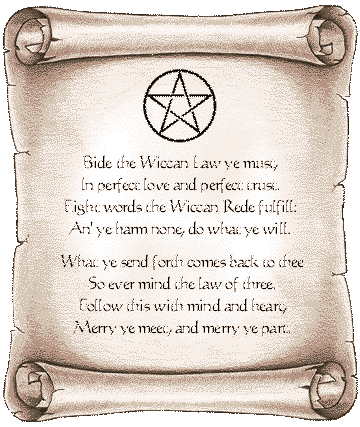
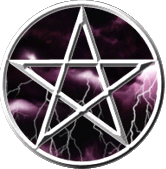
A pentacle is a five-pointed star symbol that is sacred to Wiccans. A pentagram is an object on which a pentacle is drawn, carved, etc. Each point of the star has a specific meaning: Earth, Air, Fire, Water, and Spirit. The top point of the pentagram represent the element of Spirit--it represent the ethereal, the everlasting, and the immanence of the Goddess. The top left point of the pentagram represents Earth.It symbolizes security, growth, nourishment--all of the things that the Earth Mother provides for us. The top right point of the pentagram represents Air.It represents thought, intelligence, rationale.The bottom left point in the pentagram represents Fire. It represents that part of us that wants to overthrow reason, to lead by the horns, to plunge on without thinking about our actions.The last point, the bottom right, is the element Water. Water represents the cycle of life: we came from the watery dark of the womb, and we return to watery tears of death.
RITUALS-
Wiccans, whether they are solitary or coven (group) practitioners, celebrate 8 Sabbats (seasonal festivals) in the year four Greater and four Lesser. The Greater Sabbats include Imbolc, Beltane, Lughnasa and Samhain while the Lesser Sabbats comprise the Summer and Winter Solstices and the Spring and Autumn Equinoxes. Imbolc signifies "the first stirrings in the womb of Mother Earth"(Farrar and Farrar, 1984), Beltane celebrates fertility, Lughnasa the harvest and Samhain (Halloween) the time when, according to Celtic belief, it was most auspicious for contacting the dead (Parker, 1993). In addition 13 Esbats are convened each lunar month (every 28 days),usually around the time of the full moon, for the purpose of conducting coven ritual/s and business. Additional rituals include the conferring of the three degrees of Wicca, Wiccanings (the blessing of a new-born child), Handfastings (the marrying of a couple for 1 year and 1 day) and Requiems (celebrations for the dead) (Farrar and Farrar, 1984). Wiccan rituals may also include the performance of simple candle-burning (usually but not always practiced by an individual witch) and workings such as the "Drawing Down of the Moon" during which the coven High Priest/ess invokes the Goddess. Cord magic rituals may also be performed and along with candle-burning may be classed as spell-casting proper. New rituals and new ways of performing old rituals are continually being devised. The number of rituals and their nature is limited only by the imagination of the Wiccan.