
When you think of the word Nimrod, you may think of someone who is a big oaf or dumb, when, in actuality, it was the name of a leader: the founder of the first, great world empire of post-flood civilization, the first king of Babylon.
The flood of Noah devasted the current world. After it was over, God commanded the survivors to "spread out, and fill the earth" (Genesis 9:7). The people of the day, however, began to have other ideas.
About two hundred years after the flood, the surviving few began to multiply, in exponential numbers. The sons and other close relatives of Noah became the patriarchs to many of these famillies, now-turned nations. This began to set the stage for what we now know as the empire and religion which originated at Babylon.
"And the whole earth was of one language, and of one speech... they found a plain in the land of Shinar, and they dwelt there.... And they said,
Go to, let us build us a city and a tower, whose top may reach unto heaven; and let us make us a name; lest we be scattered abroad upon the
face of the whole earth..."
Genesis 11:1-4
Strange, but, as we see in Giants, the people of the post-flood era began to do the same thing as those before: to make "a name for themselves," as well as disobey God's commandments! The reason was simple: they thought highly of their ancestors, destroyed by Noah's flood, and wanted to make sure, that if God became angry with their sacrilege this time, they would not be destroyed. This was the whole reason for the tower. According to a variety of ancient texts, the people of the day, under Cush's command, wanted to build a structure so tall that they would escape any flood wrath that would be imposed on them. They also wanted to reach up to heaven, march up to God, and destroy His authority over them. There was power in their unity, and, nothing, at least in their minds, was going to stop this resolve for their "freedom."
Its almost unbelievable how sacrilegious the people had become, so soon after the flood, but that is what happened. Again, God was not to be taken over so easily:
"And the LORD came down to see the city and the tower, which the children of men builded. And the LORD said, Behold, the people is one,
and they all have one language; and this they began to do: and now nothing will be restrained from them, which they had imagined to do.
Go to, let us go down, and there confound their language, that they might not understand one another's speech. So the LORD scattered them
abroad from thence upon the face of the whole earth: and they left off to build the city. Therefore the name of it was called Babel; because
the LORD did there confound the language of all the earth: and from thence did the LORD scatter them abroad upon the face of all the earth."
Genesis 11:5-9
That's about all the Bible goes into it, but this sets the stage for, probably, the most influential movement in our world, since the flood of Noah.
After this confusion, people began to speak in languages only certain other people could understand. Construction of this once-great tower now came to a grinding halt. Cush, their one time leader, was forced to give up his tower-building project, in disgrace. Those family/nations that were once united in the cause of rebellion were now separated, and scattered abroad, to nearby areas, just as God wanted. The people, however, were still rebellious, and carried the knowledge and influences Cush once had given them. This set the stage for the immortalization of the building of the tower, and the deification of those individuals who were formerly involved.
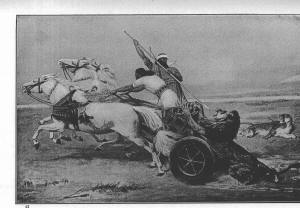
Most of the people gave up the tower project; those still around continued the job of finishing the city. The city "they left off to build" was now called Babylon: the first great influence of the post-flood world. The word Babylon literally means this confusion, the confusion which resulted from God changing everyone's languages. As stated, even though Cush was disgraced, he was still looked upon in somewhat of high esteem because of his attempt to challenge God. His son, however, would bring back the diginity and respect Cush once had over those around him. Nimrod took the reigns of power after his father's downfall. Also known as The Subdoer of Leopards, he began the awesome task of re-converting the people who were now scattered, and attempted to unify them, again. The Bible mentions him in only a couple of verses:
"And Cush begat Nimrod: he began to be a mighty one in the earth. He was a mighty hunter before the LORD... And the beginning of his
kingdom was Babel, and Erech, and Accad, and Calneh, in the land of Shinar."
Genesis 10:8-10 (also in Micah 5:1)
Nimrod was the first "mighty one" of the post-flood world. He got his fame, first, through the conquoring of animals, then other people around him. This hunter began the first empire of the world, known as the Assyrian/Babylonian Empire. He brought the original power and grandeur of the Tower of Babel into an empire, and, ultimately, a religion. From this, the foundation for pagan religion was formed. Cush and Nimrod both were involved with "channeling," or the communication with spirits of the dead. From these spirits, they acquired more of this forbidden, occult knowledge and power, much the same as those who lived before the flood. He and his father accomplished one more feat, the same as the giants before the flood: to "make a name" for themselves. The scattered people of the tower, in each one's own language, carried with them the names and occult knowledge they acquired from these one-time leaders. They began to idolize the two, and transform them into "gods." Each reference to Nimrod or Cush became the foundation for most of our ancient mythological stories. As new nations emerged, these same Babylonian figures became a part of the each nation's individual's history. Cush, for example, would be known as the gods Thoth, Hermes or Mercury, Nimrod would become Jupiter, Osiris or Mars. Although not mentioned by name, they also became the gods Baal and Merodach, in the Bible. The world of Noah, with God as the one and only God, was about to change.