
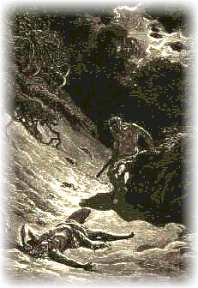
Although Cain was a child of Eve, he also had the genes of an upset and complaining angelic being, now made human for his punishment. With all this anger and resentment inside, could it had been a plausible reason for Cain ability to easily commit such a crime?
The serpent (Azazel or Nachash), as postulated before, had sex with Eve, and she became pregnant. From their union, they may have created twins: Cain and Abel. No where in the Bible does it say that Cain was Adam's son, nor is he listed in any geneologies of Adam (Genesis 5:1). Cain, on the contrary, was actually said to be, "of the wicked one" (I John 3:12). The Bible also states that the third son born to Eve, Seth, was the first child born to Eve that actually resembled Adam (Genesis 5:3). Could the first two have the bloodline of someone else? Lets look:
"And Adam knew Eve his wife; and she conceived, and bare Cain..."
Genesis 4:1
"And Adam eventually acknowledged the distinguishing sign that had come upon Eve; that she was with child, and realized she was about to
give birth to Cain..."
Genesis 4:1
See how easily things can get misunderstood, when people think they should translate them in a certain way? The verse could also mean that it was time for Cain to be born, and Adam realized it. The next part of this same verse gives us even more creditability for our argument. Apparently, Eve first saw the baby Cain, and thought she had gotten him from someone beyond her world. As the rest of the verse states, she said, "I have gotten a man from the LORD (Genesis 4:1)." According to the New Jerusalem Translation, however, we have the translation a little differently:
"... I have gotten a man from an angel of the LORD."
An angel of the LORD, a fallen angel of the garden, maybe? Eve apparently thought so. In Untold Eden, we already mentioned how the angels of the six-day creation rebelled, and their punishments handed out were so that they had to descend to earth, and take on human form. As we see, in the Bible, there were other punishments dealt out by God to Eve. Curiously enough, these included punishments that related to pregnancy, or childbirth. Could these have been directly related to the act the serpent and Eve participated in? There, also, were curses to the serpent:
"But He (God) turned to the serpent (in great wrath) and said: 'Since thou hast done this... There shall not be left thee ear, nor wing, nor one limb
of all that with which thou did ensnare them in thy malice and causesdst them to be cast out of paradise..."
The Apocalypse of Moses 26:1-4
Apparently, God dished out their punishments an "eye for an eye:" his one sexual "limb" for the way he used it.
"After Adam and his wife sinned, and the serpent had intercourse with Eve and injected filth into her, Eve bore Cain. He had the shape from
above and from below (the earth)... Therefore, he was the first to bring death into the world, caused by his side, as he came from the filth
of the serpent. The nature of the serpent is to lurk, so as to kill, and his issue, Cain, learned his ways."
The Zohar: 26 Pekudei 21
Cain apparantly carried on the attributes of his father, and that's what led him to easily commit the murder of Abel. In another curse to the serpent, God said something would come about, in probably one of the most important prophecies of the Bible:
"And I will put enmity between thee and the woman, and between thy seed and her seed; it shall bruise thy head, and thou shalt bruise his heel."
Genesis 3:15
The verse is a little complex, and is divided into two parts. First, it states the seed (or descendents) of the serpent will be at enmity (or hatred) to the seed of Eve. The serpent's seed would form one bloodline, Adam's whole seed another. The second part, simply, was a prediction about Jesus Christ himself, and how he (a member of Eve's seed) will bruise the serpent's head, but members of the serpent's seed will only bruise the heel of Jesus (by crucifying him on the cross). Jesus will become victorious in the end, by raising from the dead, and defeat Satan's curse of death (on the world, because of what happened in the garden). If Jesus was from the true seed of Adam and Eve, then the seed of the serpent will possess enmity for Jesus and his teachings. If Cain (and possibly others) were indeed from the seed of the serpent, then his descendents will be at arms against anything that is truly of God.
Those who also had blood of the serpent would go on to form what was known as the "mixed multitudes" (of people). The conflict between the morals, religious beliefs, and overall ideals of these groups of people and those who descended from Adam would form one of the most important conflicts in our modern history. The interpretation of this division is very simple:
"... the members of the mixed multitude are the children of the primordial serpent that seduced Chavah (Eve) by the tree of knowledge, so the
mixed multitude is indeed the impurity that the serpent injected into Chavah. From this impurity, which is considered the mixed multitude,
Kayin (Cain) came forth and slew Hevel (Abel)..."
The Zohar: 2 Bershith a28
There is more about these mixed multitudes, and their significance in this whole story, in the Birds and Beasts. As well, there is a lot more evidence in ancient written works which support this claim of Cain's bloodline in my upcoming book.