
As we mentioned, the King James translators tried to translate the Bible to the best of their abilities, and preconceived notions. When we see references to "birds" and "beasts," we have evidence from ancient texts, such as the Bible, that these may be referring to more than just animals. Lets look at some examples.
The ancients, in their writings, often referred to other people as "animals" of whom they distated. Not to single out anybody in any way, the ancient Jews, for example, wrote this way. The King James translators, not knowing these were actually human beings, tried to place them in their translation as menbers of the animal kingdom. As we will see, there may be a lot more to it.
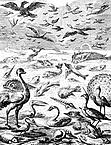
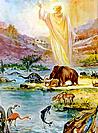
"There are many kinds among Israel that are called cattle and beasts. One is from the side of the serpent and another from the side
of idolatrous nations, who are like animals and wild beasts."
The Zohar 2 Bereshith a29
Often, those members of an ancient society who were "wild" were looked upon in this way. Even though the translators tried to make them animals, we will see that it is clear the bahemah, and others, were actually people:
Zechariah 8:10 "For before those days there was no hire for man, nor hire for beast (bahemah)..." - what kind of animal gets hired, or paid?
Jonah 3:8 "But let man and beast (bahemah) be covered with sackcloth, and cry mightily
unto God: let them turn every one from his evil way." - what animal knows he's evil, and cries to God?
Exodus 19:13 "There shall not an hand touch it, but he shall surely be stoned, or shot through;
whether it be beast (bahemah) or man..." - what animal has hands?
Exodus 29:11 "No foot of man shall pass through it, nor foot of beast (bahemah) shall pass
through it..." - what animal has feet?
Exodus 20:10 "But the seventh day is the sabbath of the LORD they God; in it thou shalt
not do any work, thou, nor thy son, nor thy daughter, thy manservant, nor thy
maidservant, nor thy cattle (bahemah), nor thy stranger that is within thy gates." - this verse refers to only people, and their work.
Jonah 3:7 "... Let neither man nor beast (bahemah), herd nor flock, taste any thing..." - the humans and animals are gouped together,
separately, if you notice.
There is something going on, here. Could the "beasts" or "bahemah" which were created around the time of Adam be human beings, as well? Would that mean that Adam was not the father of everyone, and there were other groups of people in the world at the time? As we see in Untold Eden, there may have been more than just Adam and Eve working in the garden. We know there were references to the "beasts of the field" and "fowl (birds) of the air" at the time of Adam. Could these be the names of people, which appear this way as animals, in the King James Translation of the Bible? The proper Hebrew words, translated as beasts and fowl, are chay and owph. Could these be the proper Hebrew names for groups of people?
I personally believe, based on the evidence, there were at least four groups, or classifications, of people at the time of Adam (in their original Hebrew titles): the Chay (beasts) of the Field, the Owph (fowl) of the Air, the Remes that Creepeth and Adam (the group that Adam belongs to). These titles come up, again and again, in our scripture. They seem to be referring to a title, or a specific group of individuals, rathen than just a group of animals. If these groups (as well as the aforementioned bahemah) were indeed people, then the world of Genesis would take on a whole new meaning, as well as how we perceive these old stories of the Bible. Lets take a look:
Isaiah 43:20 "The beasts (Chay) of the field shall honor me..." - what kind of animal knows how to honor?
Clearly, there is something going on, here. The following verses concern how, at least in the Old Testament, the Israelites needed to be separate from their neighboring nations, and groups of people. This was necessary, at least then, to fulfill the promise of a true and uncompromised "seed" of Adam and Eve to pass through to the mother of Jesus, thus fulfilling the prophecy of Genesis Three (see Untold Eden):
Leviticus 20:22 "Ye shall therefore keep my statutes, and all my judgments, and do them: that the land, whither I bring you to dwell therein,
spue you out not.
20:23 And ye shall not walk in the manners of the nation, which I cast out...
20:24 But I have said unto you, Ye shall inherit their land, and I will give it unto you to possess it... I am the
LORD your God, which separated you from other people.
20:25 Ye shall therefore put difference between clean beasts (bahemah) and unclean, between unclean fowls (Owph) and clean: and ye shall
not make your souls abominable by beast (bahemah), or by fowl (Owph), or by any manner of thing that creepeth (probably the Remes)
on the ground (earth), which I have separated from you as unclean.
20:26 And ye shall be holy unto me: for I the LORD am holy, and have severed you from other people..."
Since this prophecy has been fulfilled, and Jesus' sacrifice was indeed carried out (to "crush the serpent's head"), the need to separate these groups is not an issue, like before. What is important is that they existed. What if these groups, however, did survive the flood, and would continue to play a part in the affairs of mankind? God mentions these same groups before the flood, in Other Flood Survivors. Could many more people have been around in the days of Noah, and beyond, and made their mark on the world, to come? There is much more about this in my upcoming book.