
Galaxies
Galaxies

Our galaxy is thought to be shaped like a bar
galaxy. This
picture is from NASA if you want to read more about this.
Our galaxy may also have gas arms (without stars)
according to
Australian astronomers,
that stretch out from the arms containing stars in them.
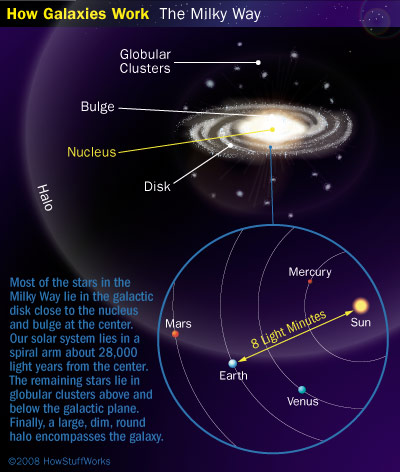
How
Stuff Works discusses the halo in a way I am familiar with.
The halo exists outside the boundary formed by the almost 2
dimensional milky way galaxy at this scale. How stuff works also mention
globular clusters of stars that are dotted around the galaxy, these stars have
no gas apparently. If you ever get a astronomy program, try a fly-by of the
galaxy, these globular clusters remind me of single stars (in fly-by mode; page 6 when viewed on November 2008), but
they are in fact made up of a huge number of stars in reality.
Apart from globular clusters our galaxy has and is colliding
with mini-galaxies and will eventually collide with the Andromeda spiral galaxy:
The Halo is quite interesting because it is made up of hot gas,
dark matter (apparently) and of cause photons of electromagnetic radiation (on
earth we see this radiation (a small part of it) as light). While how it works
does not state this directly, we can infer this from the fact that hot gas will
at minimum give off infrared radiation. However the hot gas spoken of here could
be of much higher temperatures.
The classical galactic structure is:
-
Galactic Disk
-
Nucleus
-
bulge
-
spiral arms
-
Halo
The magnetic fields of our galaxy are part of a structure we can
not easily see and yet it does have a large amount of energy stored in it due
simply to its' large scale.
"The Galactic Magnetic Field and Cosmic Rays
The disk of the galaxy is permeated by a magnetic field. This field is weak,
being only about 1/50,000 of the strength of the Earth's magnetic field at the
surface, but it influences the motion of charged particles in the galaxy. One
important consequence of the magnetic field is that it can bend the path of and
even trap the high-energy charged particles that we call cosmic rays. Thus the
galaxy is filled with cosmic rays and because of the effect of the magnetic
field we cannot tell with certainty where they come from, though the strongest
arguments favour supernova explosions for their source."Source of quote:
http://csep10.phys.utk.edu/astr162/lect/milkyway/components.html
The milky ways magnetic fields can trap high energy particles despite being
weak when compared to our own solar systems magnetic field strength.
For
example: cosmic rays rotate around the Milky Way with the gas and stars.
While I would expect these trapped particles to emit synchrotron radiation, I
can not find any supporting work for this assumption.
"Total
magnetic field strengths can be determined from the intensity of total
synchrotron emission, assuming energy balance (equipartition) between
magnetic fields and cosmic rays. This assumption seems valid on large spatial
and time scales, but deviations probably occur on local scales in galaxies. The
typical average equipartition strength for spiral galaxies is about 10 μG
(microGauss) or 1 nT (nanoTesla). For comparison, the Earth's magnetic field has
an average strength of about 0.5 G or 50 μT. Radio-faint galaxies like M 31
(Fig.3) and M 33, our Milky Way's neighbours, have weaker fields (about 5 μG),
while gas-rich galaxies with high star-formation rates, like M 51 (Fig.1), M 83
and NGC 6946 (Fig.2), have 15 μG on average. In prominent spiral arms the total
equipartition field can be up to 30 μG strong, in regions where also cold gas
and dust are concentrated. The strongest total equipartition fields (50-100 μG)
were found in starburst galaxies, like M 82 and the "Antennae", and in nuclear
starburst regions, like in the centers of NGC 1097 and other barred galaxies.
"
This quote (above) from
www.scholarpedia.org indicates that synchrotron emission does occur in the
weak magnetic fields formed on a galactic scale. Below; slide 28 also shows
synchrotron radiation does exist because of the Milky Ways magnetic fields.
"Slide
28 Following subtraction of the dipole anisotropy and components of the detected
emission arising from dust (thermal emission), hot gas (free-free emission), and
charged particles interacting with magnetic fields (synchrotron emission) in the
Milky Way Galaxy, the cosmic microwave background (CMB) anisotropy can be seen."
Still, such maps are hard to understand (at least for me) but in combination
it would seem that magnetic fields in the galaxy and in the galactic arms do
produce synchrotron radiation. This might indicate that charge is flowing around
the galactic arms.
Does the huge galactic field simply form part of a circuit?
Further this magnetic field can focus a supernova into a flash light like
pattern increasing its power out to further distances then previously thought.
This means that distant super nova explosions previously thought harmless can be
a threat to the earth.
Other sources of strong magnetic fields are black holes and this forms jets
of high energy particles that emit synchrotron radiation.
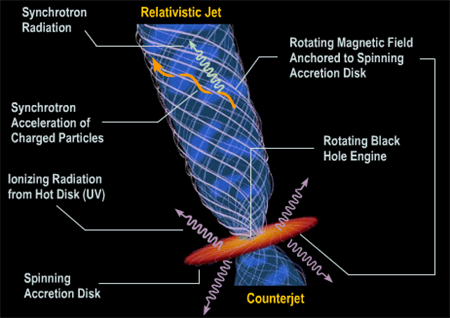
Picture from:
http://astronomyonline.org/Cosmology/Galaxies.asp
However now that we believe that the galaxy is a bar galaxy
type, this classical structure may be changed eventually. It is beginning to
look very likely that a super massive black hole exists in the centre of our
galaxy. It was originally thought that all black holes evaporated if they
happened to have formed during the big bang, however scientist now feel that
some black holes (containing exotic sub particles I believe) may have survived
the big bang, could one of these surviving black holes be the youngster that
eventually make the black hole in the centre of our galaxy (who knows).
The galaxy itself if one of many. Apparently if we zoomed back and looked at
all the galaxies in the universe they would seem to
form clouds that
resemble strings that border spaces that appear empty (some say these spaces
have dark matter in them, while other say that dark matter and matter are
intertwined.).
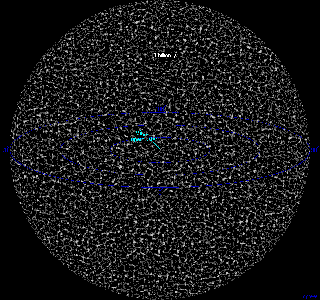
This picture is from
http://www.atlasoftheuniverse.com , the site has some really cool pictures
and you can zoom in and out of them.
Dark Matter
Why is dark matter important when considering a galaxy
Dark matter probably help form our galaxy and hold it together and it will
play a part in how our galaxy behaves in the long run.
I also have questions that remain to be answered about "what happens when the
galaxy expands and matter and dark matter becomes more dispersed?" but those
answers will no doubt have to wait until the true answers on what dark matter is
are answered.
What is it?
Dark matter is a recent discovery, it causes all sorts of new theories to
exist. Examples are that it is dark matter that holds our galaxies together.
Dark matter was influential in the formation of galaxies and so forth.
The
exact nature of dark matter is currently under investigation. This
investigation might also include
the new CERN particle accelerator and resultant discoveries.
The risks of examining the universe!
Note: CERN does
have some detractors saying that it will trigger the end of the universe or
send a mini-black hole to the centre of the earth that will eventually devour
the earth. This particular question
- "Is the Higgs mechanism for generating elementary
particle masses in the Standard Model indeed realised in
nature? If so, how many Higgs bosons are there, and what are
their masses? "
is also related apparently to the idea that a universe can
form inside our universe and break off apparently. I have yet to
find a reliable source for that theory however but it is a
interesting twist of what fooling around with the beginning of
time can cause.
The
theory of
parallel universes is nothing new.
Solving the dark matter puzzle will probably not end the
mysteries that our universe has
The universe holds lots of mysteries and scientists and
speculators are trying to guess all that could go wrong if we
examine the universe with tools like CERN (probably similar to
the speculation that was done when man first went to the moon I
believe). Dark matter will no doubt not be the end of the
mysteries that our reality (the universe) will show us.
Dark matter may also alter theories to how our universe might end
There has also been some alternative discussions about the thought that
matter may one day simply evaporate. Could dark matter also be part of what
holds atoms together on the atomic scale. So far this idea seems unlikely since
dark matter is probably left over antimatter that had a higher then expected
survival rate then originally expected.
a variation of matter disappearing (and not related to the previous
discussion) is of
black holes swallowing all matter and then dissolving away. However, I
believe that dark matter will add a very interesting twist to this story in the
near future as science advances and begins to understand what dark matter is.
Keep a look out for further news on Dark matter and fundamental particles
The discussion of dark matter will certainly be interesting and worth the
effort to keep track of if you are interested in galactic structures or exotic
forms of subatomic particles.
Incidentally, this matter of subatomic particles is also being investigated
by particle accelerators such as CERN as mentioned above.
Solar System orbital's
Classical models of our solar system have been rocked by a number of
discoveries, these include bodies about the size of Pluto. This has caused a
renaming of orbital body party that will probably last for some time and cause
many discoverers much joy or pain. For what is the latest news on this I like to
look up http://www.nineplanets.org/ if
only for the reason that the URL seems to make more sense then others.
One thing of interest is to take a careful look at new moons discovered and
any new rings discovered around planets.
One of the early surprises of the name changes was Pluto being given dwarf
planet status instead of planetary status. This means there are only 8
planets.
Eris (larger then Pluto) and Ceres are two other dwarf planets.
Some sites say there are two additional minor planets: Haumea and
Makemake.
Up one level
Back to home page