
In this page I will give you a bit of a background on each, showing you that they present nearly a century of proud tradition the the Navy and our country will long remember. Not to mention that each ship made a definate impact on the lives of those who served aboard them. Including myself.
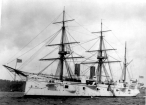
It all began with this ship the first CHICAGO, a twin-screw protected steel cruiser and the largest of the initial ships of the "New Navy" authorized by Congress in early 1883 later commissioned in 1889. Two smaller protected cruisers were named Atlanta and Boston. The initial ship was named Dolphin, an unarmored cruiser built as an example of a highspeed commerce raider. These were the pioneers of the United States Navy's warships of Steel.
When Secretary of the Navy John D. Long organized a "Squadron of the Evolution" to cruise in European waters, CHICAGO was designated flagship. Other initial ships in the squadron were protected cruisers ATLANTA and BOSTON, and the recently-built YORKTOWN. They would capture the imagination of the world as the famed "WHITE SQUADRON," a title supplied by their appearance after their outside hulls were painted white down to the waterline.
In 1895, She was decommissioned for a four year overhaul, and as a result, did not see action in the Spanish-American War. The work included the removal of the mainmast, bowspirit, and most of the yards. She served as flagship in the Atlantic, Pacific and Mediterranean until she was decommissioned a final time in 1923.
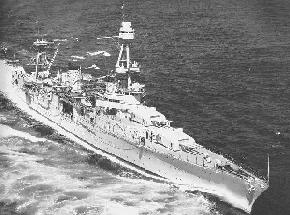
CHICAGO was designed for a length overall of 600 feet, 3 inches; extreme beam of 66 feet, 1 inch; standard displacement of 9,300 tons; a mean draft of 16 feet, 8 inchs; and a complement of 45 officers and 576 men. She was initially armed with nine eight-inch .55 caliber guns; four 5-inch .25 caliber guns; eight .50 caliber machine guns; and six 21-inch surfaced torpedo tubes. She had a designed speed of 32.5 knots. She had armor right inchs thick and was equipped with two capapults amidships.
In April 1930 CHICAGO departed San Francisco Bay on a shakedown cruise that took her to Hawaii, Papette, Tahiti, and Pago Pago American Samoa. She then headed for the U.S. East Coast for duty as flagship for VADM Marvell, Commander Cruisers, Scouting Force, U.S. Fleet. Not long after she returned to the Pacific and based in San Pedro, California.
On 25 October 1933 CHICAGO was rammed by the 6,000-ton oil tanker SS SILVER PALM in a dense fog just off the coast of Point Sur, California. CHICAGO had barely maneuvered clear of another merchantman and then almost immediately there came another ship out of the fog on her port bow, close aboard, and headed directly for the bow. Engines in emergency full speed astern, whistle tooting the approaching vessel still crashed just forward of the number 1 gun which kept the bow from being sheers off. 3 of the ships officers were killed in their staterooms.
All repairs finally completed and with the outbreak of WWII in the Pacific, CHICAGO became engaged in a number of operations which inflicted damage on Japanese forces. On January 29, 1943, near Guadalcanl, CHICAGO was struck by a torpedo plane attack. Having lost ship control, CHICAGO was taken under tow by a tug the following day. Enemy torpedo bombers struck again and put four more torpedos in her side. The damage being far to much the ship was ordered abandoned and the crew watched as she sank into the depths colors still flying.
Below you see CHICAGO, her stern low in the water giving the crew their last look of a ship with a glorious name sink with the colors waving bravely.
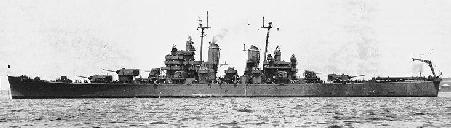
The third CHICAGO was built by the Philadelphia Naval Shipyard. Her keel was laid 28 July 1943, She was launched on 20 August 1944, under the sponsorship of Mrs. Edward J. Kelly, wife of the Mayor of Chicago, Illinois. The new heavy cruiser was commissioned in the Philidelphiia Naval Shipyard on 10 January 1945, Capt. Richard R. Hartung, USN, commanding.
CHICAGO has an overall length of 674 feet 11 inches; extreme beam of 70 feet 10 inches; standard displacement of 13,600 tons; a mean draft of 20 feet, 6 inches; designed speed of 33 knots; and a designed complement of 59 officers and 1,083 enlisted men. She was originally armed with nine 8-inch .55 caliber guns; twelve 5-inch .38 caliber guns; eleven quadruple 40-mm gun mounts; two twin 40-mm gun mounts; and twenty eight 20-mm guns. The maximum thickness of her armor was 8 inches. She was equipped with two aircraft catapults.
After joining the Pacific Fleet in May, she soon was conducting shore bombardment of the Japanese mainland along with Admiral Shafroths's task force which included the battleships MASSACHUSETTS, SOUTH DAKOTA, and INDIANA, also the Cruier QUINCY and nine destroyers were the remaining ships in the bombardment unit. CHICAGO also supported carrier air strikes on the enemy. At the conclusion of the war, CHICAGO sailed to the U.S.
In June, 1947, she was decommissioned and assigned to the Reserve Fleet in Bremerton, Washington. There she remained until 1959, when conversion to become the fourth ship to bear the name USS CHICAGO.
This now the fourth ship to bear the name was commissioned at the San Francisco Navy Shipyard on 2 May, 1964, Captain John E Dacey, USN, Commanding. Her new armament after her conversion from CA-136 to the now CG-11 included two surface-to-air TALOS missile launchers; two surface-to-air TARTAR missile launchers; an anti-submarine rocket launcher (ASROC); two triple torpedo tubes; two conventional 5-inch .38 caliber guns; and two anti-submarine helicopters. To coordinate her offensive nd defensive capabilities, she was equipped with the Navy Tactical Data System, a computer that automatically receives information from radar, sonar and other ships sensors, and provides instantaneous solutions to battle problems.
CHICAGO was assigned the the Cruiser-Destroyer Force, U.S. Pacific Fleet. She is a veteran in the Western Pacific, having served seven successive deployments (1966-1976). During most of these deployments CHICAGO served principally as a screen for carriers of the coast of Vietnam as coordinator for air operations in Vietnam (PIRAZ) Positive Identification Radar Advisory Zone. CHICAGO was credited with shooting down servera MIG aircraft during the Vietnam War.
After the Vietnam War ended, CHICAGO served two more Western Pacific deployments for a complete total of nine deployments in all. During this time she served as Flagship for many cruiser destroyer wargame opperations in the South China Seas, Kangaroo III excersize with the Australian Navy in the South Pacific and Indian Ocean. CHICAGO earned a record setting 11 consecutive Missile Excellency Awards. She was known as the Worlds Most Powerful Guided Missile Cruiser and later The Worlds Greatest.
On 16 October 1979, CHICAGO on her final westpac deployment sailed to the spot where USS CHICAGO CA-29 sank to the depths below and the crew of CG-11 performed a memorial service in honor of that ship and her brave crew. Colors were paraded, a history of USS CHICAGO CA-29 was read, followed was a scripture reading, Laying of the wreath, a rifle salute, Taps was played, and then colors were retired. Presiding were Rear Admiral A. M. Sinclair, USN, Commander task Force 75, Captain H. S. Lewis, USN, Commanding Officer, USS CHICAGO CG-11, Commander R. C. Trossbach, USN, Executive Officer, USS CHICAGO CG-11, Commander V. H. Krulak, CHC, USN, CHAPLAIN, USS CHICAGO CG-11, Captain M. E. Edwards, USMC Commanding Officer, Marine Detachment, USS CHICAGO CG-11, and various crew memebers of USS CHICAGO CG-11
On March 1st, 1980 USS CHICAGO CG-11 was decommissioned in San Diego to end her career in the service to the U. S. Navy. The crew sad to see her go as she was towed to Bremerton Washington and put into the mothball fleet until later taken and scrapped. Sad ending for a ship with not one but two glorious histories many memories and great friendships.
NOTE: The above animation was created by BM2 Mark Wilson, 1st Division CG-11 (1976-1980). Hope you enjoy it.
GUIDED MISSILE CRUISER CG-11 (1964-1980)
BACK